Key takeaways
- Front caster wheels let a walk-behind mower pivot like a zero-turn. See the one mower whose Amazon listing still states locking front casters.
The real decision with a front caster mower is whether the swivel front wheels are worth hunting for at all, because almost no current walk-behind mower still offers them. Fixed front wheels force you to lift or drag the front of the deck around every tree, bed edge and fence corner, while casters let the nose pivot in place. The catch is that the design has nearly disappeared from mainstream ranges, so the honest shortlist is far shorter than most buyers expect.
This article is for gardeners with obstacle-heavy lawns who want that pivot without stepping up to a zero-turn rider. Every product below was included only because its own Amazon listing states front caster wheels in its title or description, and the specifications quoted come from that listing page rather than from roundups or manufacturer summaries.
Quick Picks
As an Amazon Associate we earn from qualifying purchases
| Product | Best for | Key spec from title |
|---|---|---|
| WORX WG771 56V Lithium-Ion 3-in-1 Cordless Mower with Locking Caster Wheels, 19-Inch | Small, obstacle-filled lawns that need tight pivots | Locking Caster Wheels |
How to Choose
Confirm the Casters Are Really in the Listing
Start by reading the listing literally, because many mowers marketed as easy to manoeuvre use ordinary fixed front wheels and a high rear wheel pair instead. A true front caster design states it outright, in phrases such as caster wheels, swivel front wheels or a stated rotation range. If the product page only talks about high wheels, ball bearings or light weight, it is a fixed-wheel mower with good marketing, and it will not pivot the way this category promises. Check the title first, then the description, because on genuine caster models the wheel design is a headline feature, not a footnote.
Locking Casters Versus Free-Swivel Casters
Free-swivel casters are a gift around flower beds but a nuisance on a slope, where the front of the deck keeps trying to wander downhill. Locking casters solve this with a knob or lever that pins the wheels straight for side-hill passes and long runs, then releases them for tight work. If your lawn mixes flat, planted areas with any kind of gradient, a locking design is the safer specification to insist on before you buy. Also check how the lock is worked: a knob you can reach from the handle side beats one that needs you to crouch at the deck mid-pass.
Deck Width and Turning Space
Caster wheels pay off most on smaller decks, where the mower already fits between beds and can spin inside its own length. A deck around nineteen to twenty-one inches suits fenced suburban plots with trees and edging to work around. Wider decks cover open ground faster, but the extra width fights the pivot in narrow gates and tight corners, so match deck size to your narrowest gap rather than to the biggest open patch of grass. Measure the gate and the tightest bed gap before you order, not after the mower arrives.
Power Source and Runtime Reality
Most surviving caster models are older designs, and the ones still listed tend to be cordless rather than petrol. That means checking what the listing actually includes: the battery count, the charger, and the stated area cut per charge all matter more than the voltage headline. A mower sold with two batteries and a charger in the box is a very different purchase from a bare tool that assumes you already own the platform. It also pays to confirm the platform is still supported with replacement batteries, because an orphaned battery line shortens the mower’s useful life.
The 1 Best Option
Only one mower cleared the verification bar for this update: a walk-behind model whose Amazon listing states locking front caster wheels in its own title and describes their rotation and locking knob in its own text. Other well-known caster models from past ranges could not be confirmed as still sold on Amazon US with the caster wording in their listings, so they were excluded rather than padded in. That includes petrol models whose manufacturers describe front casters on their own sites but which no longer show a live Amazon US listing, and current mowers whose listings talk up manoeuvrability without ever stating a swivel front wheel. A short roundup built on one verified product is more useful than a long one built on guesses, so the single pick below carries the full weight of the category, with its limits stated openly.
WORX WG771 56V Lithium-Ion 3-in-1 Cordless Mower with Locking Caster Wheels, 19-Inch
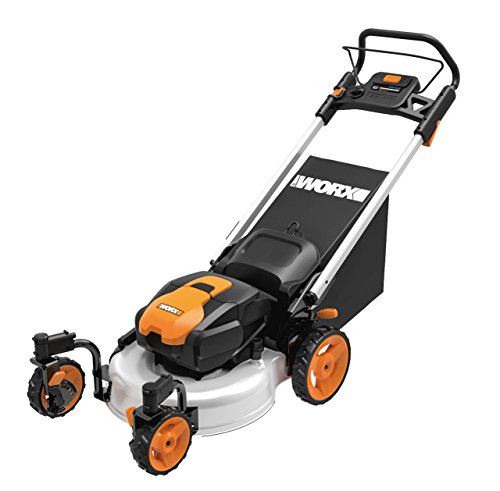
This is the pick for a small lawn crowded with trees, beds and path edges, where a fixed-wheel mower spends half its time being lifted and re-aimed. The listing states 360-degree rotation front caster wheels with a lock knob for side-hill cutting, a nineteen-inch steel deck, and two 56V batteries with a charger in the box. Its IntelliCut system raises torque in thicker grass, and the 3-in-1 deck bags, mulches or side-discharges, so the pivot comes without giving up normal clipping handling.
Specs
- Power source: battery powered, two 56V MAXLithium batteries included
- Cutting width: 19 inches, steel deck
- Front wheels: caster wheels with 360-degree rotation and a lock knob
- Rear wheels: 10-inch high wheels; front wheels 7-inch
- Clipping modes: 3-in-1 bagging, mulching and side discharge, 1.4-bushel bag included
- Torque control: IntelliCut torque-on-demand dial with battery indicator
- Handle: folding aluminium arms with release triggers
- Deck care: quick-connect washout port
- Item weight: 67 pounds
- Model number: WG771
Best for: Gardeners with small, planted lawns who turn constantly and want the front of the mower to steer instead of being lifted.
Watch out for: This is an older 56V platform design, so confirm on the listing that the batteries and charger are included in the box and that replacement 56V batteries suit your budget before ordering.
Which One Fits Your Situation
Lawns Wrapped Around Trees and Beds
If your grass runs in ribbons between planting, the WG771 is the fit, because its casters rotate a full turn and let the deck change direction without a three-point shuffle. The nineteen-inch deck is narrow enough to thread between beds, and the lock knob pins the wheels straight again when you cross an open stretch or a side slope. Bagging as you go keeps clippings off the beds you have just steered around.
Sloped Plots That Still Need Tight Turns
A gradient is where free casters usually misbehave, so the locking mechanism is the deciding detail here. Lock the front wheels before a side-hill pass so the mower tracks straight, then release them at the bottom for the fiddly work around edging and posts. Few current mowers offer that combination at walk-behind size, and none of the fixed-wheel alternatives can imitate it, however large their rear wheels are.
Gardeners Moving Away From Petrol
Because the verified caster option is cordless, this article suits buyers happy to trade fuel cans for batteries. The box includes two 56V batteries and a charger per the listing, plus a washout port that simplifies deck cleaning. If you specifically need a petrol caster mower, be aware that no current Amazon US listing stating front casters could be verified for one this season, so waiting or buying through a dealer channel are the realistic routes.
Anyone Tempted by a Zero-Turn Rider Instead
If your turns are tight but your lawn is small, a walk-behind caster mower solves the same problem in far less storage space. The WG771 folds at the handle for compact storage and needs no shed bay of its own. A zero-turn only makes sense once the area is large enough that deck width, not turning, is your real bottleneck, and its own front casters are built for speed across open ground rather than for threading between flower beds.
Common Mistakes
- Assuming any mower with big rear wheels has casters, when the front pair is fixed and the deck still has to be lifted and dragged to turn at every obstacle.
- Buying a discontinued caster model from a marketplace listing without checking that the Amazon listing itself states the caster wheels and shows an active offer from a current seller.
- Ignoring the lock: free-swivel casters on a slope drift sideways, so skipping the locking check leads to crooked passes, missed strips and scalped edges along borders.
- Choosing deck width for the open lawn and then finding the mower cannot pivot through the side gate, between raised beds, or around the base of a mature tree.
- Forgetting the battery platform: an older cordless design is only good value if its batteries are included in the box and still replaceable when they eventually fade.
Frequently Asked Questions
What do front caster wheels actually do on a mower?
They let the front of the deck swivel instead of rolling only forwards, so the mower can pivot in place around trees, posts and bed corners. The WORX listing describes 360-degree rotation front caster wheels, which means the nose can be steered with the handle rather than lifted and dragged into each new line. On lawns with many obstacles, that difference is felt on every single pass, not just occasionally.
Can caster wheels be locked for straight lines?
On the verified pick here, yes. Its listing describes a lock knob on top of the caster wheels that pins them in place for side-hill cutting, plus a lever that adjusts front cutting height. That lock matters on slopes and long straight runs, where free casters tend to wander off line. Unlocking them again at the end of the pass restores the tight turning the design exists for.
Why are front caster mowers so hard to find now?
Mainstream ranges have standardised on fixed front wheels with high rear wheels, which are cheaper to build and adequate on open lawns. Caster designs survive mainly on older models and commercial wide-area machines, so a listing that states casters and is still sold is rare, which is why this roundup honestly contains a single verified product. Several famous caster models from past seasons now appear only as parts listings or out-of-stock pages.
Are front casters better than high rear wheels?
They solve different problems. High rear wheels help a mower roll over uneven, bumpy ground, while front casters help it turn in confined, planted spaces. Lawns with both problems are uncommon; choose casters when turning is your frustration, and high wheels when rough ground is, rather than expecting one design to do both jobs equally well. The verified pick here actually pairs casters with ten-inch rear wheels, which covers moderate unevenness as well.