Key takeaways
- Find the best RV leveling blocks for campsites and stability in 2026. Compare interlocking blocks, tri-levelers and camper levelers for safe, level setups.
- Top Pick: Camco FasTen Leveling Blocks, 10-Pack
- Runner-up: Camco Leveling Blocks with Storage Bag, 10-Pack
- Also consider: Camco FasTen XL Leveling Blocks
A sloped campsite can turn a good trip into a restless night. When the floor tilts, doors swing open on their own, water pools on one side of the sink, and the refrigerator works harder than it should. Leveling blocks fix that by lifting the low-side wheels until the rig sits flat.
This guide compares five leveling options that cover the common setups: interlocking blocks for travel trailers and motorhomes, a tri-leveler for quick drive-on leveling, and a curved leveler for fine adjustment. Each one earns its place through capacity, footprint, or ease of use, and every pick below includes a verified ASIN so you can find the exact model.
As an Amazon Associate, we earn from qualifying purchases.
Quick answer
For most RV owners, the Camco FasTen 10-pack is the safest default: interlocking blocks with a 40,000-pound capacity, a T-handle for placement, and a 4.5-inch maximum stack. Owners of heavy rigs or dual tires should look at the FasTen XL for its wider footprint, while the Andersen Camper Leveler suits drivers who want fine, drive-on adjustment without stacking blocks.
1. Camco FasTen Leveling Blocks, 10-Pack

The Camco FasTen set is the workhorse of this roundup. Ten interlocking blocks stack like building bricks, so you can build a small pyramid under a tire and drive onto it, or lay a flat pad under a stabilizer jack.
Each block measures 8.5 by 8.5 inches with one inch of added height, and the maker lists a 40,000-pound capacity for the set. The included T-handle lets you slide blocks into place and pull them out again without crawling under the trailer, a small detail that becomes a big one on a hot afternoon or a muddy site. The maximum stack height is 4.5 inches, which covers the slope of most developed campgrounds.
This set suits owners who want one kit for the whole rig. Ten blocks is enough to level one side of a tandem-axle trailer and still have a few left for the jacks. If you camp mostly on paved or gravel pads with a mild slope, this is the set to buy first.
Specs:
– Type: Interlocking leveling blocks
– Size: 8.5 x 8.5 x 1 inches per block
– Capacity: 40,000 pounds
– Pack: 10 blocks with T-handle
– Maximum stack height: 4.5 inches
– Model: 21022
– ASIN: B07ZHP8XFD
2. Camco Leveling Blocks with Storage Bag, 10-Pack
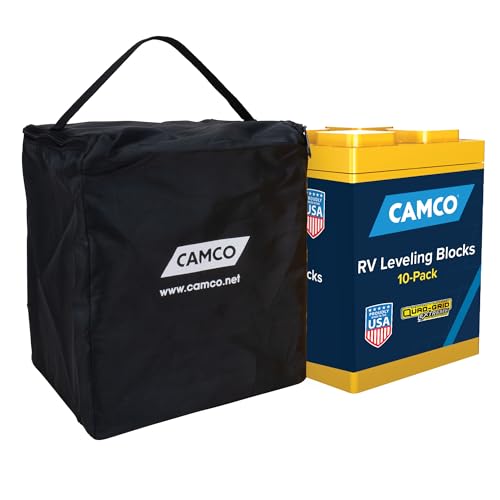
The Camco 44510 set takes the same interlocking idea and adds a storage bag, which solves the most annoying part of owning leveling blocks: keeping ten loose pieces together between trips. The bag holds the full set, so you can toss it in a bay without blocks migrating to every corner of the compartment.
The footprint matches the FasTen at 8.5 by 8.5 inches, and each nested block adds one inch of height. One note of caution: the listing text for this model shows conflicting thickness figures in different places, so treat the one-inch-per-block figure as the working number and confirm the stack height with a level on your first setup.
For owners who already own a set of blocks and keep losing pieces, this set is a practical replacement. For a first-time buyer, the bag makes the kit easier to live with than a loose stack, and the capacity is ample for most travel trailers and fifth wheels on developed sites.
Specs:
– Type: Interlocking leveling blocks with storage bag
– Model: 44510
– Pack: 10 blocks plus storage bag
– Footprint: 8.5 x 8.5 inches
– Added height: 1 inch per nested block
– ASIN: B072VSBLH7
3. Camco FasTen XL Leveling Blocks

The FasTen XL is the heavy-duty sibling of the standard FasTen. Each block measures 10.5 by 10.5 inches, giving a wider footprint that spreads the load on soft ground and sits more securely under dual tires. The maker describes the XL as about one-fifth larger than the standard block and twice as strong, which makes it the right call for larger fifth wheels and Class A motorhomes.
The gray color sets the XL apart from the standard yellow blocks at a glance, so you will not mix the two sets in a shared storage bay. The maximum stack height is 4.5 inches, the same as the standard set, and the blocks interlock in the same way.
The trade-off is bulk. Ten XL blocks take up more room than ten standard blocks, and the wider size can be overkill for a small single-axle trailer. Buy the XL when your rig is heavy, your tires are wide, or your favorite sites have soft ground. For a light trailer on pavement, the standard FasTen does the same job in a smaller package.
Specs:
– Type: Oversize interlocking leveling blocks
– Size: 10.5 x 10.5 inches per block
– Model: 21026
– Pack: 10 blocks
– Maximum stack height: 4.5 inches
– Color: Gray
– ASIN: B07ZHNWMH2
4. Camco Super Tri-Leveler

The Super Tri-Leveler takes a different approach: instead of stacking blocks, you drive onto a single molded ramp with three height settings. The three steps give 2, 3.5, and 5 inches of lift, so you pick the step that matches the slope and drive up until the bubble level reads true. There is no stacking, no counting blocks, and no second trip to the bay for one more piece.
The maker lists a 12,500-pound capacity, which covers most single-axle and many tandem-axle trailers. Because the lift comes from one piece, the setup is fast, and the takedown is just as quick: drive off, pick it up, and stow it.
Do not confuse this model with the regular Camco Tri-Leveler, model 21027, which is a different listing with a 3,500-pound capacity and a maximum lift of about 3-7/8 inches. The Super Tri-Leveler, model 21028, is the heavier-duty version and the one to choose for a loaded travel trailer. The regular version suits lighter utility trailers and pop-up campers.
Specs:
– Type: Tri-level drive-on ramp block
– Model: 21028
– Heights: 2, 3.5, and 5 inches
– Capacity: 12,500 pounds
– ASIN: B07ZHQ1K8S
5. Andersen Camper Leveler 3604, 2-Pack with Bag

The Andersen Camper Leveler is the precision tool in this roundup. It is a curved ramp: you drive onto the curve, and the wheel rises gradually as it rolls forward. Stop when the level reads true, then slide the included chock under the curve to lock the wheel in place. The result is fine adjustment in small increments, without the fixed steps of stacked blocks.
The two-pack covers one side of a tandem-axle trailer, and the included bag keeps the pair together. The maker lists the model as 3604-RTBA, and the listing is sold by Andersen Hitches with shipping from Amazon.
The learning curve is short but real. You need a spotter or a level you can see from the driver seat, because the adjustment happens while you drive. It suits owners who move sites often and want a quick, repeatable routine.
Specs:
– Type: Curved drive-on leveler with chock
– Model: 3604-RTBA
– UPC: 871155009886
– Pack: 2 levelers with bag
– ASIN: B076X5W1LZ
How to choose RV leveling blocks
Match the capacity to your rig first. Check the gross vehicle weight on the data plate, then divide by the number of wheels that will sit on blocks. A set listed at 40,000 pounds covers most trailers with room to spare, while a 12,500-pound tri-leveler is plenty for a single-axle trailer but tight for a loaded fifth wheel.
Next, think about the ground. Wide blocks spread the load on grass, dirt, and sand, where narrow blocks sink and lose height overnight. If your favorite sites are soft, the FasTen XL earns its keep. On pavement and hard gravel, the standard footprint is fine. A curved leveler like the Andersen also works on soft ground, but the chock needs a firm seat to hold, so carry a flat board for very soft sites.
Count how many blocks you will actually use. A tandem-axle trailer needs enough blocks to build a pad under two wheels on the low side, plus a few for the stabilizer jacks. Ten blocks is the practical minimum for most rigs.
Finally, watch out for discontinued models. The older Camco 44501 is listed by the maker as discontinued, so do not buy it from a leftover listing. Stick to the current models in this guide, and confirm availability before you order, because leveling gear sells out during peak camping season.
Who should skip leveling blocks
Owners with hydraulic auto-leveling systems can skip blocks for most sites, since the jacks handle the slope on their own. The same applies to owners who only ever park on flat concrete at home: blocks add nothing until the first sloped site.
Small teardrop trailers and pop-up campers with a single axle and a light load can often level with a single tri-leveler or a pair of curved levelers instead of a full ten-block set. Buying the biggest set for the smallest rig wastes storage space. And if your rig never leaves a paved RV park with level concrete pads, put the money toward a good wheel chock set instead.
FAQ
How many leveling blocks do I need for a travel trailer?
Ten blocks is the practical minimum for most travel trailers. A tandem-axle trailer needs a pad under two wheels on the low side, which can take four to eight blocks depending on the slope, plus a few more under the stabilizer jacks. A single-axle trailer needs fewer, often four to six.
Can I stack leveling blocks under dual tires?
Yes, but build the pad wide enough to support the full tire contact patch. The FasTen XL, with its 10.5-inch footprint, is the better choice for dual tires because it spreads the load and resists tipping. Stack the blocks in a pyramid shape, with the widest layer at the bottom, and never stack higher than the 4.5-inch maximum. Check that both tires sit fully on the pad before you unhitch.
Do leveling blocks work on soft ground?
They work, but wide blocks work better. On grass, dirt, or sand, a narrow block can sink under a heavy wheel and lose height overnight, leaving the rig tilted by morning. Use the widest blocks you own, place a flat board under the stack if the ground is very soft, and recheck the level after the first hour.
Are curved levelers better than interlocking blocks?
Neither is better in every case. Curved levelers give fine, continuous adjustment and a fast setup, which suits owners who move often. Interlocking blocks give fixed steps, a higher maximum stack, and a stable pad under jacks, which suits heavier rigs and steeper sites.
Final verdict
The Camco FasTen 10-pack is the best default for most RV owners, with enough capacity, a useful T-handle, and a stack height that covers common campground slopes. Heavy rigs and soft-ground campers should step up to the FasTen XL, while frequent movers will love the speed of the Andersen Camper Leveler. Whichever you choose, level the rig before you unhitch, recheck after the first hour, and confirm availability before you order.