Key takeaways
- Compare compost tumblers for garden waste, with dual-chamber drums, sturdy frames and fast-spinning designs that turn scraps into rich compost sooner.
A compost heap on open ground works, but it asks for patience, space, and regular turning with a fork. A tumbler turns that chore into a short spin: kitchen scraps and garden clippings go into a sealed drum, air vents keep oxygen flowing, and a few turns every couple of days mix everything without bending over a heap. The real decision is not whether to tumble, but which drum fits the amount of waste a household produces and how much effort turning it will take.
This guide is for home gardeners who want finished compost without a sprawling heap, for households that cook often and trim often, and for anyone who needs a tidy, pest-resistant bin beside the garden. The five tumblers below were chosen from their names and listed details on Amazon pages, spanning compact dual-chamber drums for small yards up to a 100-gallon double-bin unit for large gardens.
Quick Picks
As an Amazon Associate we earn from qualifying purchases
| Product | Best for | Key spec from title |
|---|---|---|
| FCMP Outdoor IM4000 | Continuous small-batch composting | Dual chamber, 37-gallon drum |
| VEVOR 43-Gallon Dual Chamber | Alternating two batches | Dual chamber, 43-gallon drum |
| Lifetime 60309 Double Bin | Largest garden waste volume | Double bin, 100-gallon capacity |
| Maze RSI-MCT-D245 | Easy turning with a geared handle | Geared handle, 65-gallon drum |
| Sun Joe SJ-CMPS1 | Simple all-season tumbling | Dual chamber, 42-gallon drum |
How to Choose
Match capacity to your waste stream
Capacity decides whether a tumbler keeps up or becomes a bottleneck. A household that fills a kitchen caddy once or twice a week and trims a small yard can manage with a drum in the high 30s or low 40s of gallons, since each chamber holds one batch while the other cures. Larger gardens that produce wheelbarrows of leaves and clippings each weekend need a 65-gallon drum or a 100-gallon double bin, or the drum will sit full while fresh waste waits in bags. Measure the waste first, then pick a drum a little larger than the weekly load.
Choose the chamber layout
A single chamber holds one batch at a time, so adding fresh scraps resets the clock on the whole load. Dual chambers solve that problem by letting one side cure while the other side keeps accepting new material. Two separate bins on one frame do the same job at a bigger scale. If the household generates scraps every day, a dual-chamber or double-bin layout is worth the extra bulk. If composting happens in occasional bursts, a single chamber can still serve, provided the user is willing to pause filling until the batch finishes.
Check the turning effort
Turning is the chore that decides whether a tumbler gets used or ignored. A light drum with deep handholds turns easily by hand, while a heavy drum full of wet material can fight back. A geared handle or a crank arm changes the effort completely, letting one person rotate a large load without straining. Ground clearance matters too, since a drum that sits high enough lets a wheelbarrow slide underneath for emptying. Before buying, picture the drum at full weight on a hot afternoon and ask whether turning it still sounds easy.
Look at the frame, vents, and emptying
A tumbler lives outdoors, so the frame and drum material carry the long-term risk. Galvanized or zinc-coated steel frames resist rust, while UV-protected plastic drums hold up under sun. Air vents matter because composting needs oxygen; adjustable vents let the user tune airflow as the mix changes. Loading and emptying deserve the same attention: a wide door makes adding bulky clippings simple, and a removable lid or a sliding door makes scooping finished compost far less messy than tipping a whole drum.
The 5 Best Options
FCMP Outdoor IM4000 Dual Chamber Tumbling Composter

The FCMP Outdoor IM4000 is the classic small-yard tumbler, an octagonal dual-chamber drum that keeps one batch curing while the other accepts fresh scraps. Its 37-gallon total capacity suits households that cook regularly and trim a modest garden, and the two chambers create a steady flow so finished compost arrives more often than with a single bin. The drum is made from post-consumer recycled polypropylene with a UV inhibitor, mounted on a galvanized steel frame, and deep fins around the body double as handholds for turning.
Specs
- Capacity: 37 gallons total, two 18.5-gallon chambers
- Material: post-consumer recycled polypropylene, BPA-free and UV-inhibited
- Frame: galvanized steel
- Dimensions: 30 x 28 x 36 inches
- Weight: 28 pounds
- Ground clearance: 13.5 inches
- Aeration: adjustable air vents and deep fins
Best for: Households that want a steady supply of compost from a compact dual-chamber drum.
Watch out for: Assembly takes a while and a helper, and the drum has no locking feature to hold a chamber in place while emptying.
VEVOR 43-Gallon Dual Chamber Compost Tumbler

The VEVOR 43-gallon tumbler is a straightforward dual-chamber drum for gardeners who want to alternate batches without fuss. Two chambers sit inside one rotating drum, each with its own sliding door, so fresh scraps go in one side while the other side finishes. The polypropylene body is listed as BPA-free and UV-resistant on a metal frame, and the listing gives a 110-pound load-bearing capacity, the most generous figure among the drums here. A 360-degree tumbling action and internal grooves keep the mix moving with each rotation.
Specs
- Capacity: 43 gallons total, dual chamber
- Load capacity: 110 pounds
- Body: polypropylene, BPA-free and UV-resistant
- Frame: metal
- Doors: two sliding doors
- Tumbling: 360-degree rotation
- Dimensions: 29 x 24.6 x 37.6 inches
- Weight: 21.87 pounds
- Aeration: air vents with internal grooves
- Composting window: 4 to 6 weeks per the listing
Best for: Gardeners who want two batches moving at once in a mid-size drum with wide sliding doors.
Watch out for: Both chambers rotate together, so the two sides cannot turn independently, and the listing states no warranty term.
Lifetime 60309 Double Bin Rotating Composter
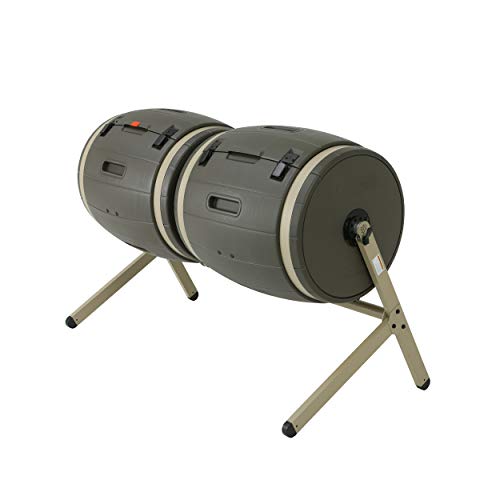
The Lifetime 60309 is the heavyweight of this group, two 50-gallon bins on one frame for a 100-gallon total that suits large gardens and heavy seasonal waste. Each barrel carries its own internal aeration bar, which mixes material and feeds air as the drum turns, and a spring-loaded pin locks a barrel in place while loading. The double-wall high-density polyethylene panels are built to absorb and retain heat, and the brown wood-grain finish blends into a garden better than a plain black drum. A fully removable lid makes loading bulky material simple.
Specs
- Capacity: 100 gallons total, two 50-gallon bins
- Material: black double-wall high-density polyethylene panels
- Aeration: internal aeration bar in each barrel
- Locking: spring-loaded pin holds barrels in place
- Lid: fully removable
- Dimensions: 65 x 31 x 42.25 inches
- Weight: 85 pounds empty
- Color: brown with wood-grain texture
Best for: Large gardens and households that produce a lot of organic waste and want the biggest capacity here.
Watch out for: Assembly is a two-person job that takes a while, and the drum gets hard to turn when both bins are full and heavy.
Maze RSI-MCT-D245 Two Stage Compost Tumbler

The Maze RSI-MCT-D245 is built around one idea: turning a full drum should not feel like a workout. A geared handle with a ratchet lock rotates the 65-gallon barrel smoothly, even when the load is heavy, and the drum can run as one full chamber or split into two compartments so one batch cures while the other fills. The zinc-coated metal frame resists rust, the drum is UV-protected high-impact plastic, and air vents on all sides keep oxygen moving. Fifteen inches of ground clearance leaves room for a cart underneath when unloading.
Specs
- Capacity: 65 gallons (8.69 cubic feet)
- Chambers: dual, two-stage, runs as one chamber or two
- Handle: geared turning handle with ratchet lock
- Frame: zinc-coated metal
- Drum: UV-protected high-impact plastic
- Dimensions: 41.3 x 30 x 44.5 inches
- Ground clearance: 15 inches
- Aeration: air vents on all sides
- Warranty: 1-year limited warranty
- Cart: compost cart sold separately, model RSI-MC-CT55
Best for: Gardeners who want a large drum that still turns easily thanks to a geared handle.
Watch out for: The compost cart is a separate purchase, and assembly takes 60 to 90 minutes with careful alignment of the panels.
Sun Joe SJ-CMPS1 Outdoor Tumbling Composter

The Sun Joe SJ-CMPS1 is the simplest tumbler in this group, a 42-gallon dual-chamber drum that asks little of its owner. Two sliding chambers let one side cure while the other keeps taking scraps, and the 360-degree tumbling action mixes the load with a few spins. The body is BPA-free with advanced aeration vents, and the listing gives a composting window of 2 to 10 weeks depending on the mix and the weather. Its compact footprint fits a small yard or a spot beside the shed without dominating the garden.
Specs
- Capacity: 42 gallons
- Chambers: dual, sliding chamber design
- Tumbling: 360-degree rotation
- Material: BPA-free
- Aeration: advanced aeration vents
- Composting window: 2 to 10 weeks per the listing
Best for: Small yards and first-time composters who want a simple dual-chamber tumbler.
Watch out for: The compact size fills fast in a large garden, and wet loads take more effort to turn by hand.
Which One Fits Your Situation
Small yard with kitchen scraps and light trimmings
A compact dual-chamber drum fits this yard best. The FCMP Outdoor IM4000 or the Sun Joe SJ-CMPS1 holds a steady stream of kitchen scraps and light clippings without taking over the garden, and the two chambers keep compost flowing while one side cures. Either drum turns by hand without a crank, which suits a household that composts a few times a week rather than every day.
A household that fills a bin every week
A family that cooks daily and trims often needs a drum that accepts new material without pausing the curing batch. The VEVOR 43-gallon tumbler or the Maze RSI-MCT-D245 handles that rhythm, since both run two chambers and keep fresh scraps away from a finishing batch. The Maze earns the nod when turning effort matters, while the VEVOR suits a household that wants wide sliding doors for easy loading.
A large garden with heavy seasonal waste
Big gardens produce waste in waves, especially when leaves fall or hedges get cut back. The Lifetime 60309 double bin is the only drum here that swallows 100 gallons, so it handles autumn leaves and large trimmings without overflowing. Its two 50-gallon bins also let one side cure while the other fills, which matters when the waste arrives faster than a small drum can process it.
Someone who wants the easiest turning possible
Turning effort decides whether a tumbler becomes a habit or a chore. The Maze RSI-MCT-D245 is the clear pick here, since its geared handle and ratchet lock rotate a heavy drum with far less strain than handholds alone. The Lifetime 60309 also turns smoothly for its size, but its weight when full still asks for more muscle than the Maze.
Common Mistakes
- Filling a drum to the brim with fresh scraps and leaving no air space for the mix to move.
- Adding only green material and ending up with a wet, smelly sludge instead of crumbly compost.
- Forgetting to turn the drum for a week, then finding the contents packed into a single heavy ball.
- Placing the tumbler in deep shade, where the drum never warms enough to break material down quickly.
- Choosing the biggest drum available and then struggling to turn it when both chambers are full.
Frequently Asked Questions
How often should I turn a compost tumbler?
Turn the drum every two to three days, giving it five or six rotations each time. Regular turning mixes oxygen through the material, breaks up clumps, and keeps moisture even across the load. A drum left still for a week can pack down and slow the whole process, while turning too often cools the pile and delays curing.
What can I put in a compost tumbler?
Kitchen scraps such as vegetable peelings, fruit cores, coffee grounds, and eggshells belong in a tumbler, along with garden waste such as grass clippings, leaves, and small prunings. Mix green, nitrogen-rich material with brown, carbon-rich material such as dried leaves or shredded paper. Keep meat, dairy, oils, and diseased plants out, since they attract pests and create odors.
How long does compost take in a tumbler?
Most batches finish in four to ten weeks, depending on the mix, moisture, temperature, and how often the drum turns. Warm weather and a good balance of greens and browns speed the process, while cold spells and wet loads slow it down. A batch is ready when it looks dark, smells earthy, and crumbles easily in the hand.
Do compost tumblers work in cold weather?
A tumbler still works in cold weather, but the process slows as temperatures drop. A black drum placed in a sunny spot absorbs heat and keeps microbes active longer into the season. In freezing weather the contents can stiffen or freeze solid, so keep turning on milder days and expect the batch to finish once warmer weather returns.