Key takeaways
- Compare the best oil for older lawn mowers, from classic SAE 30 to 10W-30 blends, with viscosity, zinc and oil-consumption guidance for worn engines.
An older mower engine asks different things of its oil than a new one. Ring and valve-guide wear let it burn oil it once kept, seals have hardened through years of heat cycles, and the flat-tappet valve train was designed in an era when engine oil carried more anti-wear additive than modern car oil is allowed to hold. The right bottle answers all three problems at once: the viscosity the manual called for, a small-engine formula rather than a car formula, and enough oil in the bottle to cover both the change and the top-ups an aging engine will ask for between changes.

This guide lines up four small-engine oils that suit older mowers, from the straight SAE 30 the manuals of the last century specified to modern synthetic blends and a full synthetic for mowers that work across wide temperature swings. Match the grade to your manual and your climate first, then pick the formula that fits how your engine behaves today.
As an Amazon Associate, we earn from qualifying purchases.
Quick Picks
| Product | Best for | Key point |
|---|---|---|
| Briggs & Stratton SAE 30 Engine Oil, 48 oz (100028) | Older flathead and OHV mowers that follow the classic manual spec | Straight SAE 30 in the big bottle, sized for a change plus top-ups |
| Kohler 10W-30 Engine Oil, 1 qt (25 357 06-S) | Older Kohler Command and Courage engines | The engine maker’s own synthetic blend in a single quart |
| STP Premium Small Engine 10W-30, 32 oz | Worn engines of any brand that need an anti-wear formula | Synthetic blend built around wear reduction for mowers and tractors |
| Briggs & Stratton SAE 5W-30 Synthetic, 32 oz (100074) | Older mowers used from cold spring mornings to hot summer cuts | Full synthetic multi-grade for the widest temperature range |
How to Choose
SAE 30 versus 10W-30 is a temperature decision first. Straight SAE 30 is the grade older manuals printed most often, and it remains the right call for a mower that only works in warm weather: it holds a thick, stable film at summer operating temperatures and does not thin out in a hot, air-cooled crankcase. Its weakness is cold flow. On a chilly spring morning a straight 30-weight is slow to reach the valve train, which is exactly where an old engine can least afford dry running. A 10W-30 flows far sooner when cold and still finishes at the same 30-weight thickness when hot, so for a mower used from early spring to late autumn it is usually the safer year-round grade.
Worn engines burn oil, and that changes the shopping list. An older engine with worn rings or valve guides consumes oil between changes, sometimes noticeably. Two habits matter more than any brand choice. First, check the dipstick before every mow and top up little and often, because running an air-cooled engine low on oil is the fastest way to finish it off. Second, buy a bottle bigger than the change itself: a 48 oz bottle covers a typical walk-mower change with oil left over for top-ups, where a single quart may leave you short by mid-season. Resist the urge to jump to a much thicker grade to slow consumption unless the manual allows it; overly thick oil circulates poorly on cold mornings and can mask, rather than fix, the wear.
Zinc matters on flat tappets. Nearly every older mower engine uses a flat-tappet valve train, where the cam lobe slides directly against a flat lifter face. That sliding contact is protected by zinc-based anti-wear additives, commonly called ZDDP. Modern passenger-car oils have steadily reduced those additives to protect catalytic converters, a part no mower has ever carried. Small-engine oils are blended for air-cooled engines without that constraint, which is the single strongest reason to buy an oil labelled for small engines instead of pouring in leftover car oil from the garage shelf.
Conventional, blend or full synthetic in an old engine. A conventional small-engine oil that matches the manual grade is entirely adequate for an older mower, and it is what the engine was designed around. Synthetic blends add oxidation resistance that helps when an engine runs hot and the oil stays in service a long time. A full synthetic earns its place when the mower works across a wide temperature range, because it flows sooner in the cold and resists thinning in heat. One honest caution: switching a high-hour engine to synthetic sometimes reveals seepage at old, hardened gaskets that conventional oil never pushed past. It does not cause the wear, but check the level more often for the first few mows after any switch.
Change it on hours, not on hope. Old oil in an old engine is a poor combination, because the oil is also the cooling and cleaning system of an air-cooled block. Follow the manual interval if you have it; if the manual is long gone, a change every season or after roughly 25 hours of running, whichever comes first, is a sensible rhythm for a walk-behind mower, with the level checked far more often than that.
Best Options
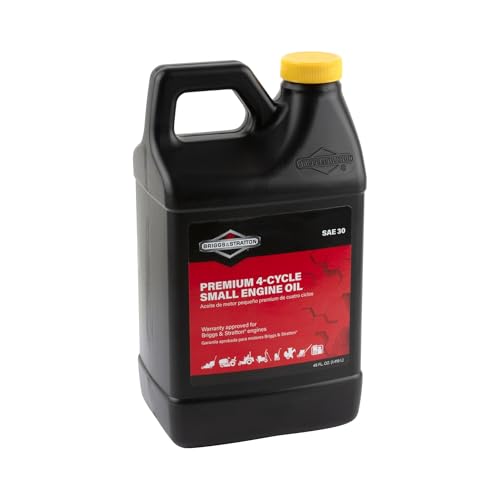
Briggs & Stratton SAE 30 Engine Oil, 48 oz (100028)
This is the oil the classic manuals were written around: a straight SAE 30 detergent oil from the engine maker itself, described in its listing as formulated for the higher operating temperatures of air-cooled engines. For an older Briggs & Stratton flathead or OHV engine that has run SAE 30 its whole life, there is no guesswork here at all. The grade matches, the formula is a small-engine formula, and the additive package suits the flat-tappet valve train these engines carry.
The 48 oz bottle is the practical detail that matters for an aging engine. A typical walk-mower sump takes well under that, so one bottle covers the change and leaves a reserve for the top-ups a worn engine will ask for across the season. If your mower only works in warm weather and has always run straight 30-weight, this is the default choice and the one the rest of the guide has to beat.
Specs
- Viscosity SAE 30; liquid volume 48 fluid ounces; manufacturer part number 100028; detergent 4-cycle small-engine oil formulated for air-cooled engines
Best for: Older mowers that follow the classic SAE 30 manual spec and work in warm weather
Watch out for: Straight 30-weight flows slowly on cold mornings, so it is a poor pick for early-spring or late-autumn mowing in a cold climate
Kohler 10W-30 Engine Oil, 1 qt (25 357 06-S)
Kohler’s own oil is the brand-matched answer for the many older riders and walk mowers running Kohler Command, Courage and other overhead-valve engines. The listing describes it as a universal engine oil specially formulated for small engines rather than adapted from a car formula, in the 10W-30 grade Kohler specifies for a wide band of operating temperatures. For an older Kohler that sees spring and autumn duty as well as summer, that multi-grade coverage is the point.
The synthetic blend base brings better resistance to oxidation and viscosity breakdown than a basic conventional oil, which suits engines that run hot and work long between changes. The single quart is sized for one change on most Kohler-powered mowers, so owners of oil-burning engines should plan on a second bottle for top-ups rather than discovering the shortage mid-season.
Specs
- Viscosity SAE 10W-30; liquid volume 32 fluid ounces (1 quart); manufacturer part number 25 357 06-S; synthetic blend 4-cycle small-engine oil for gasoline and overhead-valve engines
Best for: Older Kohler-powered mowers that need the maker-specified 10W-30 across a long season
Watch out for: Kohler has superseded this part number with a newer one, so confirm the listing you order from is the current replacement before buying
STP Premium Small Engine 10W-30, 32 oz

STP’s small-engine oil is the brand-neutral pick of this guide: a synthetic blend 10W-30 whose listing leads with an engine-care formula built to reduce wear, aimed squarely at lawnmowers, push mowers and tractors. That wear focus is the right emphasis for an older engine of any make, where the priority is protecting a valve train and ring pack that already have years of service behind them.
The 10W-30 grade gives it the same cold-flow advantage as the Kohler oil, so it suits mowers used across a long season rather than only in high summer. At 32 oz it matches the single-change size most walk mowers need. Owners whose engines burn oil should treat it the same way as the Kohler quart: buy with top-ups in mind, because no anti-wear formula can compensate for a sump run low.
Specs
- Viscosity SAE 10W-30; liquid volume 32 fluid ounces; synthetic blend 4-cycle small-engine oil; part number 18588; listing names lawnmowers, push mowers and tractors
Best for: Worn engines of any brand that want a wear-focused 10W-30 without buying the engine maker’s label
Watch out for: It is a single-quart bottle, so an engine that consumes oil will need a second bottle on the shelf for top-ups
Briggs & Stratton SAE 5W-30 Synthetic, 32 oz (100074)

The full synthetic in this guide exists for one situation: an older mower that has to work across the whole temperature map. Its 5W-30 grade flows the soonest of any oil here on a cold morning, which protects a worn valve train during the seconds before oil pressure and splash reach every surface, and the synthetic base resists the thinning and oxidation that hot, air-cooled running encourages at the other end of the year.
Briggs & Stratton markets this oil for air-cooled 4-cycle engines generally, not only its own, so it is a legitimate pick for an older mower of another make whose manual allows a 5W-30 or a synthetic 10W-30 alternative. Keep the earlier caution in mind: on a high-hour engine, watch the dipstick and the gasket lines closely for the first few mows after switching, because a free-flowing synthetic can reveal seepage that thicker conventional oil never found.
Specs
- Viscosity SAE 5W-30; liquid volume 32 fluid ounces; manufacturer part number 100074; full synthetic 4-cycle small-engine oil for air-cooled engines
Best for: Older mowers used from cold spring mornings through hot summer cuts, and engines whose manuals allow 5W-30
Watch out for: Check your manual before choosing it, because some older engines specify SAE 30 or 10W-30 only, with no 5W-30 approval
Which One Fits
- Choose the Briggs & Stratton SAE 30, 48 oz if your mower has always run straight 30-weight, works in warm weather, and burns a little oil between changes.
- Choose the Kohler 10W-30 if your older mower carries a Kohler engine and you want the maker’s own grade and formula.
- Choose the STP Premium Small Engine 10W-30 if your worn engine is another brand and you want a wear-focused blend in the season-spanning 10W-30 grade.
- Choose the Briggs & Stratton SAE 5W-30 Synthetic if your mower works from cold spring mornings to hot summer afternoons and its manual allows the grade.
Common Mistakes
Pouring in leftover car oil. Modern car oil is blended around catalytic converters, with reduced zinc additives and friction modifiers a flat-tappet mower engine never asked for. A small-engine oil of the right grade is blended for exactly the engine you own; the car oil on the shelf is not a saving, it is a compromise.
Changing the oil but never checking it. On a new engine, the level barely moves between changes. On an older one, consumption is normal and the dipstick is the maintenance schedule. Most older mowers that die mid-season die with a near-empty sump, not a worn-out one.
Jumping to a much thicker oil to stop burning. A thicker grade can slow consumption slightly, but it also slows cold circulation to the valve train and can strain a splash-lubricated engine on cool mornings. Stay within the grades the manual lists, top up more often, and treat heavy consumption as a wear symptom to monitor rather than a problem oil alone can solve.
Buying exactly one change worth of oil. A quart may cover the change and nothing else. An older engine needs a reserve bottle for top-ups, and running out mid-season is how a mower ends up running low. The 48 oz bottle in this guide exists precisely to prevent that arithmetic.
FAQ
Can I use regular car oil in an older lawn mower?
It will pour and the engine will run, but it is the wrong formula. Modern car oils carry reduced zinc anti-wear additives to protect catalytic converters, while an older mower’s flat-tappet valve train depends on those additives. A small-engine oil in the manual’s grade protects the valve train the way the engine was designed to be protected.
Should an oil-burning older mower use a thicker oil?
Only within the grades its manual allows. Moving from 10W-30 to SAE 30 for summer use is a legitimate, manual-approved step for many older engines and can trim consumption. Jumping beyond the listed grades risks poor cold circulation, so the better answer is the thickest approved grade plus frequent top-ups.
Is full synthetic oil safe in an old mower engine?
Yes, provided the grade matches the manual. Synthetic flows sooner in the cold and resists heat breakdown, both useful in an air-cooled engine. The one habit to adopt is checking the level and the gasket lines more often for the first few mows, because synthetic can seep past hardened old seals that conventional oil never pushed through.
How often should I change the oil in an older mower?
Follow the manual if you have it. Without one, change it at least once a season or roughly every 25 hours of running on a walk-behind mower, and check the level before every mow. On an engine that burns oil, fresh top-ups help, but they do not replace a full change, because the contaminants leave only when the sump is drained.
Final Verdict
For most older mowers, the decision is simpler than the shelf suggests. Warm-climate engines that have always run SAE 30 should stay with the Briggs & Stratton 48 oz bottle, which also solves the top-up problem in the same purchase. Engines that work a long season belong on a 10W-30: the Kohler oil for Kohler engines, the STP blend for everything else with wear on its mind. Save the full synthetic 5W-30 for mowers that face cold mornings as well as hot afternoons. Get the grade right, keep the sump full, and an old engine will usually keep cutting.