Key takeaways
- Need a commercial centrifugal juicer for daily carrot juice? Compare 5 heavy-duty models by motor, chute width, jug size, and pulp capacity.
Choosing a commercial centrifugal juicer for carrot juice is a decision about throughput and pulp handling, not about finding the prettiest machine on the counter. Carrots are dense, fibrous, and unforgiving. A weak motor stalls, a narrow chute forces endless trimming, and a small pulp bin stops a busy morning cold. The right machine takes whole or halved carrots, keeps a steady pace through a full crate, and clears pulp without constant interruption.

This guide is for cafe owners, juice bar operators, and home juicers who press carrots every day and need equipment that keeps up. Each model below was picked from its Amazon listing by motor strength, chute width, jug and pulp capacity, and the way it handles hard produce like carrots. The list runs from a true commercial unit to simpler home machines, so the right pick depends on batch size and how often the juicer runs.
Quick Picks
As an Amazon Associate we earn from qualifying purchases
| Product | Best for | Key spec from title |
|---|---|---|
| Breville Commercial Juice Fountain XL Pro | High-volume cafe service | 1200-watt motor, 70 oz jug |
| Breville Juice Fountain Elite 800JEXL | Fast daily carrot batches | 1000-watt motor, 13,000 RPM |
| Cuisinart CJE-1000 | Adjustable speed for mixed produce | 1000-watt 5-speed extractor |
| Breville Juice Fountain Cold BJE430SIL | Cooler juice with sealed storage | 850-watt motor, 70 oz jug |
| Hamilton Beach Big Mouth 67601A | Simple high-volume juicing | 800-watt motor, 3-inch chute |
How to Choose
Motor Power and Speed Control
Carrots demand torque. A motor in the 800 to 1200 watt range holds its speed when a thick carrot hits the cutting disc, while a weaker motor bogs down and leaves wet pulp behind. Two speeds give a useful edge: run hard produce on high and switch to low for softer fruit so the machine does not fling soft ingredients through the filter. Variable speed adds finer control for a menu that changes through the day. Match the motor to the load: a single morning glass needs far less power than a crate of carrots before opening time.
Feed Chute Width and Carrot Prep
A wide chute is the difference between feeding carrots whole and standing at the cutting board for twenty minutes. A 3-inch chute takes most carrots halved or whole, and a 3.5-inch chute swallows full-size carrots with almost no trimming. Check the chute against the carrots you actually buy: thick farmers market carrots need more room than slim supermarket bunches. A centered chute over the shredding disc also feeds more evenly than a side entry, so produce meets the disc squarely instead of catching on one edge.
Jug and Pulp Capacity for Batch Size
Capacity decides how often the line stops. A 70-ounce jug fills several glasses before it needs pouring, while a 1.1-quart jug suits one or two servings at a time. The pulp bin matters more than most buyers expect: a 115-ounce bin lets a cafe run through a full batch of carrots without stopping to empty it, and a 3.6-quart bin covers a family morning easily. Small bins mean frequent pauses, wet hands, and pulp spilling over the rim. Size both containers for the largest batch you make on a normal day, not the smallest.
Cleaning and Durability Under Daily Use
A juicer that is hard to clean gets used less, no matter how strong its motor is. Look for dishwasher-safe parts, a pulp container that lifts out cleanly, and a cleaning brush in the box for the mesh filter, because dried carrot fiber clogs fine mesh fast. Die-cast and stainless steel housings stand up to daily wiping and the odd knock on a busy counter far better than light plastic shells. A safety locking arm and overload protection add peace of mind when staff rotate through the station. Rinse the filter right after juicing and the next batch starts clean.
The 5 Best Options
Breville Commercial Juice Fountain XL Pro
Built for food service, this is the only model here with a commercial listing, and it shows in the numbers: a 1200-watt motor, a 3.5-inch chute, a 70-ounce jug, and a 115-ounce pulp bin. Whole carrots drop straight in, and the variable speed dial lets the operator slow down for soft fruit or push hard produce through at full pace. The continuous feed design keeps a juice bar moving through a morning rush without stopping to empty pulp every few minutes.
Specs
- 1200-watt motor
- 3.5-inch extra-wide feed chute
- 70 fl oz juice jug
- 115 fl oz pulp bin
- Variable speed control
- Continuous feed centrifugal type
- cUL commercial listed
Best for: Cafes and juice bars pressing carrots in high volume.
Watch out for: Its footprint is large, so measure counter space and overhead clearance before ordering.
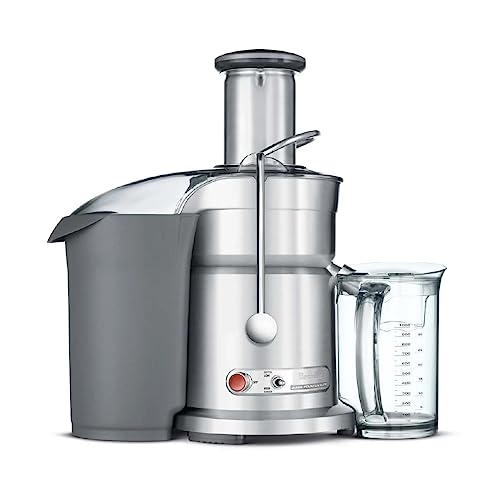
Breville Juice Fountain Elite 800JEXL
The Elite pairs a 1000-watt motor with speeds up to 13,000 RPM, which is the combination that shreds dense carrots cleanly instead of squeezing them slowly. Its 3-inch chute takes most carrots with a single cut, and the titanium-reinforced disc with a micro mesh filter basket keeps juice smooth. The 1.1-quart jug and 3.2-quart pulp container suit steady daily batches, and two speeds cover hard roots on high and softer fruit on low. The die-cast housing stands up to daily use on a busy counter.
Specs
- 1000-watt motor
- Speeds up to 13,000 RPM
- 3-inch extra-wide feed chute
- 1.1-quart juice jug
- 3.2-quart pulp container
- Titanium-reinforced cutting disc
- Italian-made micro mesh filter basket
- Two speeds for hard and soft produce
Best for: Daily carrot batches where speed and smooth juice matter most.
Watch out for: The pulp container fills fast on large carrot batches, so keep an eye on it during long runs.
Cuisinart CJE-1000

Five speeds set this extractor apart for a kitchen that juices more than carrots. Run dense roots on the higher settings and drop down for berries, citrus, and leafy greens without swapping machines. The 1000-watt motor and 3-inch chute handle halved carrots without fuss, while the die-cast and stainless steel housing gives the machine a solid feel on the counter. A foam-reducing filter basket keeps the pour cleaner, and the anti-drip spout stops juice from running across the counter. The control dial lights up so the chosen speed is easy to see at a glance.
Specs
- 1000-watt 5-speed juice extractor
- 3-inch feeding chute
- Die-cast and stainless steel housing
- Foam-reducing filter basket
- Anti-drip adjustable flow spout
- 2-liter pulp container
- 1-quart juice pitcher
- Dishwasher-safe parts
Best for: Mixed produce menus where one machine must handle carrots, fruit, and greens.
Watch out for: Five speeds mean a short learning curve; start low with soft produce until the settings feel familiar.
Breville Juice Fountain Cold BJE430SIL

Cold Spin Technology is the headline here: the disc and mesh filter are designed to limit heat transfer into the juice, which suits anyone who presses a big batch of carrot juice and stores it for later. The 850-watt motor runs at 6,500 RPM on low and 13,000 RPM on high, so hard carrots get full power while soft fruit stays gentle. A 70-ounce Seal and Store jug with a froth separator and a 3.6-quart pulp container round out a machine built for family-size batches.
Specs
- 850-watt motor
- Two speeds: 6,500 RPM and 13,000 RPM
- 3-inch extra-wide feed chute
- 70 fl oz Seal and Store juice jug with froth separator
- 3.6-quart pulp container
- Cold Spin Technology
- Stainless steel micro mesh filter basket
- 1-year limited product warranty
Best for: Pressing carrot juice ahead and keeping it sealed in the jug for later.
Watch out for: The jug and pulp container are large, so check shelf and cabinet space for storage between uses.
Hamilton Beach Big Mouth Juicer 67601A

The Big Mouth keeps things simple: an 800-watt motor, a 3-inch chute, and parts that come apart fast for washing. Whole or halved carrots feed through without long prep, and the pulp ejects into its own container while juice flows into the pitcher. It is the lightest-duty machine in this group, so it fits a home kitchen or a small cafe better than a nonstop juice bar. For straightforward daily carrot juice without extra settings to learn, it does the job.
Specs
- 800-watt motor
- 3-inch feed chute for whole fruits and vegetables
- Centrifugal extractor
- Removable parts are dishwasher safe and BPA free
- 3-year limited warranty
Best for: Simple daily carrot juicing at home or in a small cafe.
Watch out for: The 800-watt motor is the weakest here, so feed thick carrots slowly and let the disc clear between pieces.
Which One Fits Your Situation
Running a Cafe or Juice Bar
Pick the Breville Commercial Juice Fountain XL Pro. Its 1200-watt motor, 3.5-inch chute, and 115-ounce pulp bin are built for continuous service, and the variable speed dial adapts to each order. No other model here matches its capacity for back-to-back carrot batches during a rush. The cUL commercial listing also fits health and safety checks in a professional kitchen.
Pressing Carrot Juice for a Family Every Day
Pick the Breville Juice Fountain Cold BJE430SIL. The 70-ounce sealed jug stores a full family batch, and Cold Spin Technology limits heat in juice that waits in the fridge. Two speeds cover carrots on high and softer fruit on low, so one machine handles the whole morning menu without extra fuss.
A Kitchen That Juices More Than Carrots
Pick the Cuisinart CJE-1000. Five speeds make it the most flexible model here, moving from dense carrots to berries and leafy greens with a turn of the dial. The die-cast housing and dishwasher-safe parts suit a machine that gets used for every kind of produce, every day in a busy home kitchen.
A First Heavy-Duty Juicer Without Complications
Pick the Hamilton Beach Big Mouth 67601A. It has the fewest settings to learn, parts that wash easily, and a 3-inch chute that takes carrots with little prep. The Breville Juice Fountain Elite 800JEXL is the step up when speed matters more: its 1000-watt motor and 13,000 RPM top speed shred carrots faster.
Common Mistakes
- Buying on wattage alone and ignoring chute width, jug size, and pulp capacity.
- Feeding whole thick carrots into a 3-inch chute instead of halving the widest ones first.
- Letting carrot fiber dry on the mesh filter, which clogs fine pores and cuts yield on the next batch.
- Running soft fruit on high speed, which flings it through the filter and leaves wet pulp.
- Choosing a small pulp bin for a cafe rush, then stopping every few minutes to empty it.
Frequently Asked Questions
Are centrifugal juicers good for carrot juice?
Yes. Carrots are hard and dense, which is exactly what a fast spinning disc handles well. A centrifugal juicer shreds carrots against a mesh filter and flings the juice out in seconds, so a batch takes minutes rather than a long slow press. Pick a model with at least 800 watts and a wide chute for the best results with whole carrots.
How do I keep carrot pulp dry?
Feed carrots at a steady pace and let the disc clear between pieces instead of forcing a whole pile down the chute at once. Run hard carrots on high speed so the disc spins fast enough to throw moisture out of the pulp. Empty the pulp bin before it packs down, and rinse the filter right after juicing so dried fiber does not block the mesh.
Can I juice whole carrots without cutting them?
It depends on the chute. A 3.5-inch chute takes most whole carrots with no trimming, while a 3-inch chute handles slim carrots whole and needs thick ones halved first. Trim the leafy tops and wash the carrots well before juicing. Cut any carrot that is wider than the chute rather than forcing it, which can stall the motor.
How much carrot juice can these juicers make at once?
That depends on the jug and pulp bin, not just the motor. A 70-ounce jug holds several glasses before pouring, and a 115-ounce pulp bin runs through a large batch without stopping. Smaller jugs suit one or two servings, so size the machine for the biggest batch you press on a normal day.