Key takeaways
- Four verified gas walk-behind string and brush mowers for field work, compared by engine, cutting width, wheels and cutting head.
Disclosure: As an Amazon Associate, we earn from qualifying purchases.
Our top pick: Earthquake Walk Behind String Mower, model 40314. Runner-up: Earthquake Walk-Behind String Mower, model 47325.
Field work is a different job from mowing a lawn. Out in a field, a pasture edge or an overgrown lot, the grass is tall, the ground is uneven, and there are saplings, brush and hidden obstacles that would stop an ordinary rotary mower or damage its blade. The machine built for that work is the walk-behind field and brush mower, and it is worth being honest about what that means on Amazon US: complete blade-type field mowers of the kind sold through specialist dealers are not sold as complete machines there, where only parts and accessories for them appear. The field mower type that is genuinely sold on Amazon US is the gas walk-behind string mower, also called a walk-behind brush cutter. Instead of a steel blade, it cuts with heavy-duty line on a wide cutting head, pushed on tall wheels that roll over rough ground. That design suits field work: the line gives when it strikes a stone or a stump instead of bending a blade shaft, the tall wheels keep the head up over ruts and tufts, and the wide swath clears tall grass and light brush at walking pace.
This guide covers four gas walk-behind string and brush mowers, each checked against a real Amazon US listing with a verified ASIN. Three are Earthquake models from Ardisam, and one is a SENIX high-wheel brush cutter. All four are the same product type, all run 4-cycle gas engines in the 150cc to 160cc class, and all cut a swath of about 22 inches where a width is stated. The differences that matter are in the cutting head, the wheels and the height adjustment — the details that decide how a machine behaves on rough, overgrown ground.
Quick Picks
- Earthquake Walk Behind String Mower, model 40314 — Best overall for field work: 160cc Viper engine, 22-inch cutting diameter and 14-inch never-go-flat wheels.
- Earthquake Walk-Behind String Mower, model 47325 — Runner-up: Hurricane cutting head, 22-inch cutting diameter and airless wheels on a 160cc Viper engine.
- SENIX High Wheel Gas Walk Behind Brush Cutter and String Trimmer (STMG-L) — Best for height control: five cutting height positions, a steel deck and .155-inch line.
- Earthquake 28463 M205 Walk Behind String Mower — Best simpler Earthquake option: 150cc Viper engine and a high-wheel layout for rough ground.
Earthquake Walk Behind String Mower, model 40314
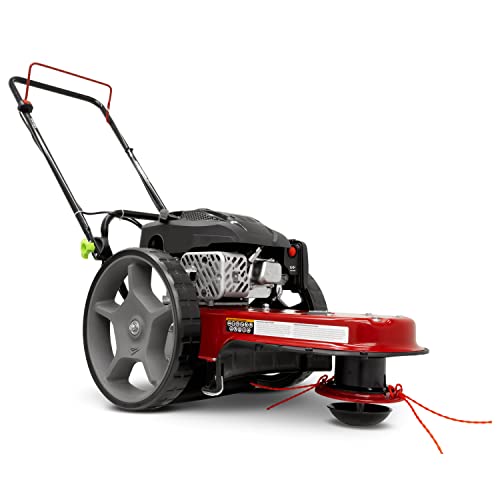
OUR TOP PICK
The Earthquake 40314 is the most complete field package in this guide, and the model to look at first. As stated on the Amazon listing, it runs a 160cc Viper 4-cycle engine and cuts a 22-inch diameter swath, the working width that decides how many passes a field, a ditch bank or a fence line takes. A 4-cycle engine matters in this class because it runs on straight gasoline rather than a fuel and oil mix, keeping refuelling simple far from the shed.
The detail that earns it the top spot is the wheel specification. The listing states 14-inch never-go-flat wheels, and in field work that is more than a convenience. Fields are where thorns, sharp stubble and discarded wire live, and a pneumatic tyre that goes flat halfway across a rough lot turns a mowing job into a recovery job. Solid wheels that cannot puncture remove that failure mode entirely, and at 14 inches they roll over ruts, molehills and tufted grass instead of digging in. The adjustable handlebar, also stated on the listing, lets the operator set the push height to suit their build and the slope, which matters over a long session on uneven ground.
As a field tool, the 40314 is aimed at the classic walk-behind string mower work: reclaiming overgrown corners, cutting down tall grass and weeds before they seed, clearing around outbuildings, posts and trees where a tractor cannot go, and keeping paths and fence lines open. The line head will not fell mature woody growth, and no machine in this guide will, but for grass, weeds and light brush it is the right mechanism, because the line keeps cutting where a blade would already have been damaged. The manufacturer is Ardisam, Inc., the company behind the Earthquake outdoor power equipment line.
Specs
– Model: 40314
– Engine: 160cc Viper 4-cycle, as stated on the listing
– Cutting diameter: 22 inches, as stated on the listing
– Wheels: 14-inch never-go-flat, as stated on the listing
– Handlebar: adjustable, as stated on the listing
– Manufacturer: Ardisam, Inc.
Pros
– 160cc Viper 4-cycle engine runs on straight gasoline, with no fuel mixing
– 14-inch never-go-flat wheels remove punctures from field work
– 22-inch cutting diameter clears tall growth in fewer passes
– Adjustable handlebar for operator height and slope work
Cons
– Line head is for grass, weeds and light brush, not mature woody growth
– Walk-behind pace, so very large acreage is slow work
Earthquake Walk-Behind String Mower, model 47325

The Earthquake 47325 is the runner-up, and the difference between it and the 40314 comes down mainly to the cutting head. As stated on the Amazon listing, it also runs a 160cc 4-cycle Viper engine and cuts a 22-inch diameter swath, but it is fitted with a Hurricane cutting head. The cutting head is the part of a string mower that decides how the line is held and fed, and how well it stands up to repeated strikes against stems, edges and the ground itself, so a named, purpose-built head design is a meaningful point of difference in a machine whose whole job is hitting things with line at speed.
The wheels are the other stated difference. The listing gives 2.5 x 14.5-inch airless wheels, slightly taller than the 40314 set and, like them, unable to go flat. The extra height helps the machine ride over rutted and tufted ground while keeping the head at a steadier height. An adjustable handlebar is also stated on the listing, so the same ergonomic adjustment is present here.
Choose the 47325 when the cutting head is the priority: dense, stemmy growth, lots of edge work around posts and stones, and long sessions where head durability and line behaviour decide how often work stops. Choose the 40314 when the priority is the simpler all-round package. The two machines are close cousins from the same manufacturer, with the same engine class and cutting width, and the honest deciding factors are the head design and the wheel dimensions.
Specs
– Model: 47325
– Engine: 160cc 4-cycle Viper, as stated on the listing
– Cutting head: Hurricane cutting head, as stated on the listing
– Cutting diameter: 22 inches, as stated on the listing
– Wheels: 2.5 x 14.5-inch airless, as stated on the listing
– Handlebar: adjustable, as stated on the listing
Pros
– Hurricane cutting head for demanding line work in dense growth
– 160cc Viper 4-cycle engine and 22-inch cutting diameter
– Tall 14.5-inch airless wheels that cannot puncture
– Adjustable handlebar
Cons
– Line head is for grass, weeds and light brush, not mature woody growth
– Closely matched to the 40314, so the choice rests on head and wheel details
SENIX High Wheel Gas Walk Behind Brush Cutter and String Trimmer (STMG-L)

The SENIX STMG-L is the non-Earthquake option in this guide, and it brings two specifications none of the Earthquake models state: a steel deck and a five-position height adjustment. As recorded for its listing, it runs a 160cc 4-cycle engine and cuts a 22-inch swath with .155-inch line. The .155-inch line figure is worth noting, because line diameter is what decides how much abuse the cutting line takes before it wears or snaps: heavier line is the right choice for brush work, where the head is constantly striking thick stems rather than trimming lawn edges.
The five-position height adjustment, stated as 1.57 to 3 inches, is the SENIX machine’s clearest field advantage. Field work is not one job: a first pass through standing growth wants the head high so the machine is not swamped, while a second pass over the same ground wants it lower to take the stubble down. Set height positions make that two-pass method repeatable instead of guesswork, and help on ground that changes character across a single lot, from open grass to rough scrub at the edges. The steel deck, as stated, is the housing that takes the knocks from stones and debris thrown up by the head, and steel is the durable choice for that role.
The listing information also states 14-inch rubber wheels and a weight of 48.5 lb. Fourteen-inch wheels put it in the same rough-ground class as the Earthquake models, and the stated weight is manageable for a machine of this engine size when it has to be turned at the end of each pass and loaded for transport. Pick the SENIX when height control and a steel deck are the priorities, and when the work involves repeated passes over the same ground at different cutting heights.
Specs
– Model: STMG-L
– Engine: 160cc 4-cycle, as recorded for the listing
– Cutting swath: 22 inches, as recorded for the listing
– Line: .155 inch, as recorded for the listing
– Deck: steel, as recorded for the listing
– Wheels: 14-inch rubber, as recorded for the listing
– Height adjustment: 5 positions, 1.57 to 3 inches, as recorded for the listing
– Weight: 48.5 lb, as recorded for the listing
Pros
– Five-position height adjustment from 1.57 to 3 inches for two-pass field cutting
– Steel deck and heavy .155-inch line for brush work
– 160cc 4-cycle engine and 22-inch cutting swath
– 14-inch wheels for rough, uneven ground
Cons
– Line head is for grass, weeds and light brush, not mature woody growth
– Height range tops out at 3 inches, so very tall first passes need care
Earthquake 28463 M205 Walk Behind String Mower

The Earthquake 28463 M205 is the earlier, simpler machine in the Earthquake line covered here, and it is the pick for a buyer who wants the walk-behind string mower format without the newer models’ refinements. As recorded for its listing, it runs a 150cc 4-cycle Viper engine, is gas powered, and uses a high-wheel design. The engine is a step down in displacement from the 160cc units in the other three machines, which in practice means a little less reserve when the head is buried in the thickest growth, but the same 4-cycle convenience of running on straight gasoline with no mixing.
The high-wheel design is the defining feature, and the one that made this format popular for field work in the first place. Tall wheels are what let a walk-behind mower travel over ground that has never been a lawn: rutted tracks, tufted pasture, ditch edges and the rough margins around fields and outbuildings. A small-wheeled trimmer on that ground spends its time stuck; a high-wheel machine keeps rolling and keeps the head working. That is the honest core of this model: fewer stated specifications than its newer stablemates, but the same architecture that suits the machine to rough, overgrown ground.
Choose the M205 when the work is the steady, recurring kind — keeping a rough lot, a long fence line or the edges of a smallholding cut down through the season — and when a straightforward, proven layout matters more than the newest head design. Buyers who regularly face the densest, wettest growth should look at the 160cc models above first, but for general field tidying the M205 has the same line-head advantage over any blade machine: it can strike the hidden stone or stump that fields always contain and keep working, where a bent blade would end the day.
Specs
– Model: 28463 M205
– Engine: 150cc 4-cycle Viper, as recorded for the listing
– Fuel: gasoline, as recorded for the listing
– Design: high-wheel walk-behind string mower, as recorded for the listing
Pros
– High-wheel design built for rough, uneven field ground
– 150cc Viper 4-cycle engine runs on straight gasoline
– Simple, proven walk-behind string mower layout
– Line head tolerates strikes against stones and stumps
Cons
– Smaller 150cc engine than the 160cc models in this guide
– Fewer specifications stated for this model than for the newer Earthquake machines
How to Choose
Start with an honest picture of the ground. Walk-behind string mowers, including every machine in this guide, are built for tall grass, weeds and light brush on rough ground. They are the right tool for reclaiming overgrown areas, maintaining fence lines, ditch banks, orchard rows and lot margins, and cutting around posts, trees and outbuildings. They are not a substitute for a tractor and rotary cutter on large acreage, and they will not clear mature, woody saplings; thick woody stems need a blade machine or a different method first, after which a string mower is excellent at keeping regrowth down.
Next, look at the engine. All four machines here are 4-cycle, which means straight gasoline and no oil mixing, and the class runs from 150cc in the M205 to 160cc in the other three. Engine size here is about reserve: dense, wet, stemmy growth loads the head heavily, and the larger engine holds its speed better when the line is working hard. For ordinary tall grass and weeds, any of the four has enough; for the thickest seasonal clear-outs, favour the 160cc models.
Wheels decide how the machine travels, and in field work travel is half the job. Look for tall wheels, around 14 inches, that roll over ruts and tufts, and consider whether the wheels can puncture. The 40314 states never-go-flat wheels, the 47325 states airless wheels, and the SENIX states 14-inch rubber wheels. On ground with thorns, sharp stubble or debris, a wheel that cannot go flat is a genuine working advantage.
Then consider the cutting head and the height adjustment. The head decides how the line is held and how the machine copes with constant strikes; the 47325 states a Hurricane cutting head, and the SENIX states heavy .155-inch line. Height adjustment decides how well the machine handles the two-pass method — a high first pass to knock standing growth down, a lower second pass to finish it — and the SENIX states five positions from 1.57 to 3 inches. If the ground and growth vary a lot, stated height positions are worth having.
Finally, think about the operator. Field sessions are long walks on bad ground, so an adjustable handlebar, stated on both newer Earthquake models, helps set a comfortable push height and reduces fatigue on slopes. Weight matters when the machine is turned at the end of every pass; the SENIX states 48.5 lb.
FAQs
Can a walk-behind string mower really handle field work?
Yes, within its design limits. A gas walk-behind string mower with a 150cc to 160cc 4-cycle engine and a cutting swath of about 22 inches is built for tall grass, weeds and light brush on rough ground, which is most of what field work involves: reclaiming overgrown corners, maintaining fence lines and ditch banks, and cutting around obstacles. Its line head is an advantage in fields, because line gives way when it strikes stones or stumps that would damage a blade. It will not clear mature woody growth or replace a tractor-mounted cutter on large acreage.
Why are there no blade-type field and brush mowers in this guide?
Because complete blade-type field mowers are not sold as complete machines on Amazon US; only parts and accessories for them appear there. The field mower type genuinely sold on Amazon US is the gas walk-behind string and brush mower, so this guide compares the verified machines of that type, each with a real Amazon US listing, rather than listing blade machines that cannot actually be bought there.
How do I choose between the Earthquake 40314 and the 47325?
The two machines share a 160cc Viper 4-cycle engine and a 22-inch cutting diameter, so choose on the details. The 40314 states 14-inch never-go-flat wheels and is the straightforward all-round package. The 47325 states a Hurricane cutting head and slightly taller 2.5 x 14.5-inch airless wheels, which suits dense, stemmy growth and heavy edge work around posts and stones. Either will do the same field jobs; the head and wheel specifications are the deciding factors.
Conclusion
For field work bought on Amazon US, the honest choice is a gas walk-behind string and brush mower, and the Earthquake 40314 is the top pick here: a 160cc Viper 4-cycle engine, a 22-inch cutting diameter and 14-inch never-go-flat wheels. The Earthquake 47325 is the runner-up, adding a Hurricane cutting head and taller airless wheels for the densest growth. The SENIX STMG-L is the pick when five-position height adjustment, a steel deck and heavy .155-inch line matter most, and the Earthquake 28463 M205 is the simpler high-wheel option for steady seasonal tidying. Before buying, walk the ground, note how much of it is grass and light brush versus woody growth, and check the listing for the exact model.