We independently review everything we recommend. When you buy through our links, we may earn a commission. As an Amazon Associate we earn from qualifying purchases.
Best Gas Cans for Cars, Generators, and Yard Equipment
Five gas cans compared for drivers and homeowners: squeeze and trigger spouts, a flat off-road pack, a diesel pick, and safe storage basics.
Five gas cans compared for drivers and homeowners: squeeze and trigger spouts, a flat off-road pack, a diesel pick, and safe storage basics.
A gas can earns its place in the garage at a few specific moments: topping up the car when a fuel stop was skipped, keeping a generator ready for an outage, or feeding the mower, trimmer, and snow blower through the season. Modern cans are shaped by safety rules, so the spout seals itself, the cap resists small hands, and the body is built to limit vapor loss. That makes the differences between models practical rather than cosmetic: how the spout controls the flow, how the can vents while pouring, and how much weight you are holding once the can is full.
This guide compares five portable fuel containers chosen for drivers and homeowners. Two are five-gallon gasoline cans with very different spouts, one is a yellow five-gallon diesel can, one is a flat two-gallon pack built for off-road racks, and one is a smaller can sized for yard tools and two-stroke mix. Each section sticks to maker-stated specifications, and the handling notes follow standard practice throughout: fill outdoors, away from ignition sources, and store every can upright in a ventilated space away from living areas.
As an Amazon Associate, we earn from qualifying purchases.
Quick answer
For most households, a five-gallon gasoline can with a controlled spout covers cars, generators, and yard equipment in a single purchase. Choose the Scepter FSCG552 for squeeze-controlled pouring, or the SureCan SUR5SFG2 if tipping a full can is the part you dislike. Diesel owners should pick the yellow Scepter FSCD552, off-road drivers the flat RotopaX RX-2G, and small-tool owners the SureCan SUR2SFG2.
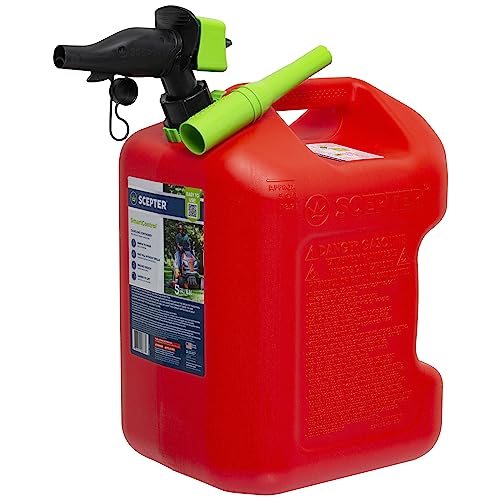
1. Scepter FSCG552 SmartControl 5-Gallon Gas Can
Top Pick
1. Scepter FSCG552 SmartControl 5-Gallon Gas Can
Capacity: 5 gallons
Fuel type: Gasoline
Spout: SmartControl squeeze control with flame mitigation device, per maker
The FSCG552 is Scepter’s five-gallon gasoline container built around its SmartControl spout. Rather than a nozzle that opens only when it is pushed against a filler neck, the SmartControl design uses a palm squeeze control: squeeze to start the flow, squeeze harder for a faster pour, and ease off to slow down before the receiving tank tops out. Scepter rates the spout for fills of up to 3 gallons per minute, and a funnel is included for equipment with recessed filler openings. A rear handle works alongside the top handle, which helps steady a full can while it is tilted. The maker also fits a flame mitigation device and describes the container as EPA and CARB compliant.
Who it’s for: Households that want one full-size gasoline can for the car, a generator, and yard equipment, and that prefer squeeze control over a push-in spout.
Who should skip: Anyone who dislikes tipping a full five-gallon can at all; the bottom-feed SureCan below keeps the can upright instead.
2. SureCan SUR5SFG2 5-Gallon Gas Can
Runner-Up
2. SureCan SUR5SFG2 5-Gallon Gas Can
Capacity: 5 gallons
Fuel type: Gasoline
Spout: Flexible rotating spout, rotates down more than 180 degrees, per maker
Control: Thumb release trigger with locking system, per maker
The SureCan takes the opposite approach to pouring: the can stays upright and the fuel feeds from the bottom. Its flexible spout rotates down more than 180 degrees from its parked position on top, so it can be aimed into a filler neck while the can rests on a fender, a step, or the ground beside the machine. A thumb release trigger on the handle controls the flow, and the maker describes the can as self-venting, which keeps the pour smooth instead of glugging. Hand grips molded into the bottom help on the occasions when the can does need to be lifted or tipped to empty the last of the fuel.
Who it’s for: Anyone who finds a full five-gallon can heavy or awkward to tilt, and owners of equipment with hard-to-reach filler necks.
Who should skip: Buyers who want the simplest possible spout with no trigger mechanism, and diesel owners, who should use a yellow diesel container such as the FSCD552 below.
3. Scepter FSCD552 SmartControl 5-Gallon Diesel Can
3. Scepter FSCD552 SmartControl 5-Gallon Diesel Can
Capacity: 5 gallons
Fuel type: Diesel only
Color: Yellow, the standard diesel container color
Diesel follows its own color code, and the FSCD552 follows it: a yellow five-gallon container that Scepter sells specifically for diesel fuel. It uses the same SmartControl squeeze spout as the red gasoline model above, so the pouring technique is identical, with the flow set by how firmly the palm control is squeezed and a maker-rated rate of up to 3 gallons per minute. A rear handle helps steady the can when filling a diesel truck, a tractor, or a generator. Keeping diesel in a dedicated yellow can also guards against the costly mistake of putting the wrong fuel into an engine, in either direction.
Who it’s for: Diesel truck, tractor, and generator owners who want controlled pouring in the correct diesel color.
Who should skip: Gasoline users. This container is for diesel only, and gasoline belongs in a red can such as the FSCG552 above.
4. RotopaX RX-2G 2-Gallon Gasoline Pack
The RX-2G is a different shape of fuel container entirely. Instead of an upright can, it is a flat two-gallon pack only about three inches thick, shaped to mount on compatible racks and carriers fitted to off-road vehicles, overlanding rigs, and utility machines. RotopaX sells the mounting hardware separately, and a spout is included with the pack. The listing describes the body as high-density polyethylene and rates the pack to CARB and EPA specifications. Carried on an exterior mount, the flat pack stays put instead of sliding or tipping the way a loose can does in a cargo area.
Specs
Capacity: 2 gallons
Fuel type: Gasoline
Material: High-density polyethylene, per maker
Dimensions: About 18.5 x 14 x 3 inches
Empty weight: About 4.3 pounds
Included: Spout
Mounting: Mounting kit sold separately, per maker
Compliance: CARB and EPA specifications met, per listing
Origin: Made in the USA, per listing
Who it’s for: Off-road and overland drivers who want a reserve that mounts flat on a rack and stays secured outside the cabin.
Who should skip: Anyone whose only option is carrying fuel inside the passenger cabin or trunk. No fuel container belongs there; containers should ride secured outside the cabin, be filled outdoors on the ground, and be handled under local rules and the maker’s instructions. Also skip it if two gallons is too little between fuel stops.
5. SureCan SUR2SFG2 2.2-Gallon Gas Can
5. SureCan SUR2SFG2 2.2-Gallon Gas Can
Capacity: 2.2 gallons
Fuel type: Gasoline
Spout: Flexible rotating spout, rotates down more than 180 degrees, per maker
Control: Thumb release trigger with child safety lock, per maker
The SUR2SFG2 shrinks the SureCan formula to 2.2 gallons, a size that suits chainsaws, trimmers, and small mowers and leaves headroom for mixing two-stroke oil into the fuel. It keeps the rotating bottom-feed spout and thumb trigger of the five-gallon model, so fuel can be dispensed into a small filler neck while the can rests upright instead of being balanced in midair. SureCan describes a child safety feature on the trigger that locks when the trigger is released, and the body uses the maker’s six-layer high-density polyethylene construction.
Who it’s for: Owners of small yard tools who mix two-stroke fuel and want controlled, upright pouring from a light can.
Who should skip: Anyone fueling a vehicle or generator often. At 2.2 gallons it means frequent refill trips, and a five-gallon model fits that work better.
How these gas cans compare
Capacity splits the group first. The two gasoline five-gallon cans and the diesel five-gallon can are storage-and-refill tools: they cut trips to the fuel station and keep enough on hand for a generator or a week of mowing. The 2.2-gallon SureCan and the 2-gallon RotopaX trade capacity for control and portability, one at the workbench and the other on a rack.
Spout design splits it again. The Scepter pair uses a squeeze control at the top of a conventional upright can, so the pour depends on grip pressure and the can still has to be tipped. The SureCan pair removes the tipping: the can stays upright, the spout swings down to the filler neck, and a thumb trigger meters the flow. The RotopaX is the outlier, a flat pack whose spout serves a mounted reserve rather than routine equipment fueling.
Materials are uniform here, since every pick is molded polyethylene, which keeps weight down and removes rust from the picture. Buyers who specifically want metal should look at the separate class of steel Type I safety cans, which makers fit with self-closing lids and flame arresters and rate under workplace fire codes; they are heavier and pour through a single opening, a fair trade for some workshops. Color is the last check: red for gasoline, yellow for diesel, and never swap the two.
FAQ
What size gas can should a car emergency kit have?
A small can in the two-gallon range is the practical size for a vehicle reserve, big enough to reach a fuel station without taking over the cargo area. It must ride secured outside the passenger cabin, never loose in the trunk or interior, and it should be filled outdoors on the ground and handled under local rules.
Can diesel go in a red gasoline can?
No. Container colors are a safety code: red for gasoline, yellow for diesel, and blue for kerosene. Diesel belongs in a yellow container such as the FSCD552, and gasoline in a red one. Using the right can prevents misfuelling and keeps every container correct for its contents.
How should gas cans be stored at home?
Store containers upright with caps closed, in a ventilated space away from living areas, water heaters, furnaces, and other ignition sources, and out of the reach of children. A detached garage or shed is the usual choice. Keep only the amount local rules allow, and rotate stored fuel into a vehicle so it does not sit for years.
Why do modern gas cans pour slowly or glug?
Current EPA and CARB rules require sealed, self-closing spouts and low vapor loss, and many makers add flame mitigation devices, all of which restrict flow compared with the open vents on older cans. Self-venting designs, like the SureCan trigger system, and squeeze-controlled spouts, like the Scepter SmartControl, are the makers’ answers: both aim to keep the pour smooth without reopening the can to the air.
Final verdict
For a single can that covers the car, the generator, and the mower, the Scepter FSCG552 is the straightforward pick, with the SureCan SUR5SFG2 as the better choice for anyone who would rather not tip a full can. Diesel owners should keep the fuels separate with the yellow Scepter FSCD552. The RotopaX RX-2G serves off-road drivers who mount their reserve outside the cabin, and the SureCan SUR2SFG2 is the right size for two-stroke mix and small tools. Whichever can comes home, the safe routine is the same: approved container, filled outdoors away from ignition sources, carried secured outside the cabin, and stored upright and ventilated away from living areas.
Product and ASIN Reference
Product
ASIN
Scepter FSCG552 SmartControl 5-Gallon Gas Can
B08W7VY3BP
SureCan SUR5SFG2 5-Gallon Gas Can
B0B2HXZG5Q
Scepter FSCD552 SmartControl 5-Gallon Diesel Can
B08W7VVV7S
RotopaX RX-2G 2-Gallon Gasoline Pack
B003YBMDRU
SureCan SUR2SFG2 2.2-Gallon Gas Can
B00XMLLENQ
C
Carros Editorial Team
We compare specs, materials and verified owner reviews before a product earns a spot. Rankings are never paid.
Affiliate disclosure. As an Amazon Associate we earn from qualifying purchases at no extra cost to you. Prices accurate as of the date shown.
The best rechargeable CR123A batteries compared by chemistry, voltage and charger: SureFire LiFePO4, Tenergy and Nitecore RCR123A cells, plus the safety checks that matter first.
The best batteries for the Traxxas 1/16 E-Revo VXL compared: Traxxas Series 1 NiMH, HRB and Gens ace 2S 2200mAh LiPo packs, fit, connectors, parallel running, and charging safety.
How to choose a 510 thread battery for Brass Knuckles vape cartridges: voltage ranges, draw vs button activation, cartridge fit, charging, and safety checks explained.
How to pick a stereo keyboard amplifier with balanced line outputs, from power and speaker size to XLR outs, stereo linking, and the five models that set the standard.
A radial drill press swings its head out from the column to reach wide boards and off-centre holes. Learn how swing, spindle travel, speeds and chuck size decide the right machine.
Diamond-frame commuter e-bikes explained: fit, motor feel, battery range, and the equipment that makes a daily ride work, plus the mistakes to avoid before buying.
Find the best tablets under 125 for streaming, reading, school and family use. Compare five budget tablets with strong battery life and sharp displays.
Find the best window fans to cool a room with our guide to twin-blade models, thermostats, remotes, and window fit — compare airflow, noise, and controls.



 5. SureCan SUR2SFG2 2.2-Gallon Gas Can