Key takeaways
- The ANCEL AD310 reads and clears check engine codes, live data and freeze frame on most OBD2 cars. See its specs, limits and who it suits best.
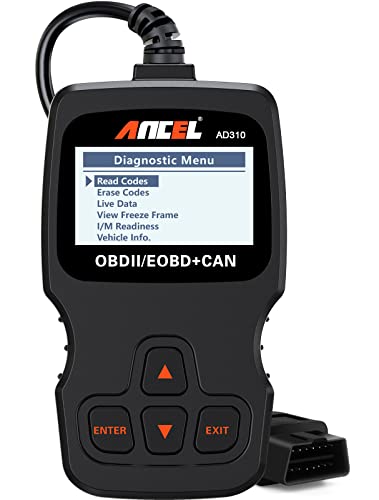
A check engine light tells a driver that something is wrong, but it does not say what, how serious it is, or whether the car is safe to keep driving. The ANCEL AD310 Classic Enhanced Universal OBD II Scanner is a wired handheld code reader built for exactly that moment. It plugs into the vehicle diagnostic port, reads the fault codes stored by the engine computer, shows each code with its definition, and clears the codes once the underlying fault has been repaired.
The AD310 keeps its scope deliberately narrow. It works on the engine system only, through the standard OBD2 functions that every compliant car supports. There is no phone app, no Bluetooth pairing, and no internal battery to charge, because the unit draws its power directly from the vehicle. That simplicity is the core of the product: a small tool that lives in a glove box and answers one question quickly, namely why the check engine light is on.
As an Amazon Associate, the publisher of this site earns a commission from qualifying purchases made through links on this page.
Quick Answer
The ANCEL AD310 is a wired, engine-only OBD2 code reader for owners of most 1996 and newer gasoline and diesel cars. It reads and clears fault codes, shows live data and freeze frame records, checks I/M readiness, and runs an EVAP leak test. It does not read ABS, airbag, or transmission systems, so drivers needing those systems should choose a different class of scanner.
Key Specs
| Spec | Detail |
|---|---|
| Brand | ANCEL |
| Model | AD310 |
| Product type | Wired handheld OBD2 code reader |
| Supported protocols | KWP2000, ISO9141, J1850 VPW, J1850 PWM, CAN |
| Display | 128 x 64 pixel LCD, white backlight, contrast adjustment |
| Controls | 4 buttons (Up, Down, Enter, Exit) |
| Cable length | 2.5 feet |
| Power source | Vehicle battery via OBD2 Data Link Connector, no internal battery |
| Operating voltage | 8.0 to 18.0 V |
| Operating temperature | 32 to 140 °F |
| Storage temperature | -4 to 158 °F |
| Vehicle coverage | Most 1996 and newer US-based, 2000 and newer EU-based, and 2005 and newer Asian OBD2 cars |
| Fuel and voltage limits | 12 V gasoline and diesel vehicles only |
| Languages | English, French, German, Spanish, Dutch, Finnish, Portuguese, Russian |
| Dimensions | not stated |
| Weight | not stated |
Who It’s For / Who Should Skip It
Who it’s for
The AD310 suits car owners who want to understand a check engine light before visiting a workshop, so a conversation about repairs starts from an actual code rather than a guess. It also suits drivers preparing for an emissions or smog inspection, because the I/M readiness function shows whether the vehicle monitors have completed their self-tests since codes were last cleared. Owners of older OBD2 cars benefit as well, since the reader supports all five standard OBD2 protocols, including the earlier J1850 and ISO9141 variants used by many vehicles from the late 1990s and early 2000s. Anyone who prefers a tool with no app, subscription, or battery maintenance will also find the plug-in design appropriate.
Who should skip it
Drivers who need to diagnose ABS brakes, airbags, automatic transmissions, or service reminders should skip this model, because it reads the engine system only and cannot access those systems. Owners of hybrid and fully electric vehicles should also look elsewhere, as ANCEL states the AD310 does not support them. The same applies to heavy trucks and vehicles without a standard 16-pin OBD2 port. Finally, anyone who wants graphed data on a large color screen, saved reports on a phone, or guidance through repairs will find the small monochrome display and code-focused menu too limited.
How It Compares With Typical Alternatives
Against basic code readers that only display a code number, the AD310 adds context: definitions appear on screen, freeze frame data shows the engine speed, load, and temperature recorded when the fault was set, and live data shows sensor values while the engine runs. Together they turn a bare code into a starting point for diagnosis.
Against Bluetooth dongles that pair with a phone, the AD310 trades screen size and data logging for independence. There is no app to install, no pairing step, and no phone battery involved; the unit powers up from the car and works as a single dedicated tool. The trade-off is real in both directions: phone-based tools present data more richly, while the wired reader is simpler and ready the moment it is plugged in.
Against full system scanners, the difference is scope rather than quality. Higher classes of scanner read ABS, airbag, transmission, and other control units, and some add service reset functions. The AD310 covers the standardized engine functions, including I/M readiness, EVAP leak testing, oxygen sensor testing, on-board monitor results, and vehicle information retrieval such as VIN, CIN, and CVN. For a single illuminated check engine light on a compliant car, that standardized set covers the task; for warning lights from other systems, it does not.
One caution applies to every code reader in this class, including this one. Clearing a code turns off the light and resets the readiness monitors, but it does not repair the fault. If the problem remains, the code returns after further driving, and freshly reset monitors need driving time before an emissions inspection.
FAQ
Does the ANCEL AD310 work on diesel cars?
Yes, within its stated limits. ANCEL lists support for 12 V diesel and gasoline cars that use a standard OBD2 protocol and a 16-pin connector. It does not support hybrid or electric vehicles, and coverage depends on the vehicle following its regional OBD2 standard.
Can the AD310 clear the check engine light?
Yes. After reading stored, pending, and historic codes, the reader can erase them, which turns off the malfunction indicator light and resets the monitors. The light will return if the fault that set the code has not been repaired, and erased monitors need driving time before an emissions test.
Does it read ABS or airbag codes?
No. The AD310 is an engine-system tool. It cannot read or clear codes for ABS, airbag (SRS), transmission, or oil service systems, and ANCEL states this limitation directly. Diagnosing those systems requires a scanner built for full-system coverage.
Does the AD310 need batteries or charging?
No. The unit has no internal battery and takes its power from the vehicle through the OBD2 Data Link Connector, within an operating voltage range of 8.0 to 18.0 V. It starts when plugged in and the ignition is switched on.
Final Verdict
The ANCEL AD310 does a defined job with few complications: plug it into an OBD2 port, read the engine fault codes with their definitions, check freeze frame and live data for context, confirm I/M readiness before an inspection, and clear codes after a repair. Full support for all five OBD2 protocols, a backlit screen, and power drawn from the car itself make it a practical glove-box tool for owners of compliant gasoline and diesel cars. Its limits are equally clear and stated openly by the manufacturer: engine diagnostics only, no ABS or airbag access, and no hybrid or electric vehicle support. Judged inside that scope, it is a coherent, focused reader; judged outside it, a different class of scanner is the right choice.