We independently review everything we recommend. When you buy through our links, we may earn a commission. As an Amazon Associate we earn from qualifying purchases.
Best Seedling Heat Mats: Five Picks for Even Germination, With and Without Thermostats
Compare five seedling heat mats by size, wattage, waterproofing, and thermostat control, from simple plug-in mats to digital combos for propagation shelves.
Compare five seedling heat mats by size, wattage, waterproofing, and thermostat control, from simple plug-in mats to digital combos for propagation shelves.
As an Amazon Associate, we earn from qualifying purchases made through links on this page.
Seeds germinate on their own schedule, and cold potting mix stretches that schedule out. Peppers, tomatoes, eggplant, and most flowers sprout fastest in warm soil, and a seedling heat mat supplies that warmth from below, holding the root zone roughly 10 to 20 degrees Fahrenheit above the surrounding room air. That small lift is often the difference between a tray that pops up evenly in a week and one that straggles in over three, with the late cells damping off while the early ones stretch toward the light.
The five products below are all seedling heat mats, but they split into two families. Fixed-output mats from VIVOSUN, BN-LINK, and Jump Start plug in and hold a steady band of warmth with no controls to set. Thermostat combos from VIVOSUN and AC Infinity add a probe and a digital controller, so the mat cycles to hold a soil temperature you choose. Which family suits you depends on how steady your room temperature is and how fussy your crops are. Every pick is sized around the standard 1020 propagation tray, is built to shrug off watering splashes, and carries a recognized electrical certification.
What to look for in a seedling heat mat
Size against your trays. The standard 1020 flat measures about 10 by 20 inches, and most mats in this class are cut at 10 by 20.75 inches to cover one flat end to end. The Jump Start mat is slightly smaller at 8.875 by 19.5 inches, which suits windowsill trays and narrower flats but leaves the rim of a full 1020 uncovered. Measure your tray before ordering; a mat that overhangs the tray edge wastes heat and curls, and one that falls short leaves cold corners where germination lags.
Wattage and what it buys. Mats in this size draw between 17 and 20 watts. That sounds trivial, and the running draw is genuinely small, but wattage is what lets a mat hold its temperature lift when the room cools overnight. A 20-watt mat keeps its band of warmth in a chilly garage or basement more reliably than a lower-output mat. None of these products is a room heater; they warm the tray sitting on them and little else.
Fixed output or a thermostat. A fixed-output mat warms the root zone a set amount above ambient air, so the soil temperature drifts with the room. In a heated house that drift is harmless for most vegetables. A digital thermostat with a probe pushed into the mix holds a chosen setpoint instead, which matters for peppers and other crops with a narrow germination window, and it protects against overheating on a warm afternoon. The trade-off is cost, an extra cable, and one more thing to set. If you buy a plain mat now, a plug-in thermostat controller can be added later, as the VIVOSUN combo below shows.
Waterproofing and construction. Seed trays get watered, misted, and occasionally flooded. Look for sealed PVC construction with a published IP code: the BN-LINK and AC Infinity mats carry IP67 waterproofing, and the VIVOSUN mats use a sealed waterproof build. Waterproofing here means splashes and wipe-downs are fine; it does not mean the mat or its cord should sit submerged in a flooded tray. Heat-bonded seams, like the ones Hydrofarm uses on the Jump Start, keep moisture out of the heating element over seasons of use.
Certification. A heat-producing appliance that lives under wet soil should carry a listing from a recognized lab. The mats below are UL listed, MET certified, or ETL listed depending on the model, and that mark is printed on the mat itself.
Placement rules that apply to every mat. Put the mat on a hard, flat, dry surface, never on carpet or bedding. Do not cover it with insulating material, do not fold or crease it, and set the tray directly on top. Once seeds sprout, most crops come off the heat or get a lower setting, because warm soil after emergence encourages leggy growth and fungal trouble.
This is the plain mat that anchors the category: a 10 by 20.75 inch pad drawing 20 watts at 120 volts, sized to sit under one standard flat. VIVOSUN builds it from sealed PVC layers with the heating element spread across the full surface, and the mat is MET certified and waterproof, so overhead watering and misting are not a concern. Like most fixed-output mats, it is designed to warm the rooting area 10 to 20 degrees Fahrenheit above the ambient temperature of the room.
Because there is no control to set, using it well is about placement. In a room that sits in the high sixties, the soil lands in the band most vegetables want. The mat rolls up for storage between seasons, and the surface wipes clean.
Who it suits: growers sowing one or two trays at a time in a heated house, who want plug-in warmth with nothing to program.
Limitations: with no thermostat, soil temperature follows the room. In a cold garage the lift may not reach pepper-germination warmth, and in a warm room it can push past the preferred band for lettuce and other cool-season crops. A separate plug-in controller fixes that later, but it is not in this box.
BN-LINK’s mat covers the same 10 by 20.75 inch footprint at 20 watts, and it leans harder on durability. The construction is flexible multilayer PVC around the heating wire, with IP67 waterproofing that shrugs off splashes and sprays, and the mat is ETL listed. BN-LINK prints a germination guide directly on the surface, with approximate days to sprouting for common vegetables, which is genuinely handy when the mat lives under a tray for weeks at a time.
The printed chart aside, this is the same simple formula as the VIVOSUN: plug it in and it holds its warming band above room temperature. The PVC skin is thick enough to resist the scuffs of trays sliding on and off, and it wipes clean between crops.
Who it suits: growers who water from above, run trays in a greenhouse or potting shed where splashes are routine, and want the toughest skin in this group.
Limitations: also fixed output with no controller included, so the same room-temperature drift applies. The printed chart gives general guidance only; crop-specific temperatures still come from the seed packet. Growers who later want setpoint control need to buy a thermostat controller separately.
This set pairs the VIVOSUN mat above with the company’s digital thermostat controller, and the pairing changes what the mat can do. The controller’s probe pushes into the potting mix, the display shows the soil temperature it reads, and you set a target anywhere in the controller’s 40 to 108 degree Fahrenheit range. The mat then cycles on and off to hold that setpoint instead of floating above the room.
That control is what slow, expensive, or heat-demanding seed wants. Peppers that sulk below the mid-seventies can sit at a steady setting, and the controller cuts power on a sunny afternoon when a fixed-output mat would keep climbing. The mat itself keeps the same 20-watt, waterproof, MET certified build, and the combo carries UL and MET certification as a set.
Who it suits: pepper, eggplant, and flower growers, and anyone sowing in an unheated room where ambient temperature swings widely between day and night.
Limitations: one controller runs the mat plugged into it, so a shelf of several mats needs either several controllers or mats grouped under a controller rated for the combined load, which you should confirm on the listing before wiring anything together. The probe reads one spot, so a tray at the far end of a long bench is not individually monitored.
Hydrofarm’s Jump Start line is the old name in this category, and the MT10006 is its smaller mat: 8.875 by 19.5 inches, 17 watts, and UL listed. Hydrofarm rates it to warm the root area 10 to 20 degrees Fahrenheit over ambient, builds it with heat-bonded seams rather than glued ones to keep moisture sealed out, and fits a 6-foot power cord, longer than most, which helps when the only outlet sits across the bench.
The smaller footprint is the point. It matches windowsill trays, half flats, and the narrow seed trays sold for kitchen herbs, and it tucks onto a shelf where a full 10 by 20.75 inch mat would overhang. Construction is noticeably heavier than the budget mats, at half again the thickness Hydrofarm quotes for its design, which suits a mat that gets moved and re-rolled often.
Who it suits: windowsill and small-batch growers, herb trays, and anyone whose trays are narrower than a standard 1020 flat.
Limitations: on a full-size 1020 tray the uncovered rim runs cooler, so germination across the tray can be uneven. Output is fixed with no controller included, and the smaller surface means one mat per small tray rather than one mat under a big flat.
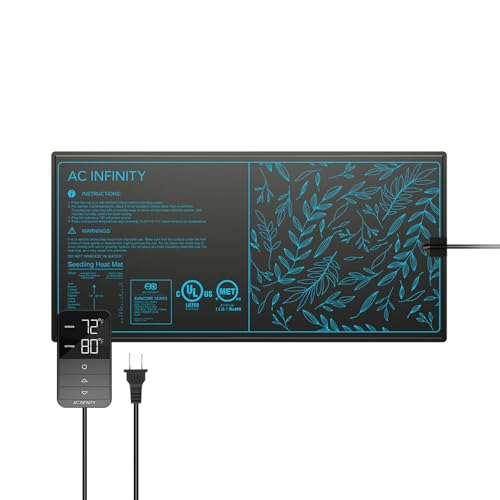
The SUNCORE H3 is AC Infinity’s current thermostat mat in the standard size. Instead of a wire element, it heats through a far-infrared film spread across the mat, a design the company uses to even out hot spots. The digital controller sets temperatures across a 32 to 122 degree Fahrenheit range, wider than the VIVOSUN controller’s, with the probe reporting the soil temperature on its display. The mat itself is quad-layer PVC with IP67 waterproofing.
The wide controller range is more than germination needs, and that is fine; it also covers warming duties like proofing and fermentation that stay within the same hardware. For seed work, the useful part is the precise end of the range, where the controller holds a setpoint steadily and the film element avoids the warm stripe pattern a wire mat can print onto the bottom of a tray.
Who it suits: growers who want setpoint control with the widest adjustment range in this group, and anyone standardizing on one mat model across several benches.
Limitations: the controller adds a cable and a small box to keep dry on a wet bench. The range extending far past germination temperatures means a careless setpoint can cook seed, so the display deserves a second look after any adjustment. As the newest line here, it also has the shortest track record of the five.
Comparison table
Product
Size
Power
Thermostat
Waterproofing
Certification
VIVOSUN Seedling Heat Mat
10 x 20.75 in
20 watts
None, fixed output
Sealed waterproof build
MET certified
BN-LINK Seedling Heat Mat
10 x 20.75 in
20 watts
None, fixed output
IP67
ETL listed
VIVOSUN Heat Mat and Thermostat Combo
10 x 20.75 in
20 watts
Digital, 40 to 108 degrees F
Sealed waterproof build
UL and MET certified
Jump Start MT10006
8.875 x 19.5 in
17 watts
None, fixed output
Sealed, heat-bonded seams
UL listed
AC Infinity SUNCORE H3
10 x 20.75 in
Not published for this listing
Digital, 32 to 122 degrees F
IP67
Check listing for current marks
Frequently asked questions
Do I need a thermostat with a seedling heat mat?
Not for most vegetables in a heated house. A fixed-output mat holds the soil a steady band above room temperature, which is enough for tomatoes, squash, and most flowers. A thermostat earns its place with peppers and other crops that want a specific soil temperature, and in unheated rooms where the temperature swings.
How warm does the soil actually get on a fixed-output mat?
The manufacturers of the VIVOSUN and Jump Start mats rate them to warm the root zone 10 to 20 degrees Fahrenheit above the ambient air. In a 65-degree room, expect soil roughly in the mid-seventies to mid-eighties, which is why room temperature matters as much as the mat.
What size mat fits a standard seed tray?
A standard 1020 flat is about 10 by 20 inches, so a 10 by 20.75 inch mat covers it fully. The smaller Jump Start mat fits windowsill and half-size trays; on a full flat it leaves a cooler rim.
Can a heat mat stay plugged in around the clock?
These mats are built for continuous use during the germination period, following the maker directions: hard flat surface, no insulating cover, tray directly on top. Check the setup daily, keep the cord and controller dry, and unplug the mat when the crop comes off the heat.
When do seedlings come off the mat?
For most crops, at emergence. Continued bottom heat after sprouting pushes soft, leggy growth and favors fungal problems in warm wet mix. Some growers keep heat-loving crops on a reduced setting a little longer; a thermostat combo makes that adjustment simple.
Conclusion
For a single tray in a warm house, the plain VIVOSUN or BN-LINK mat is the whole answer, with the BN-LINK’s IP67 skin ahead for wet benches. For peppers, slow flowers, or an unheated room, step up to a thermostat combo: the VIVOSUN set for a proven pairing, or the AC Infinity SUNCORE H3 for the wider control range and film heating. The Jump Start MT10006 covers the smaller trays the others overhang. Match the mat to your tray size first, then decide how much temperature control your crops actually need.
A
admin
We compare specs, materials and verified owner reviews before a product earns a spot. Rankings are never paid.
Affiliate disclosure. As an Amazon Associate we earn from qualifying purchases at no extra cost to you. Prices accurate as of the date shown.
Compare four well-built lawn mowers, from steel-deck battery mowers to a simple manual reel, and pick the model that fits your yard and mowing routine.
Compare Tork paper towel cases by sheet count, fold type and dispenser fit: multifold packs plus H1, H21 and H80 rolls, judged on total towels per case.
Four oil extractors sized for lawn mower sumps, compared on maker-stated tank capacity, pump type and tube fit for cleaner small-engine oil changes at home.
Wet, soggy lawn? These self-propelled mowers use all-wheel or rear-wheel drive, tall rear wheels and washout ports to grip soft ground and clear wet clippings.
Compare the best oil additive for lawn mowers, from thick stabilizers for older engines to cleaners for stored machines, with sizes and doses explained.
Find the best lawn mowers for very tall grass, with high cutting heights, strong motors and self-propelled drive to clear an overgrown yard in fewer passes.
The best new lawn mowers for 300-dollar budgets compared: cordless, gas, corded and reel picks with deck sizes, runtimes and upkeep notes for small yards.
Find the best motorcycle GPS mounts for riders — handlebar, AMPS and ball mounts for Garmin Zumo and TomTom Rider units, with fitment and vibration notes.


 VIVOSUN Seedling Heat Mat, 10 x 20.75 Inch
 BN-LINK Seedling Heat Mat, 10 x 20.75 Inch
 AC Infinity SUNCORE H3 Seedling Mat, 10 x 20.75 Inch