Key takeaways
- Four oil extractors sized for lawn mower sumps, compared on maker-stated tank capacity, pump type and tube fit for cleaner small-engine oil changes at home.
As an Amazon Associate, we earn from qualifying purchases made through links on this page.

Changing the oil in a lawn mower is a smaller job than changing the oil in a car, and it deserves a smaller tool. A walk-behind mower engine typically holds somewhere between 15 and 20 fluid ounces of oil, and many riding mower engines hold between 1.5 and 2 quarts. A six-liter extractor tank built for car sumps works, but it is bulky to store, slow to build vacuum in, and harder to pour from when it holds less than a pint of used oil. The extractors in this guide are the ones sized for the job: compact tanks between 1.6 and 2.5 liters, hand pumps and one small pneumatic unit, all documented by their makers for small four-cycle engines such as the ones in mowers, garden tractors, and snow blowers.
Extraction also solves a mower-specific problem. Many walk-behind mowers have no drain plug you can reach without tipping the machine on its side, and tipping risks fuel and oil spills, a soaked air filter, and a pull cord that suddenly feels much heavier. An extractor pulls the oil out through the dipstick tube from above, so the mower stays flat on its wheels. This guide covers only extractors sized and documented for small engines; general-purpose extractors for car sumps are a different, larger class of tool. Every specification below comes from the maker of that product, and where a maker does not publish a figure, such as a tube diameter, the section says so rather than guessing.
What to look for
Tank capacity against sump size. The tank needs to hold the whole sump with room to spare, because vacuum weakens as the tank fills. For a walk-behind mower holding under 20 fluid ounces, even the smallest tank here is generous. For a riding mower, add up the engine’s stated oil capacity first: a 1.6-liter tank can mean emptying mid-job on a twin-cylinder engine that holds close to 2 quarts, while a 2.5-liter tank swallows that sump in one pass.
How the vacuum is built. Three of the four picks use a hand pump: you work the handle to build vacuum, then open a valve and the oil travels up the tube. Hand pumps need no power and no other equipment, which suits a shed or a garage corner. The fourth pick is pneumatic and builds vacuum from shop air through a venturi fitting, which is quicker and steadier but ties the job to an air compressor. There is no electric pick in this group, because the compact 12-volt pumps sold for this work move oil into a container you supply rather than a sealed tank, and none of the small-engine makers documents one for mower use as clearly as the four designs below.
Tube diameter and reach. The probe has to pass down the dipstick tube and reach the bottom of the sump. Small engines have narrow dipstick tubes, so a thin probe matters more here than it does on a car. Where a maker publishes probe dimensions, they are listed in that product’s section. A probe that stops short, or a dipstick tube with a sharp bend, leaves oil behind regardless of pump strength.
Warm-oil limits. Warm oil flows far more freely than cold oil, so every maker advises running the engine briefly before extraction. The limits differ, though. One pick below caps the fluid temperature at 105 degrees Fahrenheit in its manual, which means oil that is only slightly warm; others simply advise warming without a stated ceiling. Follow the limit for the tool you own, because hot oil can distort a plastic tank.
Fluid limits. An oil extractor is not a fuel pump unless its maker says it is. One pick below is listed by its maker for fuel transfer as well as oil; another forbids gasoline outright in its manual. Check the fluid list for your model before using it for anything except engine oil, and never use any of them for hot liquids beyond the maker’s stated limit.
1. Briggs & Stratton 5430K Oil Extractor Kit (1.6 Liter)
Briggs & Stratton builds more small engines than anyone, and the 5430K is its own answer to draining them: a manual vacuum pump kit with a 1.6-liter collection tank, sized for the sumps of the engines the company sells. You pump the handle to build vacuum, place the extraction tube down the dipstick tube, and the used oil is drawn into the tank. The maker’s listing describes the kit as working with most four-cycle engines on lawn mowers, tractors, and snow blowers, and the company’s own store describes it as an oil removal kit for outdoor power equipment. Because it comes from an engine maker rather than a tool brand, the fitment guidance is written in engine terms, which is exactly how a mower owner thinks about the job.
Specs, per the maker:
- Capacity: 1.6 liters
- Operation: manual vacuum hand pump
- Extraction path: through the dipstick tube
- Documented fitment: most four-cycle engines on lawn mowers, tractors, and snow blowers
- Tube diameter: not published in the maker’s listing material
Who it is for: owners of walk-behind mowers and single-cylinder riders who want the kit an engine manufacturer documents for its own engines, in a tank that stores easily on a shelf. Limitations: 1.6 liters is the smallest tank in this group, so a twin-cylinder riding mower holding around 2 quarts will need the tank emptied partway through the job. The maker does not publish the extraction tube’s outside diameter, so if your engine has an unusually narrow dipstick tube, confirm the fit before relying on it.
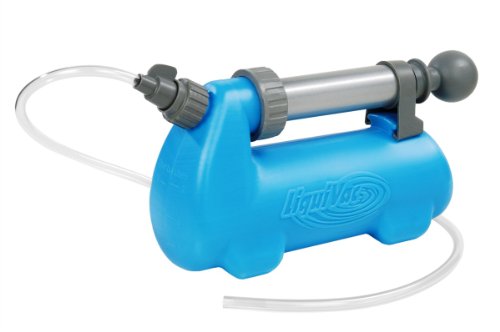
2. LiquiVac 2005LV Oil Changing System for Small Engines
The LiquiVac small-engine model, sold under the FloTool brand by the Airpower America line, is a 3-quart hand-pumped extractor built specifically for four-cycle small engines: lawn mowers, garden tractors, tillers, generators, and snow throwers. The design is a sealed tank with a pump handle on top and a cap-valve that twists open and closed. Per the maker’s manual, you close the valve, work the handle for 20 to 30 strokes to build vacuum, insert the clear hose into the dipstick tube, then twist the valve open and watch the oil flow into the tank. The 3-quart capacity is the largest in this guide, which makes it the natural pick for riding mowers and for owners who service several small engines in one afternoon.
Specs, per the maker:
- Capacity: 3 quarts (about 2.8 liters)
- Operation: manual vacuum hand pump, 20 to 30 strokes per the manual
- Fluid temperature limit: do not use with oil over 105 degrees Fahrenheit, per the manual
- Warm-up guidance: run a cold engine for 1 to 2 minutes before extraction, per the manual
- Fluid limits: never use with gasoline or other flammable liquids, per the manual
Who it is for: riding mower owners and anyone maintaining a fleet of small engines who wants the biggest small-engine tank and a valve-controlled flow they can stop instantly. Limitations: the 105-degree ceiling in the manual is strict — the oil may only be slightly warm, so extraction runs slower than it would with fully hot oil, and the manual warns that hotter fluid can distort the tank. The manual also stresses that the cap and pump gaskets must seal well, because a leaking gasket means lost vacuum and more pumping.
3. Pela PL-2000 Oil Extractor (2.5 Liter)

Pela’s PL-2000 is the scaled-down version of the maker’s larger extractors, and the maker names homeowners with lawnmowers and other power equipment directly in its description of the model. The container holds 2.5 liters, is see-through with calibration marks so you can see how much oil came out, and needs only 5 to 10 pump strokes to build a strong vacuum — noticeably fewer strokes than the other hand pumps here. Pela is also the one maker in this group that publishes full tube dimensions: a slim probe of 3/16 inch outside diameter and 43 inches long, feeding a clear tube of 3/8 inch outside diameter and 39 inches long. That thin probe is the best documented answer in this guide to narrow small-engine dipstick tubes.
Specs, per the maker:
- Capacity: 2.5 liters (2.64 quarts)
- Operation: manual vacuum hand pump, 5 to 10 strokes per the maker
- Probe: 3/16 inch outside diameter, 43 inches long
- Clear tube: 3/8 inch outside diameter, 39 inches long
- Container: see-through, calibrated, 17.5 inches tall assembled
Who it is for: owners who want the fewest pump strokes, a visible fill level, and a published thin probe for tight dipstick tubes — a strong match for walk-behind mowers and mid-size riders alike. Limitations: the probe is a slim, fairly rigid tube, so a dipstick tube with a sharp bend can still block it, as with any extractor. At 2.5 liters the tank covers nearly every mower sump, but owners of the largest twin-cylinder riders should still check their engine’s stated capacity first.
4. Mityvac MV7430 Mini Fluid Evacuator
The MV7430 is the different tool in this group: a mini evacuator from Mityvac that runs on compressed air instead of a hand pump. Shop air passing through its venturi fitting builds the vacuum, a thumb throttle varies the suction, and the extracted oil collects in an integrated reservoir of 1.9 quarts (1.8 liters). The maker lists automatic overflow prevention, a swivel air inlet, and a muffled exhaust, and states a working pressure range of 60 to 150 psi. That reservoir size sits right in mower territory — enough for a walk-behind sump several times over, or one riding mower sump — and the air-driven vacuum does not fade the way a hand-built vacuum can during a slow drain.
Specs, per the maker:
- Capacity: 1.9 quarts (1.8 liters) integrated reservoir
- Operation: pneumatic, venturi vacuum from compressed air
- Working pressure: 60 to 150 psi, per the maker
- Controls: variable thumb throttle, swivel air inlet
- Features: automatic overflow prevention, muffled exhaust
Who it is for: mower owners who already run an air compressor in the garage and want extraction with no pumping at all, plus a reservoir matched to small sumps rather than car sumps. Limitations: without shop air the tool does nothing — there is no hand-pump fallback, unlike the other three picks. The 1.8-liter reservoir can also mean a mid-job empty on the largest riding mower engines, and a compressor hose tethers you to the garage rather than the shed or the yard.
How these extractors compare
| Product | Tank capacity | Operation | Tube information | Standout point |
|---|---|---|---|---|
| Briggs & Stratton 5430K | 1.6 liters | Manual hand pump | Diameter not published by maker | Documented by an engine maker for its engines |
| LiquiVac 2005LV | 3 quarts | Manual hand pump, valve controlled | Clear hose into dipstick tube | Largest tank sized for small engines |
| Pela PL-2000 | 2.5 liters | Manual hand pump, 5 to 10 strokes | Probe 3/16 in OD x 43 in | Published thin probe, calibrated clear tank |
| Mityvac MV7430 | 1.9 quarts (1.8 liters) | Pneumatic, needs shop air | Evacuation hose for tight spaces | No pumping, steady venturi vacuum |
The pattern is simple. Capacity decides whether a riding mower sump fits in one pass: the LiquiVac and the Pela hold the most, the two smaller tanks may need an emptying pause on big twin-cylinder engines. Effort decides the rest: the Pela asks for the fewest strokes, the LiquiVac trades more strokes for its valve control and capacity, the Briggs & Stratton kit keeps things basic and engine-maker approved, and the Mityvac removes effort entirely at the cost of needing a compressor.
FAQ
Does an extractor remove all the oil from a mower engine?
On engines with a straight dipstick tube that the probe can follow to the bottom of the sump, extraction removes nearly all of it. Baffles or a sharply bent tube can leave a small amount behind. If your mower has a drain plug, draining once the conventional way and comparing the volume tells you how complete extraction is on your engine.
Can I use one extractor for both a walk-behind and a riding mower?
Yes, if the tank holds the larger sump. A walk-behind sump of 15 to 20 fluid ounces fits in any tank here. For a riding mower, match the tank to the engine’s stated oil capacity: the 3-quart LiquiVac and the 2.5-liter Pela cover the common 1.5 to 2 quart range in one pass, while the two smaller tanks may need emptying partway through.
Do I still need to tip the mower or remove the drain plug?
No. That is the point of extraction: the oil leaves through the dipstick tube with the mower flat on its wheels, which avoids the spills and soaked air filters that tipping can cause. Warm the engine briefly first, shut it off, and respect the fluid temperature limit in your extractor’s manual.
Can these pumps move fuel as well as oil?
Only where the maker says so. Briggs & Stratton lists its 5430K kit among tools for oil removal on outdoor power equipment and its store material describes broader fluid use, while the LiquiVac manual states plainly: never use it with gasoline or other flammable liquids. Treat each model’s own fluid list as the rule, and use a dedicated, approved fuel container and siphon for fuel work if your extractor’s maker does not document it.
Conclusion
For most mower owners, the Pela PL-2000 is the balanced pick: a 2.5-liter calibrated tank, the fewest pump strokes in the group, and a published thin probe that suits narrow dipstick tubes. Choose the LiquiVac 2005LV if you run a riding mower or several small engines and want the largest small-engine tank with valve-controlled flow, and keep its 105-degree fluid limit in mind. The Briggs & Stratton 5430K suits owners who prefer the kit documented by their engine’s own maker and have a smaller sump to drain. The Mityvac MV7430 is the pick when a compressor already lives in your garage and you would rather hold a throttle than work a pump handle. Match the tank to your sump, confirm the probe reaches, and any of the four turns a mower oil change into a job done standing up, with the mower flat on its wheels.