Key takeaways
- Compare soaker hoses for garden beds, with flat weepers, round rubber hoses and linkable kits that soak roots slowly without wasting water outdoors.
A soaker hose changes how a garden bed drinks. Instead of spraying leaves and paths, it seeps water straight into the soil at the roots, where plants can use it. That slow delivery keeps foliage dry, cuts evaporation on hot afternoons, and lets you water a whole bed while you do something else. The hard part is choosing among flat weepers, round rubber hoses, and linkable kits that all promise the same gentle soak.
This guide is for home gardeners who water vegetable rows, flower beds, and raised beds by hand and want a simpler routine. It covers five soaker hoses picked from Amazon listings, chosen for different bed shapes, lengths, and layouts: two flat weepers that snake between rows, two rubber kits with fittings for custom runs, and one long linkable kit for very large gardens. Each pick below lists its length, material, and fittings from its listing, so you can match a hose to the beds you actually water.
Quick Picks
As an Amazon Associate we earn from qualifying purchases
| Product | Best for | Key spec from title |
|---|---|---|
| Gilmour 75 ft Flat Weeper | Long straight rows | 75 ft flat vinyl hose with fabric cover |
| Melnor 75 ft Flat Soaker | Tight beds and easy storage | 75 ft flat hose that folds to shoebox size |
| Swan Miracle-Gro Soaker System 75 ft | Custom layouts with fittings | 75 ft rubber hose with push-on fittings |
| Swan Miracle-Gro Soaker System 100 ft | Large beds and long runs | 100 ft rubber hose with full fitting kit |
| Secbulk 200 ft Linkable Kit | Very large gardens | 200 ft in four linkable 50 ft sections |
How to Choose
Hose shape: flat or round
Flat hoses lie low and snake easily between straight vegetable rows, and they fold down small for winter storage. Round hoses hold their shape better around shrubs, trees, and curved borders, and they usually feel sturdier underfoot when you step near a bed. A flat weeper suits a tidy row garden where you lay the hose once and leave it for the season. A round hose suits a mixed border where you move it between plantings. Think about the beds you water most: straight rows reward a flat profile, while curves and woody plants reward a round one that keeps its form.
Length and layout
Measure the beds before you buy, because a hose that is too short leaves dry ends and one that is too long wastes water on paths. A 50-foot run covers a single large bed or a row of containers, while 75 feet suits two beds side by side. For long borders, a 100-foot hose or a linkable kit avoids joining several short hoses with extra couplings. Linkable sections let you add length later as beds grow, and they let you split one kit across two areas. Check whether the hose can connect to another hose at its far end, since an end cap that blocks linking limits your layout.
Material and pressure
Soaker hoses come in vinyl, rubber, and polyurethane, and each material behaves differently in a garden. Vinyl is light and easy to coil, but it can kink if you bend it sharply around a corner. Recycled rubber is heavier and tougher, holds up well under mulch, and stays put in wind. Polyurethane sits between the two, flexing easily while resisting cracks. Every soaker hose has a working pressure range, and exceeding it can split the wall or turn a gentle seep into a spray. Open the tap slowly, use a pressure reducer if your spigot runs strong, and watch the first run to confirm the water seeps rather than jets.
Fittings and upkeep
A soaker hose is only as useful as its connections. Look for standard three-quarter-inch fittings that match your spigot and timer, and check whether the kit includes tees, plugs, and end caps for branching a layout. Push-on fittings let you cut a hose and rebuild a run without tools, which matters when beds change shape each year. For upkeep, drain the hose before cold weather, coil it loosely, and store it out of direct sun. A screen filter at the spigot keeps sediment from clogging the tiny pores, and flushing the hose once a season clears the buildup that slows a seep.
The 5 Best Options
1. Gilmour 75 ft Flat Weeper

The Gilmour flat weeper is a simple, proven shape for straight beds: a 75-foot vinyl hose wrapped in a fabric jacket that lets water seep out along its whole length. It lies flat between rows, so you can snake it through vegetables without it rolling away, and the fabric cover shields the inner tube from sun while spreading the seep evenly. Gardeners who water long, straight runs like how little setup it needs — unroll it, connect it, and turn the tap on low. Its light weight makes it easy to move between beds, and it folds down small when the season ends.
Specs
- 75 feet long, flat profile
- Vinyl body with clog-resistant fabric cover
- Black color
- Item weight 2 pounds
- Model 870751-1001
- 7-year manufacturer warranty
Best for: Long straight vegetable rows and flower beds that need an even, low soak.
Watch out for: The inner tube can split if water freezes inside, so drain it before cold weather.
ASIN: B001IKU3QM
2. Melnor 75 ft Flat Soaker

The Melnor flat soaker is the lightest hose in this group, and that lightness shows in how it handles. At 75 feet it covers a wide bed, yet it folds down to a bundle that fits on a shelf, which suits gardeners with shed space. Its flat body slips between rows and under a thin layer of mulch, and the pores along its length release water slowly where roots can reach it. The hose works best at gentle pressure, so pair it with a timer and a soft touch at the tap. Its main trade-off is durability: vinyl folds easily but needs care around sharp edging and hot sun.
Specs
- 75 feet long, flat profile
- Model 65160AMZ
- UPC 042206651600
- Outside diameter 0.5 inches
- Plastic body in black and brown
- Item weight 1.07 kilograms
- Folds flat for compact storage
- 2-year manufacturer warranty
Best for: Small sheds and tight beds where a hose must fold away small.
Watch out for: Pores can clog with hard water, so a screen filter at the spigot helps.
ASIN: B09YDR76P5
3. Swan Miracle-Gro Soaker System 75 ft

The Swan Miracle-Gro system is a kit rather than a single hose, and that changes what you can build. The 75-foot rubber hose comes with push-on fittings that let you cut it and branch it into several runs, so one kit can water separate beds from a single spigot. Its three-eighths-inch rubber body is heavier than vinyl, which helps it stay in place under mulch and through wind. Water moves through at a slow rate per foot, soaking roots without wetting leaves. The kit suits gardeners who rearrange beds often, since fittings can be swapped when a layout changes.
Specs
- 75 feet long, 3/8 inch diameter
- Rubber body, black color
- Item weight 4 pounds
- Model MGSPA38075CC
- UPC 078627913836
- Push-on EZ-Connect fittings for custom layouts
- 7-year manufacturer warranty
Best for: Gardeners who want to cut and branch one kit across several beds.
Watch out for: The rubber body is heavy, so moving a full run takes more effort.
ASIN: B00ED89R0O
4. Swan Miracle-Gro Soaker System 100 ft
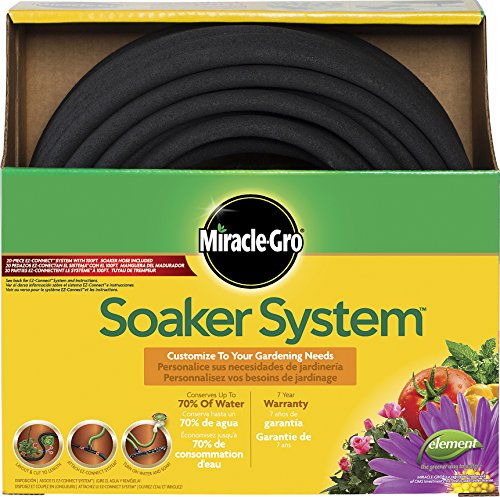
The 100-foot Swan system takes the same kit idea and stretches it across a bigger garden. It ships with enough connectors, feeders, plugs, and tees to split the run into branches, so a long border or two large beds can share one spigot. Its recycled rubber body holds up under mulch, and the built-in restrictor keeps flow gentle along the full length. The extra length is the point here: where a 75-foot hose ends, this one keeps going. It suits a gardener with a long border or several beds in a row who wants one kit to cover them all.
Specs
- 100 feet long, 3/8 inch diameter
- Recycled rubber body
- Black color
- Item weight 2 pounds
- Model MGSPAK38100CC
- UPC 078627913850
- Flow 0.5 to 1 gallon per foot per hour
- Lead-free, meets Federal Safe Drinking Water Act
- 7-year manufacturer warranty
Best for: Long borders and large beds that need one long run with branches.
Watch out for: Long runs need decent spigot pressure, or the far end may seep weakly.
ASIN: B00F0R6WLE
5. Secbulk 200 ft Linkable Kit

The Secbulk kit is built for gardens that outgrow a single hose. Four 50-foot flat sections link end to end for 200 feet of coverage, and stakes hold the runs in place along borders and fence lines. Each section is a dual-layer vinyl hose, so the kit resists leaks at the joints while staying light enough to reposition. You can split the sections across beds or join them for one long run, which makes it the most flexible layout in this group. It suits a large garden where one hose never quite reaches the far bed.
Specs
- 200 feet total, four 50-foot linkable sections
- Vinyl body, dual-layer leak-free design
- Stakes included
- Maximum pressure 90 PSI
- UPC 760701307425
- Item weight 3.75 kilograms
Best for: Very large gardens and long borders that need linked sections.
Watch out for: Long linked runs need good pressure planning, or the far end may run dry.
ASIN: B0D4XX79XJ
Which One Fits Your Situation
A small raised bed
One short flat hose is enough for a single raised bed. The Melnor 75-foot hose folds away small, and the Gilmour weeper lies flat between rows without rolling. Either one waters a bed fully with a single straight run, and neither needs extra fittings. Keep the tap low, tuck the hose under mulch, and let it seep while you work elsewhere.
A vegetable garden with straight rows
Straight rows reward a flat weeper. The Gilmour hose snakes down a row and stays put, while the Melnor hose folds small between plantings. Both release water along their length, so a whole row drinks evenly. Lay the hose at the base of the plants, cover it lightly with mulch, and water in the morning so leaves stay dry through the day.
A large garden with several beds
Several beds call for fittings and branches. The Swan 75-foot or 100-foot kit lets you cut one hose into runs for each bed, with tees and plugs to shape the layout. The 100-foot kit suits two large beds from one spigot, while the 75-foot kit suits a smaller cluster. Plan the branches on paper first, then cut once and connect.
A very large plot or long border
Very large plots need length and links. The Secbulk kit joins four 50-foot sections for 200 feet of coverage, and its stakes keep long runs in place. Split sections across borders or join them for one long fence line. Check your spigot flow first, since a long linked run needs enough water to reach the far end.
Common Mistakes
- Running full spigot pressure through a soaker hose, which can split the wall or turn a seep into a spray.
- Laying a hose across a path where feet and wheels crush the pores.
- Burying a flat weeper too deep, so water never reaches the roots near the surface.
- Skipping a screen filter, letting sediment clog the tiny pores over a season.
- Leaving water in the hose through a freeze, which can crack the inner tube.
Frequently Asked Questions
Can a soaker hose replace a sprinkler?
For beds and rows, yes. A soaker hose delivers water at the roots, so less evaporates and leaves stay dry, which suits vegetables and flowers. A sprinkler still wins for lawns, where water must cover a wide open area evenly. Use a soaker hose where plants grow in beds and rows, and keep a sprinkler for turf.
How long should I run a soaker hose?
Most beds need a slow soak of one to two hours, once or twice a week, depending on soil and heat. Sandy soil drains fast and may need shorter, more frequent runs, while clay holds water longer. Check the soil with a finger: damp to a few inches down means the soak worked, while dry soil means the run was too short.
Can I connect a soaker hose to a timer?
Yes, and a timer is the easiest way to water on a schedule. Fit the timer at the spigot, then connect the soaker hose to it, and set short, slow runs in the morning. Keep the tap open only a little if your hose weeps too hard, and check the first run to confirm the water seeps along the whole length.
How do I keep a soaker hose from clogging?
Fit a small screen filter at the spigot to catch sediment before it reaches the pores. Flush the hose once a season by running clean water through it with the far end open. Drain it fully before winter, coil it loosely, and store it out of direct sun so the material stays supple for the next season.