Key takeaways
- Compare rain gauges for gardens and yards, with analog tubes, wireless digital stations and large easy-read numbers that track every rainfall.
A rain gauge turns guesswork into a number you can act on. Gardeners who water by feel often soak beds that already hold enough moisture, while others let soil dry out between storms because no one measured what actually fell. A gauge mounted in an open spot records each shower in inches, so watering, fertilizing, and drainage decisions rest on measured rainfall instead of memory or a glance at wet pavement.
This guide covers five standalone gauges for gardens and yards, chosen from listing details on their Amazon pages. The set spans a magnifying acrylic tube, a wireless digital model with an indoor display, a tall fence-mounted tube, a flexible silicone tube that handles freezing water, and a glow-marked tube for low-light reading. Each one suits a different yard, a different way of checking rainfall, and a different tolerance for maintenance.
Quick Picks
As an Amazon Associate we earn from qualifying purchases
| Product | Best for | Key spec from title |
|---|---|---|
| AcuRite 5-Inch Magnifying Rain Gauge | Reading totals from across the yard | 5-inch acrylic tube, magnified numbers |
| AcuRite Wireless Digital Rain Gauge 00899 | Checking rainfall indoors | Self-emptying collector, 100-foot wireless range |
| Outdoor Home 6-Inch Rain Gauge | Fence and post mounting | Dual-scale tube, polycarbonate build |
| Taylor 7-Inch Silicone Rain Gauge | Cold climates and frozen water | Flexible silicone tube, 7-inch capacity |
| Taylor Glow-in-the-Dark Rain Gauge | Low-light and evening checks | Glow markings, 6-inch capacity |
How to Choose
Capacity and Measurement Scale
Capacity decides how often you empty the tube. A 5-inch gauge covers most single storms, while a 7-inch tube holds a multi-day stretch of rain without overflow. Look at the smallest graduation too: tenth-inch marks give useful precision for garden watering, while coarser marks suit only rough tracking. A dual scale in inches and millimeters helps when comparing notes with neighbors or weather reports that use metric units. Pick a capacity that matches your climate: wet regions need a taller tube, dry regions can use a shorter one without much emptying.
Reading the Numbers at a Glance
Numbers that are easy to read save a walk across wet grass. Large digits, high-contrast markings, and a floating marker all help you read a total from a standing position. Magnifying tubes enlarge the scale so small increments stay legible, and glow markings keep the scale visible after sunset. Wireless models move the reading indoors to a display, which suits anyone who checks rainfall before dressing for the garden. Decide where you will stand when you check the gauge, then choose a scale style that stays legible from that distance in daylight and at dusk.
Mounting and Placement
Placement shapes accuracy more than any feature on the box. A gauge needs an open spot away from roofs, trees, and fences that block rain or shed drips into the tube. Fence and post mounts keep the tube level and at eye height, while ground stakes suit open lawns where no post stands nearby. Check that the mount holds the tube upright in wind, because a tilted tube reads high or low. Leave clearance above the gauge so falling rain enters cleanly, and keep the spot reachable for emptying and cleaning after each storm.
Manual Tubes or Wireless Digital
Manual tubes cost less and need no power, while wireless models add convenience for a higher outlay. A manual gauge suits gardeners who pass the spot daily and empty the tube by hand. A wireless collector empties itself and sends totals to an indoor display, which suits anyone tracking rain across days or watching for heavy falls from inside. Digital models need batteries in the display and the collector, so plan for replacements. Choose manual when simplicity matters most, and wireless when you want totals, history, and alerts without stepping outside in bad weather.
The 5 Best Options
AcuRite 5-Inch Magnifying Rain Gauge
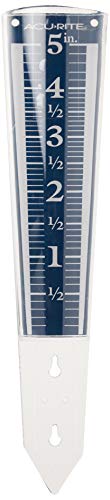
The AcuRite magnifying gauge is the simplest way to read rainfall from a distance. Its acrylic tube holds up to 5 inches of rain, and the water behind the scale magnifies the numbers by more than a third, so totals stay legible from several feet away. White numbers and markings stand out against the clear tube, and the gauge mounts on a vertical surface with two screws. Gardeners who check the yard each morning get a quick, reliable total without bending down or carrying the tube indoors. The one-piece design has no electronics to maintain, and the 1-year limited warranty covers the build.
Specs
- 5-inch capacity acrylic tube, model 00850A3
- Numbers magnified by more than a third behind rainwater
- White numbers and markings for high contrast
- Side mount with two 2-inch screws
- 1-year limited warranty
Best for: Gardeners who want a quick, easy-to-read total from across the yard.
Watch out for: Manual reading only, with no digital logging or remote display; the two mounting screws are not included.
AcuRite Wireless Digital Rain Gauge 00899

The AcuRite wireless model moves rainfall totals indoors. Its self-emptying collector sits outside and transmits readings to an LCD display every 60 seconds, covering a range up to 99.99 inches. The display shows the current event, the last 24 hours, the last seven days, and two resettable time frames, and rainfall alarms warn when a set total arrives. A tipping-bucket sensor measures each tip, and the wireless link reaches 100 feet. Gardeners tracking rain over days, or watching for heavy falls without going outside, get totals and history from the kitchen table.
Specs
- Self-emptying wireless rain collector, model 899
- Rainfall range 0 to 99.99 inches and 0 to 9999 millimeters
- Wireless range 100 feet on 433 MHz, updates every 60 seconds
- LCD display with rainfall history and rainfall alarms
- Display uses 3 AA batteries, collector uses 2 AA batteries
- Tipping-bucket sensor, 1-year limited warranty
Best for: Anyone who wants rainfall totals, history, and alarms on an indoor display.
Watch out for: The collector and display both need AA batteries; the listed lower temperature limit is 32 degrees Fahrenheit, so freezing weather can limit use.
Outdoor Home 6-Inch Rain Gauge

The Outdoor Home gauge is a tall, fence-mounted tube built for clear readings in the yard. Its dual scale shows inches and millimeters up to 6 inches, so the same tube serves gardeners who think in either unit. Polycarbonate construction resists cracking and yellowing in long sun exposure, and the included bracket and screws fix the tube to a deck or fence post at reading height. At more than 17 inches tall, the tube stays visible across the lawn, and the manual design needs no batteries or setup beyond mounting.
Specs
- 6-inch and 150-millimeter dual scale, model FBA_OHRG150
- Polycarbonate construction, made by LouRoss Technology
- Fence or post mount with included bracket and screws
- Dimensions 5.12 x 2.95 x 17.32 inches, weight 10.6 ounces
- Manual gauge with no calibration or electronics
Best for: Gardeners who want a tall, easy-to-see tube mounted on a fence or post.
Watch out for: The maker does not guarantee the tube against freezing water, so empty it before a hard freeze.
Taylor 7-Inch Silicone Rain Gauge
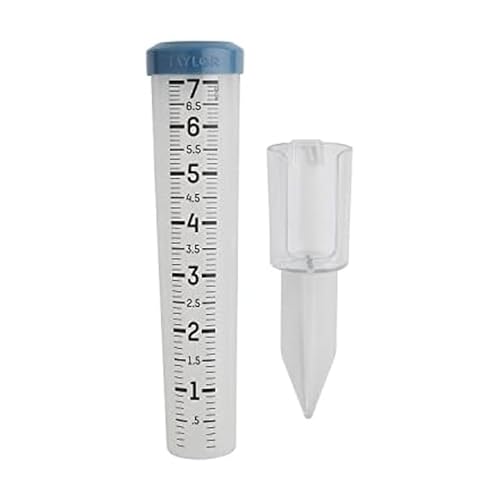
The Taylor silicone gauge suits cold climates where water freezes inside a rigid tube. Its flexible silicone body gives instead of cracking when rainwater turns to ice, and the 7-inch capacity holds a long stretch of rain before emptying. Bold black numbers in tenth-inch increments run down the tube, and the gauge mounts on a post or pushes into the ground on its stake. At 2.35 by 2 by 12 inches, the tube reads clearly at eye height, and the teal color stands out against fences and garden beds.
Specs
- 7-inch capacity with 1/10-inch increments, model 5293501
- Flexible silicone body, break and freeze proof
- Post mount or ground stake
- Dimensions 2.35 x 2 x 12 inches, weight 5.9 ounces
- Teal color, made by Lifetime Brands Inc.
Best for: Gardeners in cold regions who need a tube that survives frozen water.
Watch out for: The light 5.9-ounce build can shift in strong wind unless the mount is firm.
Taylor Glow-in-the-Dark Rain Gauge

The Taylor glow gauge keeps rainfall readable after sunset. Its glow markings stay visible in the dark, so an evening check needs no flashlight. The tube measures up to 6 inches in tenth-inch increments, and the weather-resistant build handles outdoor exposure. Mount it on a post with two screws or push the pointed end into soft ground at the base of the gauge. Gardeners who water in the evening, or check totals after a night storm, get a clear reading without waiting for morning light.
Specs
- 6-inch capacity with 1/10-inch increments, model 5288423
- Glow-in-the-dark markings, black and green
- Mountable on a post with two screws or ground stake
- Dimensions 1.2 x 2.8 x 12 inches, weight 4.2 ounces
- Weather-resistant construction
Best for: Evening gardeners who check rainfall after dark without a flashlight.
Watch out for: Do not let water freeze inside the tube; the 6-inch capacity is smaller than the 7-inch Taylor silicone gauge.
Which One Fits Your Situation
You Check the Yard Each Morning
Choose the AcuRite magnifying gauge or the Outdoor Home tube. Both give a fast visual total with no batteries and no display to check. Mount either at eye height on a fence or post near the path you walk each morning, and empty the tube after reading. The magnifying scale suits readers who want numbers enlarged, while the taller Outdoor Home tube suits a larger yard where the gauge sits farther from the house.
You Want Totals Without Going Outside
Choose the AcuRite wireless digital gauge. Its collector empties itself and sends totals to an indoor display, so rain, history, and alarms stay visible from the kitchen. Place the collector in an open spot within 100 feet of the display, and keep spare AA batteries on hand for the collector and the display. This setup suits anyone tracking rainfall across several days or watching storms from indoors.
Your Winters Freeze the Tube
Choose the Taylor silicone gauge. Its flexible body gives when water freezes instead of cracking like rigid plastic or glass. Mount it on a post or stake it in the ground before the cold season, and the 7-inch capacity carries a long wet stretch without emptying. Skip rigid tubes that sit full through a freeze, and empty any gauge you already own before the first hard frost arrives.
You Garden After Dark
Choose the Taylor glow gauge. Its markings stay visible after sunset, so you can read the total at the end of an evening watering session without a flashlight. Mount it near the beds you water last, where the scale faces the path. The 6-inch capacity covers most evening storms, and the post or stake mount keeps the tube at reading height. Empty the tube before a freeze, since frozen water can damage it.
Common Mistakes
- Mounting the gauge under a roof edge, tree, or fence that blocks rain or drips extra water into the tube.
- Setting the tube on a slope so the waterline reads high on one side and low on the other.
- Leaving a rigid tube full through a freeze, which can crack the body.
- Forgetting to empty the tube after a storm, so the next reading mixes two separate rainfalls.
- Placing a wireless collector beyond the display range or behind walls that block the signal.
Frequently Asked Questions
How much rain should I expect a gauge to hold?
A 5-inch tube covers most single storms, while a 6-inch or 7-inch tube holds a multi-day stretch without overflow. In wet regions, a taller tube means fewer trips to empty it. In dry regions, a shorter tube rarely fills, so capacity matters less than readability. Match the tube to your climate and to how often you empty it.
Where is the best place to mount a rain gauge?
Mount the gauge in an open spot away from roofs, trees, and tall fences, with clear sky above the tube. Keep it level, at a height you can read without bending, and within reach for emptying and cleaning. A fence or post mount suits most yards, while a ground stake works in open lawns. Avoid spots where runoff from a roof can splash into the tube.
Do wireless rain gauges need batteries?
Yes. The AcuRite wireless model in this guide uses three AA batteries in the display and two AA batteries in the outdoor collector. The collector sends readings every 60 seconds, so battery life depends on use and temperature. Keep spare batteries ready, and check the display for a low-battery warning before a long wet spell arrives.
Can a rain gauge survive freezing weather?
A flexible silicone tube can, because the body gives when water inside turns to ice. Rigid plastic and glass tubes can crack if left full through a freeze, so empty them before cold nights. The Outdoor Home maker notes its tube is not guaranteed against freezing water. In cold regions, pick a silicone gauge or bring rigid tubes indoors for winter.