Key takeaways
- Compare five oil extractors for topside oil changes, from manual vacuum tanks to pneumatic and 12V pumps, with maker-stated capacities and tube sizes.
An oil extractor pulls used engine oil out through the dipstick tube, so the whole oil change happens from above the engine bay. There is no crawling underneath, no drain plug to drop into a pan of hot oil, and no stream of oil running down your arm. For cars with a top-mounted oil filter, an extractor can turn a full service into a job done entirely from the front of the car.
The catch is that extractors come in three very different forms: hand-pumped vacuum tanks, pneumatic tanks that run on shop air, and small 12V electric pumps that move oil into a container you supply. Capacity, tube diameter, and how the vacuum is built all decide whether a given model suits your engine. The five extractors below cover each type, with specifications taken only from what each maker states.
As an Amazon Associate, we earn from qualifying purchases.
Quick answer
For most home users, a dual-mode tank such as the FOUR UNCLES 6.5L is the flexible pick: it works by hand pump or on shop air and holds enough for a typical car sump. If you already own an air compressor, the Mityvac MV7300 builds vacuum for you. Drivers who want the simplest manual tool can choose the EWK 6L or the metal Topsider, while the Amarine Made 12V pump suits small engines and tight storage because it needs no tank space of its own.
1. FOUR UNCLES 6.5L Oil Extractor (FU007A)

This dual-mode extractor can be run two ways: connect it to an air compressor for pneumatic vacuum, or use the built-in hand pump when no compressor is nearby. The tank holds 6.5 liters, which covers the sump capacity of most cars and light trucks in a single pass. FOUR UNCLES supplies it with five tubes of different diameters plus a brake bleeding hose, so the same unit handles engine oil and a brake fluid change.
Specs
- Capacity: 6.5 liters
- Operation: pneumatic or manual hand pump
- Model: FU007A
- Included: five extraction tubes and a brake bleeding hose
- Use: engine oil and other automotive fluids through the dipstick tube
Who it’s for / who should skip
It fits owners who want one extractor that works with or without shop air, and anyone who also bleeds brakes. Skip it if your engine holds far more than 6.5 liters and you do not want to empty the tank mid-job, or if you prefer a metal tank over a plastic one.
2. Mityvac MV7300 Pneumativac Fluid Evacuator
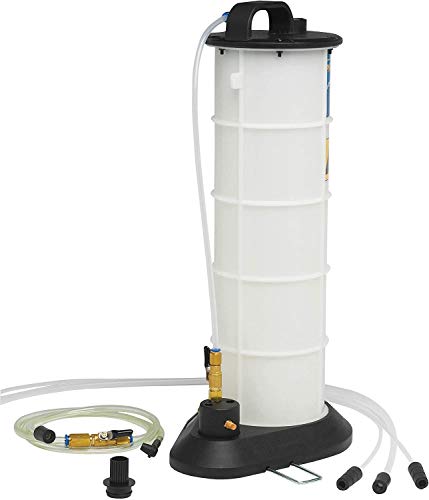
The MV7300 is built for garages that already run compressed air. Instead of a hand pump, it uses a Venturi fitting: shop air flowing through the unit creates a steady vacuum, so suction does not fade the way a hand-built vacuum can. Mityvac states a recommended inlet air pressure of 80 to 120 psi. The reservoir holds 2.3 gallons (8.8 liters), the largest capacity in this guide, and the maker includes two dipstick tubes, one 0.26 inch outside diameter and one 0.41 inch outside diameter, each 5 feet long.
Specs
- Capacity: 2.3 gallons (8.8 liters)
- Operation: pneumatic, compressed air required
- Recommended inlet air pressure: 80 to 120 psi, per maker
- Included tubes: 0.26 inch OD and 0.41 inch OD dipstick tubes, 5 feet each
- Also suited to: transmission fluid and brake or clutch bleeding with the maker’s adapter kit
Who it’s for / who should skip
It fits workshops and serious home garages with a compressor, and owners of larger engines that would overflow a smaller tank. Skip it if you have no air supply, since the unit cannot build vacuum by hand.
3. EWK 6L Vacuum Oil Extractor Pump (EB0261)

EWK’s 6L extractor is a manual-only design with no compressor or battery involved. You pump the handle to build vacuum, then the oil travels up a 42-inch flexible metal probe and through a 59-inch transparent main hose, so you can watch the oil level and condition as it moves. The wide base is made to be held down with a foot while pumping. EWK states the tool is not for gasoline or for fluids above 175 degrees Fahrenheit, and lists an 18-month warranty.
Specs
- Capacity: 6 liters
- Operation: manual hand pump only
- Model: EB0261
- Main hose: 59 inches, transparent
- Probe: 42-inch flexible metal extraction probe
- Limits per maker: no gasoline, no fluids over 175 degrees Fahrenheit
- Warranty: 18 months, per maker
Who it’s for / who should skip
It fits drivers who want a self-contained manual tool for cars, motorcycles, boats, and lawn equipment, with no other equipment to buy. Skip it if you change oil on several vehicles back to back and would rather let a compressor or motor do the pumping.
4. Airpower America FloTool Topsider 5060TS

The Topsider is the long-running metal alternative to plastic tanks. Its 8-quart canister is paired with a hand vacuum pump: you pump to build vacuum, open the valve, and oil is drawn through the dipstick tube into the sealed container. Because the tank is metal and the design has no motor or air fitting, there is very little to wear out beyond seals and hoses. Airpower America positions the 5060TS for 4-cycle engines across cars, ATVs, boats, and larger vehicles.
Specs
- Capacity: 8 quarts
- Operation: manual vacuum hand pump, no electricity or air supply
- Model: 5060TS
- Tank: metal canister
- Use: 4-cycle engine oil changes through the dipstick tube
Who it’s for / who should skip
It fits owners who value a simple, durable metal tank and work on a mix of vehicles and outdoor equipment. Skip it if you want the speed of pneumatic extraction or a larger reservoir for high-capacity diesel sumps.
5. Amarine Made 12V Oil Pump (YI-0564)

This compact electric pump takes a different approach: there is no collection tank at all. The pump body connects to a 12V vehicle battery with clips and moves oil from the dipstick tube through an outlet hose into a sealed container you provide. Amarine Made states a 60W motor drawing 5A, with a flow rate of 0.8 to 1.0 liters per minute. The maker’s instructions call for warming the oil to between 104 and 140 degrees Fahrenheit, shutting the engine off before pumping, and running the pump for no more than 30 minutes at a time. It must not be used with gasoline, water, gearbox oil, or other flammable liquids.
Specs
- Power: 12V DC, battery clips
- Motor: 60W, 5A draw, per maker
- Flow rate: 0.8 to 1.0 liters per minute, per maker
- Model: YI-0564
- Collection: no tank; pumps into your own container
- Limits per maker: warm oil to 104 to 140 degrees Fahrenheit; maximum 30 minutes continuous running; not for gasoline, water, or gearbox oil
Who it’s for / who should skip
It fits owners of motorcycles, boats, RVs, and lawn equipment who have limited storage and a suitable used-oil container already on hand. Skip it if you want a self-contained tank, or if your oil changes involve engines whose oil you cannot warm up first.
How these extractors compare
The first decision is how vacuum is made. Manual tanks such as the EWK and the Topsider ask for some pumping effort but work anywhere. Dual-mode tanks such as the FOUR UNCLES add the option of shop air. A dedicated pneumatic unit such as the MV7300 is the fastest route but is tied to a compressor. The Amarine pump replaces pumping with a small electric motor, at the cost of needing your own collection container and a battery connection.
Capacity is the second decision. Tanks in the 6 to 6.5 liter range match most car sumps. The MV7300, at 8.8 liters, suits larger engines. Whatever you choose, check the tube diameter against your dipstick tube: a probe that is too thick will not reach the sump, and makers list their tube sizes for exactly this reason. Warm oil always extracts faster and more completely than cold oil, regardless of the pump type.
One limit applies to every extractor here. A dipstick tube that bends sharply, or an oil pan baffle that blocks the probe, can leave some oil behind. On an unfamiliar engine, many owners occasionally pull the drain plug afterward to confirm how much remained, then rely on the extractor once they know the tube reaches the bottom of the pan.
FAQ
Does an oil extractor remove all the oil?
On most engines with a straight dipstick tube, an extractor removes nearly all of the sump oil, and makers design the probes to reach the bottom of the pan. Baffles or curved tubes can leave a small amount behind, so checking with the drain plug once, on a new vehicle, is a sensible way to confirm.
Can I use an oil extractor for transmission fluid or coolant?
Some models are listed by their makers for other low-viscosity automotive fluids, and the FOUR UNCLES and MV7300 both cover fluid work beyond engine oil. Always follow the individual maker’s fluid list, and never use any of these tools with gasoline or flammable liquids.
How do I dispose of the extracted oil?
Pour the used oil from the extractor tank into a clean, sealed container, label it, and take it to an oil collection point; many auto parts stores and municipal recycling centers accept used oil at no charge. Never pour used oil into drains, onto soil, or into household trash.
Is warm oil really necessary?
Warm oil flows far more freely than cold oil, so extraction is quicker and more complete. Makers such as Amarine Made give an explicit warm-up range, and manual-pump makers likewise advise extracting while the oil is warm. Run the engine briefly, then shut it off before inserting the tube.
Final verdict
Pick the FOUR UNCLES 6.5L if you want one extractor that covers the widest range of home use, with or without a compressor. Pick the Mityvac MV7300 if shop air is always available and you want the largest tank. The EWK 6L and the Topsider are the straightforward manual choices, in plastic and metal respectively. The Amarine Made 12V pump is the compact option for small engines and limited shelf space. Match the tank size to your engine’s sump capacity, confirm the probe fits your dipstick tube, and any of the five will make oil changes cleaner than the drain-plug routine.
Product and ASIN Reference
| Product | ASIN |
|---|---|
| FOUR UNCLES 6.5L Oil Extractor (FU007A) | B0CHRFDXV6 |
| Mityvac MV7300 Pneumativac Fluid Evacuator | B000JFN9WW |
| EWK 6L Vacuum Oil Extractor Pump (EB0261) | B079FJ21DV |
| Airpower America FloTool Topsider 5060TS | B001445IZ8 |
| Amarine Made 12V Oil Pump (YI-0564) | B082TNCJP8 |