Key takeaways
- Compare the best car speakers across coaxial, component, 6x9 and marine designs, with RMS power, sensitivity and fitment checks explained for buyers.
Factory car speakers are usually built to a tight cost target, with light cones and small magnets that limit bass output and clarity at highway volume. Replacing them is one of the most direct upgrades in car audio, because the speakers are the last link in the chain and the part that turns signal into sound. A good set can add low-end weight, cleaner vocals and headroom a stock head unit alone cannot deliver.
This guide compares five well-documented options across the main formats buyers shop for: a three-way coaxial set, a premium component system, a 6×9 pair for rear decks, a high-output 6.5-inch door speaker, and a marine-rated model for exposed installs. Every power and sensitivity figure below is stated exactly as the maker publishes it.
As an Amazon Associate, we earn from qualifying purchases.
How to Choose the Right Car Speakers
Start with fitment. Measure the factory opening and mounting depth first, and confirm the size against the vehicle maker’s or speaker maker’s fitment guide, because openings vary by trim level. Common sizes include 6.5-inch rounds and 6×9 ovals, but many vehicles use 5.25-inch, 6.75-inch or 6×8-inch openings instead. A deeper basket or larger magnet can also foul a window mechanism inside the door.
Next, decide between coaxial and component designs. Coaxial speakers mount the tweeter in front of the woofer, so they drop into factory locations with simple two-wire connections. Component systems separate the woofer and tweeter and add an external crossover, which lets the tweeter sit higher for a raised soundstage, at the cost of more installation work. Follow the maker’s guidance for crossover placement and wiring polarity.
Power figures need care. RMS power is the continuous rating that matters when matching speakers to a head unit or amplifier; peak power is a short-burst figure and should not drive a buying decision. Sensitivity tells you how loudly a speaker plays with a given input: higher sensitivity suits low-powered factory head units, while lower-sensitivity speakers often expect an amplifier. Note the measurement basis each maker uses, since some publish sensitivity at 1 watt and 1 metre and others at 2.83 volts and 1 metre, and the two are not directly interchangeable. Impedance matters too: most car speakers are 4 ohms, but some are 3 ohms, which draws more current, so confirm your head unit or amp is rated for the load.
Finally, match the speaker to the environment. Convertibles, boats and other exposed installs need weather-resistant materials such as polypropylene cones, rubber surrounds and, for marine use, sealed construction with a stated water-resistance rating.
Rockford Fosgate P1683 Punch 6×8 3-Way Coaxial Speakers
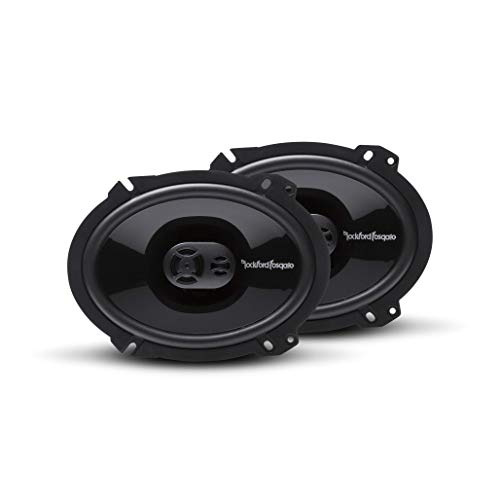
The P1683 is Rockford Fosgate’s Punch-series answer for the many vehicles that use 6×8-inch factory openings, and its three-way layout adds a dedicated midrange driver alongside the woofer and tweeter. Rockford Fosgate states power handling of 65 watts RMS and 130 watts peak per speaker, with a sensitivity of 90 dB at 1 watt and 1 metre, figures that suit factory head units and modest amplifiers alike.
The woofer uses an injection-moulded mineral-filled polypropylene cone with a butyl rubber surround, and the tweeter is a PEI dome design with an integrated concealed crossover hidden inside the basket for a cleaner install. Rockford Fosgate’s FlexFit basket uses slotted mounting holes rather than fixed screw points, allowing slight adjustment when aligning with factory holes. The maker also lists a VAST surround design intended to increase effective cone area. The P1683 is sold as a pair, and the maker’s specification sheet notes that grilles are not included, which suits installs that reuse factory door grilles.
Specs
- Size: 6×8 inches, 3-way coaxial
- RMS power: 65 watts RMS (130 watts peak), as published by Rockford Fosgate
- Sensitivity: 90 dB at 1 watt / 1 metre, as published by Rockford Fosgate
- Frequency response: 65 Hz to 24 kHz, as published by Rockford Fosgate
- Impedance: 4 ohms
- Extras: PEI dome tweeter plus midrange driver, integrated concealed crossover, FlexFit slotted basket, mounting depth 2.28 inches
JBL GTO609C 6.5-Inch Component Speaker System
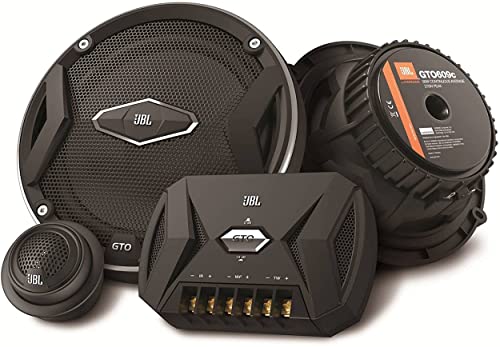
The GTO609C is a two-way component system built around separate 6.5-inch woofers, soft-dome tweeters and dedicated passive crossover networks, so the tweeters can be mounted higher than the door woofers for a better-placed soundstage. JBL publishes power handling of 90 watts RMS and 270 watts peak, with a sensitivity of 92 dB at 2.83 volts and 1 metre, and a frequency response extending to 21 kHz.
JBL’s Plus One design uses a carbon-injected cone with more surface area than a standard cone of the same size, and the fiberglass-reinforced plastic frames are intended to resist warping on uneven mounting surfaces. The 3-ohm voice coils are specified by JBL to compensate for the resistance of thin factory wiring, so check that your amplifier or head unit suits a 3-ohm load before choosing this set. The tweeters use JBL’s I-Mount system for flush or surface mounting, and the outboard crossovers use a 12 dB per octave slope. Accessory grilles are included for exposed installs.
Specs
- Size: 6.5 inches, 2-way component system
- RMS power: 90 watts RMS (270 watts peak), as published by JBL
- Sensitivity: 92 dB at 2.83 volts / 1 metre, as published by JBL
- Frequency response: 53 Hz to 21 kHz, as published by JBL
- Impedance: 3 ohms
- Extras: Plus One carbon-injected cones, I-Mount tweeter mounting, 12 dB per octave passive crossovers, grilles included, mounting depth 2-1/16 inches
Kenwood KFC-6966S 6×9 3-Way Coaxial Speakers

For vehicles with 6×9 openings in the rear deck or doors, the KFC-6966S from Kenwood’s Sport Series is a straightforward three-way coaxial pair. Kenwood publishes a rated input power of 45 watts RMS per speaker and peak power of 400 watts per speaker, with a sensitivity of 91 dB at 1 watt and 1 metre. Those figures make it a sensible match for factory head units, which deliver far less continuous power than headline peak numbers suggest.
The woofer is a polypropylene cone design, paired with a 2-inch cone tweeter and a ceramic supertweeter for the highest frequencies. Kenwood lists a frequency response of 35 Hz to 20,000 Hz, and the larger 6×9 cone area gives this format a natural advantage in bass output over smaller round speakers, which is why 6x9s remain popular for rear-deck installs. The speakers use a top-mount design with a stated mounting depth of 3 inches, so confirm rear-deck clearance before ordering.
Specs
- Size: 6×9 inches, 3-way coaxial
- RMS power: 45 watts RMS (400 watts peak) per speaker, as published by Kenwood
- Sensitivity: 91 dB at 1 watt / 1 metre, as published by Kenwood
- Frequency response: 35 Hz to 20,000 Hz, as published by Kenwood
- Impedance: 4 ohms
- Extras: Polypropylene woofer cone, 2-inch cone tweeter, ceramic supertweeter, top-mount design, sold as a pair
Kicker 46CSC654 CS Series 6.5-Inch Coaxial Speakers

The 46CSC654, sold as the CSC65, is Kicker’s CS Series 6.5-inch coaxial and the highest power handler in this roundup. Kicker publishes 100 watts RMS and 300 watts peak per speaker, with a sensitivity of 90 dB, a frequency response of 45 Hz to 20 kHz and a 4-ohm impedance. That combination works on head-unit power but leaves genuine headroom for a small amplifier later.
Kicker uses a polypropylene woofer cone with a ribbed, UV-treated surround and its EVC (Extended Voice Coil) design, which the maker describes as supporting precise linear excursion. The half-inch PEI balanced-dome tweeter has a zero-protrusion design, meaning it does not extend beyond the woofer’s mounting plane, which helps the speaker fit behind factory grilles in shallow doors. Kicker lists a mounting depth of 1-11/16 inches, one of the shallower figures in this class, and grilles are included for exposed installs. Before ordering, confirm cutout diameter and depth against Kicker’s fitment information, since 6.5-inch and 6.75-inch openings are easily confused.
Specs
- Size: 6.5 inches, 2-way coaxial
- RMS power: 100 watts RMS (300 watts peak), as published by Kicker
- Sensitivity: 90 dB, as published by Kicker
- Frequency response: 45 Hz to 20 kHz, as published by Kicker
- Impedance: 4 ohms
- Extras: EVC (Extended Voice Coil) design, zero-protrusion PEI tweeter, ribbed UV-treated surround, mounting depth 1-11/16 inches, grilles included
JBL MS6510 6.5-Inch Marine Speakers

The MS6510 is JBL’s Stage series marine speaker, built for boats and other exposed installs where ordinary car speakers would deteriorate. JBL publishes power handling of 60 watts RMS and 180 watts peak, sensitivity of 90 dB at 2.83 volts, a frequency response of 60 Hz to 20,000 Hz and a 4-ohm impedance, so it can also serve in convertibles and off-road vehicles that see weather.
The design centres on durability: JBL states an IPx5 water-resistance rating, sealed polypropylene cones, rubber surrounds, one-piece polymer baskets and UV-resistant grilles intended to stand up to spray and sunlight. The balanced dome tweeter is mounted on the grille rather than on a post through the woofer, which keeps the cone sealed. Because marine wiring lives in a corrosive environment, follow JBL’s installation guidance on sealed connections and mounting. The MS6510 is sold as a pair in grey or white grille finishes.
Specs
- Size: 6.5 inches, 2-way marine coaxial
- RMS power: 60 watts RMS (180 watts peak), as published by JBL
- Sensitivity: 90 dB at 2.83 volts, as published by JBL
- Frequency response: 60 Hz to 20,000 Hz, as published by JBL
- Impedance: 4 ohms
- Extras: IPx5 rating as stated by JBL, sealed polypropylene cone, rubber surrounds, UV-resistant grilles, grille-mounted balanced dome tweeter
Comparison: The Five Picks Side by Side
| Speaker | Type | Size | RMS power (maker-stated) | Sensitivity (maker-stated) | Impedance |
|---|---|---|---|---|---|
| Rockford Fosgate P1683 | Coaxial, 3-way | 6×8 in | 65 watts | 90 dB at 1 W / 1 m | 4 ohms |
| JBL GTO609C | Component, 2-way | 6.5 in | 90 watts | 92 dB at 2.83 V / 1 m | 3 ohms |
| Kenwood KFC-6966S | Coaxial, 3-way | 6×9 in | 45 watts | 91 dB at 1 W / 1 m | 4 ohms |
| Kicker 46CSC654 | Coaxial, 2-way | 6.5 in | 100 watts | 90 dB | 4 ohms |
| JBL MS6510 | Marine coaxial, 2-way | 6.5 in | 60 watts | 90 dB at 2.83 V | 4 ohms |
The clearest split in the table is format. The GTO609C is the only component system, and the only pick that asks for crossover mounting and a 3-ohm-capable amplifier, in exchange for separate tweeters that can be positioned for imaging. The other four are coaxials that connect with two wires per speaker. The Kenwood is the only oval 6×9, while the Kicker offers the highest RMS rating and the shallowest mounting depth for tight doors. The MS6510 trades a little power handling for a stated IPx5 rating and sealed construction the car-only models do not claim.
FAQ
Do I need an amplifier, or will a factory head unit drive these speakers?
A factory head unit can drive any of the five at moderate volume, because all publish sensitivities of 90 dB or higher. An amplifier helps most with the higher-RMS models, such as the Kicker 46CSC654 at 100 watts RMS and the JBL GTO609C at 90 watts RMS, by supplying cleaner power at higher volume. Match the amplifier’s RMS output per channel to the speaker’s RMS rating, not its peak figure.
What is the difference between coaxial and component speakers?
Coaxial speakers combine the woofer and tweeter in one unit, so they install in the factory location with a single two-wire connection. Component systems, such as the JBL GTO609C here, separate the tweeter and add an external crossover, which allows better tweeter placement and frequency control but requires more installation work.
How do I know which speaker size fits my car?
Check the vehicle maker’s specifications or the speaker maker’s fitment guide for your exact year, model and trim, and measure both the cutout diameter and the available mounting depth. Similar-sounding sizes are not interchangeable: 6.5-inch and 6.75-inch openings differ, and oval formats such as 6×8 and 6×9 are vehicle-specific. Depth matters too, because door speakers must clear the window mechanism.
Can I use regular car speakers in a boat or convertible?
Makers rate marine speakers, such as the JBL MS6510 with its stated IPx5 rating and sealed cone, for exposure to spray and UV light. Standard car speakers carry no such rating, and their cones, surrounds and terminals are not built for that environment. For any exposed install, choose a model whose maker publishes a water-resistance rating and follow its guidance for sealed wiring connections.
Final Verdict
For most buyers replacing factory speakers, the Kicker 46CSC654 is the strongest all-round pick: it combines the highest maker-stated RMS rating here with a shallow mounting depth and a zero-protrusion tweeter that fits behind stock grilles. Drivers who want the best soundstage and are willing to install crossovers should look at the JBL GTO609C, provided their amplifier suits its 3-ohm load. The Rockford Fosgate P1683 covers the common 6×8 fitment, the Kenwood KFC-6966S is the natural 6×9 rear-deck option, and the JBL MS6510 is the pick when the install faces weather. Whichever set you choose, confirm size, depth and impedance against the maker’s fitment guidance before ordering.
Product and ASIN Reference
| Product | ASIN |
|---|---|
| Rockford Fosgate P1683 Punch 6×8 3-Way Coaxial Speakers | B001P88U12 |
| JBL GTO609C 6.5-Inch Component Speaker System | B00881CT3E |
| Kenwood KFC-6966S 6×9 3-Way Coaxial Speakers | B07B6FP8PW |
| Kicker 46CSC654 CS Series 6.5-Inch Coaxial Speakers | B07NS7NZLX |
| JBL MS6510 6.5-Inch Marine Speakers | B098RBMFDT |