Key takeaways
- Compare the best car amplifiers for subwoofers, door speakers, full systems, tight dashboards and boats, with maker-stated RMS power for each pick.
A factory head unit typically sends only a modest amount of power to each speaker, which limits volume and clarity once the road noise rises. An external amplifier solves that problem by supplying clean, continuous power that matches what your speakers and subwoofers are actually rated to handle. The right choice depends on what you are powering: a single subwoofer, four door speakers, a complete system, a cramped dashboard, or a boat where moisture is part of the environment.
This guide compares five amplifiers, one for each of those jobs. Every power figure is stated exactly as the maker publishes it, with RMS figures kept separate from peak figures, because RMS describes continuous output. Before buying, match the amplifier’s per-channel RMS output to your speakers’ RMS handling, and follow the maker’s manual for wiring, fuse size, and ground placement.
As an Amazon Associate, we earn from qualifying purchases.
How to Choose a Car Amplifier
Start with channel count. A monoblock amplifier has one channel dedicated to a subwoofer. A four-channel amplifier powers front and rear speakers, and most can be bridged so two channels combine to drive a subwoofer. A five-channel amplifier runs four speakers plus a subwoofer from one chassis, which simplifies wiring. Compact amplifiers trade total output for a small footprint that fits behind a dashboard or under a seat, and marine amplifiers add protective coatings for use on boats and powersports vehicles.
Next, compare RMS power, not peak power. RMS describes the continuous output an amplifier can sustain, while peak or maximum figures describe a momentary ceiling. Match the amplifier’s RMS output per channel to the RMS rating of your speakers: an amplifier rated well above the speakers can damage them if the gain is set carelessly, and an amplifier rated far below them will clip and distort when pushed. Check impedance as well. Most car speakers are 4 ohm loads, and amplifiers publish separate RMS figures for 4 ohm and 2 ohm operation, so use the figure that matches your wiring.
Amplifier class matters for size and heat. Class D amplifiers are efficient and compact, which is why every pick here uses Class D circuitry for at least its subwoofer channel. Finally, plan the installation before ordering. Makers direct installers to disconnect the negative battery terminal before wiring begins, to mount the main fuse a short distance from the battery, and to ground the amplifier to bare chassis metal. A wiring kit in the gauge the maker specifies is sold separately for most amplifiers.
Skar Audio RP-1200.1D: Monoblock Pick for a Subwoofer
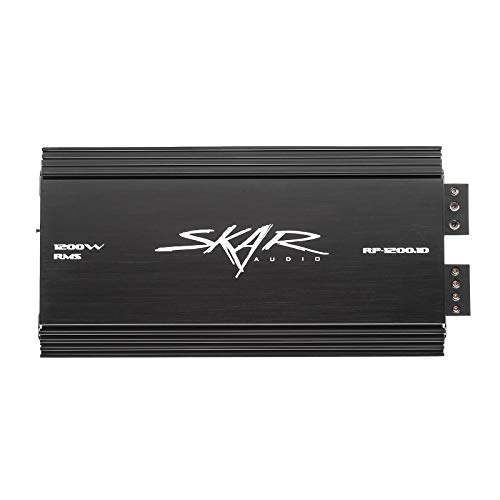
The Skar Audio RP-1200.1D is a single-channel Class D amplifier built for one job: driving a subwoofer. Skar rates it at 1,200 watts RMS into a 1 ohm load, with a maker-stated maximum of 1,600 watts, and that output suits a single high-excursion subwoofer or a pair wired to a 1 ohm load. Because it is a dedicated bass amplifier, its frequency response is limited to the low range a subwoofer reproduces.
Control is handled on the amplifier’s end panel, with a variable low-pass filter, a subsonic filter, and a switchable bass EQ that Skar sets at plus 6 or plus 12 dB at 45 Hz. A wired remote subwoofer level control is included, so bass level can be adjusted from the driver’s seat without opening a menu on the head unit. Skar also lists four-way protection circuitry covering thermal, voltage, speaker short, and DC faults. Confirm your subwoofer’s impedance and RMS rating before choosing this model, since its headline output is specified at 1 ohm.
Specs
- Channels: 1 (monoblock)
- RMS power: 1,200 watts x 1 at 1 ohm, as Skar states
- Maximum power: 1,600 watts at 1 ohm, as Skar states (peak figure, not RMS)
- Class: D
- Extras: wired remote subwoofer level control included; switchable bass EQ; variable low-pass and subsonic filters; four-way protection circuitry
Rockford Fosgate R2-300X4: Four-Channel Pick for Speakers

The Rockford Fosgate R2-300X4 is a full-range Class D four-channel amplifier from the Prime R2 series, rated at 300 watts RMS in total. It delivers 50 watts RMS per channel into 4 ohms, which is a sensible match for most aftermarket door and rear speakers, and 75 watts per channel into 2 ohms. The front and rear sections are bridgeable, so the amplifier can also run as a two-channel unit at 150 watts RMS per bridged pair, or in a three-channel layout with one bridged pair feeding a small subwoofer.
Rockford Fosgate publishes these figures under the CEA-2006 rating standard, which makes them easier to compare against other compliant brands. The amplifier accepts preamp-level and speaker-level inputs, so it can be added to a factory head unit with no RCA outputs. Variable high-pass and low-pass crossovers keep deep bass out of small speakers. A wiring kit and fuse are not included, as is typical, so budget for the gauge the manual specifies.
Specs
- Channels: 4 (bridgeable to 3 or 2)
- RMS power: 50 watts x 4 at 4 ohms; 75 watts x 4 at 2 ohms; 150 watts x 2 bridged at 4 ohms, as Rockford Fosgate states
- Class: D, full-range
- Extras: CEA-2006 compliant ratings; variable high-pass and low-pass crossovers; preamp and speaker-level inputs; cast aluminum heatsink
Pioneer GM-D9705: Five-Channel Pick for a Full System

The Pioneer GM-D9705 runs an entire system from one chassis. Its four main channels deliver 75 watts RMS each into 4 ohms, or 100 watts each into 2 ohms, while the separate subwoofer channel delivers 350 watts RMS into 4 ohms and 600 watts RMS into 2 ohms. The main channel pairs can be bridged at 200 watts RMS per pair, and Pioneer states a maximum total output of 2,000 watts, which is a peak figure rather than a continuous one.
Pioneer builds the GM-D9705 as a Class D design (its implementation is called Class-FD) and includes a wired bass boost remote for trimming subwoofer level from the front seat. Variable crossovers cover the main and subwoofer channels, and speaker-level inputs with automatic signal sensing let it switch on with a factory radio that lacks a remote turn-on lead. For speakers and a subwoofer without stacking two amplifiers, this is the most straightforward layout in the guide.
Specs
- Channels: 5 (configurable as 3 with bridged main channels)
- RMS power: 75 watts x 4 plus 350 watts x 1 at 4 ohms; 100 watts x 4 plus 600 watts x 1 at 2 ohms, as Pioneer states
- Maximum power: 2,000 watts, as Pioneer states (peak figure, not RMS)
- Class: D (Class-FD)
- Extras: wired bass boost remote included; variable crossovers for main and subwoofer channels; speaker-level inputs with automatic signal sensing turn-on
Alpine KTP-445U: Compact Pick That Fits Behind the Dash

The Alpine KTP-445U takes a different approach. It is a compact four-channel power pack, roughly the size of a paperback book at 7-7/16 inches wide, 1-1/2 inches tall, and 2-1/2 inches deep, designed to mount behind the dashboard or inside a glove compartment rather than in the trunk. Alpine rates it at 45 watts RMS per channel into both 4 ohm and 2 ohm loads, which is a meaningful step up from the output of a typical factory or aftermarket head unit.
Because it works as an inline power upgrade, installation is simpler than a conventional amplifier. The KTP-445U accepts RCA or speaker-level inputs, and Alpine’s manual describes powering it from the radio’s fused circuit or from a direct battery lead with a 15 amp fuse fitted close to the battery, so follow the manual for your vehicle. Selectable high-pass filter switches (off, 60, 80, or 120 Hz) protect small speakers from deep bass, and separate front and rear gain controls are provided. It will not drive a subwoofer on its own, but for speakers alone it adds power without giving up cargo space.
Specs
- Channels: 4
- RMS power: 45 watts x 4 at 4 ohms and at 2 ohms, as Alpine states
- Class: D (head unit power pack)
- Extras: compact chassis for behind-dash mounting; selectable high-pass filter (60, 80, 120 Hz or off); RCA and speaker-level inputs; front and rear gain controls; wiring harness included
Kenwood KAC-M1814: Marine Pick for Boats and Powersports

The Kenwood KAC-M1814 is a compact four-channel digital amplifier rated for marine and motorsports use. Kenwood states 45 watts RMS per channel into 4 ohms and a maximum total power of 400 watts, again a peak figure rather than continuous output. Its four channels can be bridged into two, which suits a pair of tower speakers or a front-speaker-plus-subwoofer layout within its power limits.
What separates it from a standard car amplifier is the conformal coating on its circuit board, which Kenwood applies to protect the electronics from moisture in marine applications and on all-terrain vehicles. The chassis is small enough for a boat console or UTV dashboard. Signal-sensing turn-on lets it wake up from speaker-level input without a dedicated remote wire, and a power and speaker wiring harness plus a short RCA cable are included. Follow Kenwood’s manual for mounting location and keep connections protected from direct spray.
Specs
- Channels: 4 (bridgeable to 2)
- RMS power: 45 watts x 4 at 4 ohms, as Kenwood states
- Maximum power: 400 watts total, as Kenwood states (peak figure, not RMS)
- Class: D (digital)
- Extras: conformal-coated circuit board for marine use; signal-sensing turn-on; speaker-level inputs; wiring harness and RCA cable included
Comparison: The Five Picks Side by Side
The table below lines up the headline specifications as each maker publishes them. Maximum figures are peak ratings; use the RMS column when matching an amplifier to speakers.
| Product | Type | Channels | RMS power (maker-stated) | Class |
|---|---|---|---|---|
| Skar Audio RP-1200.1D | Monoblock | 1 | 1,200 watts x 1 at 1 ohm | D |
| Rockford Fosgate R2-300X4 | Four-channel | 4 | 50 watts x 4 at 4 ohms | D |
| Pioneer GM-D9705 | Five-channel | 5 | 75 watts x 4 plus 350 watts x 1 at 4 ohms | D |
| Alpine KTP-445U | Compact power pack | 4 | 45 watts x 4 at 4 ohms | D |
| Kenwood KAC-M1814 | Marine | 4 | 45 watts x 4 at 4 ohms | D |
In short: choose the Skar for a subwoofer-only upgrade, the Rockford Fosgate for four speakers, the Pioneer to run speakers and a subwoofer from one unit, the Alpine when space is the limiting factor, and the Kenwood when the amplifier will live on the water.
FAQ
How much amplifier power do my speakers need?
Match the amplifier’s RMS output per channel to the RMS power handling printed in your speaker’s specifications. A close match, with the gain set correctly, gives clean volume without clipping. Peak power figures should not be used for this comparison, because they describe a momentary maximum rather than continuous output.
What is the difference between RMS and peak power?
RMS power is the continuous output an amplifier can deliver over time, and it is the figure makers measure under standards such as CEA-2006. Peak or maximum power is the highest short burst the amplifier can produce. Two amplifiers with similar peak figures can have very different RMS figures, so compare RMS when shopping.
Can a five-channel amplifier replace two separate amplifiers?
Yes. A five-channel amplifier combines four full-range channels and a dedicated subwoofer channel in one chassis, so it needs only one power run, one ground point, and one mounting location. The trade-off is that total subwoofer output is fixed by that fifth channel, so check its RMS rating against your subwoofer before buying.
What should I do before wiring an amplifier?
Follow the amplifier maker’s installation manual. Makers direct installers to disconnect the negative battery terminal before starting, to fit the main fuse close to the battery, to route power and signal cables away from each other, and to reconnect and set gains only after every connection is secure. If you are not comfortable with vehicle wiring, a professional installer is the safer route.
Final Verdict
For most cars, the decision comes down to what you are powering. The Pioneer GM-D9705 is the simplest path to a complete system, covering four speakers and a subwoofer with 75 watts RMS per speaker channel and 350 watts for the sub. If you only need bass, the Skar Audio RP-1200.1D concentrates on subwoofer output and includes a remote level control. Speaker-only upgrades are well served by the Rockford Fosgate R2-300X4, while the Alpine KTP-445U fits where a conventional amplifier cannot. On the water, the Kenwood KAC-M1814 adds the protective coating marine use calls for. Whichever you choose, match RMS ratings to your speakers and follow the maker’s installation instructions.
Product and ASIN Reference
| Product | ASIN |
|---|---|
| Skar Audio RP-1200.1D | B07F1FXPH1 |
| Rockford Fosgate R2-300X4 | B07X8QVRJW |
| Pioneer GM-D9705 | B07NBH1915 |
| Alpine KTP-445U | B003VVYL46 |
| Kenwood KAC-M1814 | B097DGV7FG |