Key takeaways
- Find the right torque wrench for lug nuts and car repairs. Five half-inch picks cover passenger cars and trucks, from click wrenches to a digital model.
- Top Pick: TEKTON 24335 Micrometer Torque Wrench
- Runner-up: EPAuto 1/2-Inch Drive Click Torque Wrench
- Also consider: LEXIVON LX-183 Click Torque Wrench
A lug nut that is too loose can work its way off while you drive, and one that is too tight can stretch a wheel stud or warp a brake rotor. A torque wrench is the tool that keeps both problems away, because it tells you exactly when to stop pulling. Every car has a lug nut specification in its owner’s manual, and the only way to hit that number with confidence is a wrench that measures torque as you apply it.
This guide covers five half-inch drive torque wrenches built for car repairs and lug nuts: three click wrenches in the most common range for passenger cars, one long high-range click wrench for trucks, and one digital wrench for anyone who wants a live reading.
As an Amazon Associate, we earn from qualifying purchases.
Quick Answer
For most passenger cars, the TEKTON 24335 is the safest first pick because its 10 to 150 foot-pound range covers nearly every lug nut specification, and its all-steel click design needs no batteries. The EPAuto offers similar coverage at a lower cost, the LEXIVON adds a calibration certificate, the Craftsman CMMT99434 reaches 250 foot-pounds for trucks, and the ACDelco ARM601-4 gives a digital readout with tighter accuracy.
How to Choose a Torque Wrench for Car Repairs and Lug Nuts
Match the range to your car before anything else. Most passenger car lug nuts call for 80 to 100 foot-pounds, while light trucks and SUVs often call for 100 to 140 foot-pounds. A wrench that covers 10 to 150 foot-pounds handles nearly every passenger car and many light trucks. If your truck calls for more than 150 foot-pounds, you need a wrench that reaches 250 foot-pounds instead. A wrench cannot measure below its lowest setting, so a 50 to 250 foot-pound wrench is wrong for small engine bolts.
Choose between a click wrench and a digital wrench. A click wrench gives an audible and tactile click when the set value is reached, needs no batteries, and survives years of garage use with little care. A digital wrench shows live torque on a screen, beeps and flashes at the target, and often measures more accurately, but it needs batteries and costs more. For lug nuts alone, a click wrench is enough. For engine work where the specification is tight, a digital wrench earns its place.
Check the drive size and the length. Half-inch drive is the standard for lug nuts and suspension bolts, and it fits the deep sockets used on wheels. A longer handle gives more leverage at high torque values, which makes 140 foot-pounds far easier to reach than with a short handle. Most click wrenches here are calibrated to plus or minus 4 percent, which is enough for lug nuts, while digital models often reach plus or minus 2 percent clockwise. Every torque wrench drifts over time, so plan on a professional calibration check about once a year or after roughly 5,000 cycles.
TEKTON 24335 Micrometer Torque Wrench
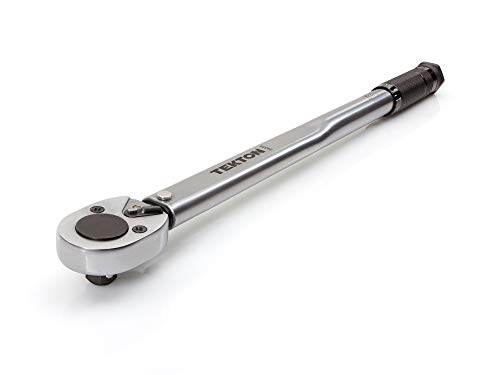
The TEKTON 24335 is the most recommended half-inch click wrench in this guide, and its range is the reason. Ten to 150 foot-pounds covers the lug nut specification of nearly every passenger car on the road. The micrometer style handle lets you dial in a value in one foot-pound steps, and the high contrast dual scale reads in foot-pounds and newton-meters even in dim garage light.
The wrench is built entirely from steel with a chrome vanadium reversible ratchet head, so there is no plastic in the parts that carry load. The knurled handle gives a firm grip, and the wrench arrives pre-calibrated to plus or minus 4 percent accuracy. Always return the handle to 10 foot-pounds before storage, or the spring will lose accuracy over time.
Specs: Drive size 1/2 inch; Range 10 to 150 foot-pounds, 13.6 to 203.5 newton-meters; Type micrometer click; Accuracy plus or minus 4 percent; Length 18-3/8 inches; Ratchet 24 tooth reversible; Construction all steel, chrome vanadium head; Case included; ASIN B00C5ZL0RU.
EPAuto 1/2-Inch Drive Click Torque Wrench

The EPAuto is the value pick in this guide, and it matches the TEKTON on the numbers that matter for lug nuts. It covers the same 10 to 150 foot-pound range with the same plus or minus 4 percent accuracy.
Where the EPAuto pulls ahead on practical value is the kit. It ships with a five inch extension bar and a half-inch to three-eighths drive reducer, plus a sturdy plastic storage case. The extension bar helps the socket reach lug nuts that sit deep inside a wheel, and the reducer lets the wrench drive smaller sockets for other jobs around the car. The handle is knurled for a non-slip grip, and at 16.25 inches long the wrench stays compact enough for a crowded toolbox while still giving enough leverage for 100 foot-pound lug nuts. It is pre-calibrated before shipping, and the same storage rule applies: return it to the lowest setting after every use.
Specs: Drive size 1/2 inch; Range 10 to 150 foot-pounds, 13.6 to 203.5 newton-meters; Type micrometer click; Accuracy plus or minus 4 percent; Length 16.25 inches; Weight 3.5 pounds; Model ST-010-1; Includes 5 inch extension bar, drive reducer, storage case; ASIN B01M1D17AW.
LEXIVON LX-183 Click Torque Wrench

The LEXIVON LX-183 stands out in this guide because of its paperwork. Every unit ships with a calibration certificate that carries a trackable serial number, so you can prove the wrench was checked before it left the factory and trace that certificate later. For a home mechanic who wants a record of accuracy, that certificate is a real advantage.
The wrench itself covers 10 to 150 foot-pounds with plus or minus 4 percent accuracy, and it uses a reinforced ratchet head made from hardened chrome vanadium alloy steel. Confirm the listing shows model LX-183 before ordering, because LEXIVON sells the same wrench family in quarter-inch and three-eighths drive versions with different model numbers.
Specs: Drive size 1/2 inch; Range 10 to 150 foot-pounds, 13.6 to 203.5 newton-meters; Type micrometer click; Accuracy plus or minus 4 percent; Length 17 inches; Weight 3 pounds; Model LX-183; UPC 840025215788; Includes calibration certificate with trackable serial number, storage case; ASIN B07MP1Q3W8.
Craftsman CMMT99434 Micrometer Torque Wrench

The Craftsman CMMT99434 is the wrench for trucks and heavy lug nuts in this guide. Its range runs 50 to 250 foot-pounds, which covers the higher lug nut specifications of full size trucks and SUVs that the 10 to 150 foot-pound wrenches cannot reach. The long handle gives the leverage needed to reach 200 foot-pounds without straining.
The scales are stamped into the metal housing rather than printed on it, so the numbers will not rub off after years of use. Craftsman states that it meets or exceeds the applicable ASME specifications for torque wrenches. The trade-off is the low end: a 50 foot-pound minimum is too high for most engine bolts and far too high for small fasteners, so this wrench is a second wrench for truck wheels and suspension work rather than a single wrench for everything.
Specs: Drive size 1/2 inch; Range 50 to 250 foot-pounds, 68 to 339 newton-meters; Type micrometer click; Locking collar; Scales stamped into metal housing; Model CMMT99434; UPC 885911610308; Case included; ASIN B07SQM2RQR.
ACDelco ARM601-4 Digital Torque Wrench

The ACDelco ARM601-4 is the only digital wrench in this guide, and it is the pick for anyone who wants to see the torque value live on a screen. Its range runs 14.8 to 147.5 foot-pounds, which covers passenger car lug nuts and most engine fasteners, and it measures with plus or minus 2 percent accuracy clockwise and plus or minus 3 percent counterclockwise. That tighter accuracy is the main reason to choose digital over click for work where the specification leaves little room for error.
It shows torque live on an LCD display in foot-pounds, newton-meters, inch-pounds, or kilogram-centimeters. When the target is reached, a buzzer sounds and an LED flashes. Peak mode holds the highest reading so you can check a bolt after the fact, and Trace mode follows the live value as you pull. Each unit ships with a NIST traceable calibration certificate, which matters for documented or warranty work. The wrench runs on four AAA batteries. Two limits are worth knowing: the display is not backlit, so reading it in a dim garage takes a flashlight, and the auto shut-off timer is short. Remove the batteries during long storage.
Specs: Drive size 1/2 inch; Range 14.8 to 147.5 foot-pounds, 20 to 200 newton-meters; Type digital with LCD display; Accuracy plus or minus 2 percent clockwise, plus or minus 3 percent counterclockwise; Modes Peak and Trace; Alerts buzzer and LED flash; Power 4 AAA batteries; Length 17-5/16 inches; Weight 3.9 pounds; Model ARM601-4; Standards ASME B107.14.14-2004, ISO 6789; Includes NIST traceable calibration certificate; ASIN B0081AQDIY.
Who Should Skip a Torque Wrench
Skip a torque wrench only if you never remove a wheel yourself and always have a shop handle tire rotations and brake work. In that case the shop owns the responsibility for correct torque, and a wrench would sit unused in your garage.
Skip the half-inch wrenches in this guide if your work is mostly small fasteners. A half-inch foot-pound wrench cannot measure the low values that small bolts need, and using one on a delicate fastener risks snapping it. For that work you need a quarter-inch or three-eighths drive wrench that reads in inch-pounds instead. Skip a digital wrench if you dislike batteries: a click wrench does the same job for lug nuts with no power source, and it costs less.
Frequently Asked Questions
What torque do car lug nuts need?
Check the owner’s manual for your exact car, because the number varies by model and wheel type. Most passenger cars call for 80 to 100 foot-pounds, while light trucks and SUVs often call for 100 to 140 foot-pounds, and full size trucks can call for more.
Can I use a torque wrench to loosen lug nuts?
No. Use a breaker bar or a lug wrench to break lug nuts loose, then use the torque wrench only for the final tightening. Loosening with a torque wrench can damage its internal mechanism and throw off its calibration, which defeats the purpose of owning one.
How often should a torque wrench be recalibrated?
Have it checked by a professional calibration service about once a year if you use it regularly, or after roughly 5,000 cycles. Store a click wrench at its lowest setting and never drop it, because a hard knock can shift the calibration at once.
Do I need a half-inch drive torque wrench for lug nuts?
Yes, for most cars. Half-inch drive matches the deep sockets used on wheels and handles the 80 to 150 foot-pound range that lug nuts need.
Final Verdict
The TEKTON 24335 is the best first torque wrench for car repairs and lug nuts because its 10 to 150 foot-pound range covers nearly every passenger car and its all-steel click design needs no batteries. Buy the EPAuto if you want the same coverage with an extension bar and reducer in the box, and buy the LEXIVON if a calibration certificate with a trackable serial number matters to you.
For trucks, add the Craftsman CMMT99434, because its 250 foot-pound top end reaches lug nut specifications that the 150 foot-pound wrenches cannot. For precision engine work, the ACDelco ARM601-4 earns its place with a digital readout, tighter accuracy, and NIST traceable paperwork. Confirm the listing matches the exact model number in this guide and recheck stock before ordering.