We independently review everything we recommend. When you buy through our links, we may earn a commission. As an Amazon Associate we earn from qualifying purchases.
5 Best Camping Knives for Outdoor Trips (November 2026)
Compare the best camping knives for outdoor trips, from fixed-blade knives to folding models, with blade steel, handle grip, sheath, and weight notes.
Compare the best camping knives for outdoor trips, from fixed-blade knives to folding models, with blade steel, handle grip, sheath, and weight notes.
A camp knife earns its place by doing many small jobs well: slicing food, trimming cord, feathering sticks for tinder, opening packages, and shaping tent pegs. The right blade feels secure in a wet hand, holds an edge through a weekend of use, and rides in a sheath that keeps it covered until needed. Blade steel, handle grip, sheath design, and weight all shape how a knife behaves at camp, and the balance between them matters more than any single feature.
This guide compares five camping knives sold on Amazon, from light fixed blades to a pocket folder and a heavy splitter. Each pick below carries a verified ASIN, with blade length, steel, handle, sheath, and weight checked against its listing. Use the guide to match a knife to your trips, and always check local carry rules before packing a fixed blade.
Quick Picks
As an Amazon Associate we earn from qualifying purchases
Product
Best for
Key spec from title
Morakniv Companion (S)
Light all-round camp work
4.1-inch stainless blade
Ka-Bar Becker BK2
Heavy splitting and batoning
5.25-inch 1095 Cro-Van blade
CIVIVI Elementum C907A
Pocket carry and everyday cuts
2.96-inch D2 folding blade
ESEE Izula II
Compact backup carry
2.63-inch 1095 carbon blade
Gerber Ultimate Survival Knife
All-in-one camp kit
4.8-inch half-serrated blade
How to Choose
Blade steel shapes edge care
Stainless steel shrugs off damp mornings and food acids, so it suits campers who wipe a blade down at night and move on. Carbon steel takes a keen edge and holds it through hard cutting, yet it wants drying and a light coat of oil after wet work, or spots and rust appear. D2 sits between the two, with strong wear resistance and a need for basic care. Match the steel to your habits: low-maintenance campers do better with stainless, while keen sharpeners may favor carbon.
Fixed blade or folder
A fixed blade has no pivot to loosen and no lock to fail, so it handles batoning, prying, and heavy carving with confidence. A folder slips into a pocket and weighs less, which suits day hikes and light camp chores. The trade is strength against convenience: folders should never baton wood, and a fixed blade needs a good sheath for safe carry. Choose a fixed blade when camp work is heavy, and a folder when the knife mostly opens packages and trims cord.
Handle grip and sheath
A handle should stay put in a wet or gloved hand. Rubberized grips, textured Micarta, and G10 all give traction in rain, while smooth plastic can turn slick with fish slime or sap. Check that the handle fills your palm without hot spots. The sheath matters as much as the handle: it should hold the knife with a firm click, cover the edge fully, drain water, and clip or loop onto a belt or pack without wobble. A lanyard hole adds a tether option for work near water.
Size and weight for the pack
Blade length sets what a knife can do. A compact blade near 2.6 inches excels at food prep and detail cuts and nearly vanishes in a pocket. A mid-size blade near 4 inches covers most camp chores, from carving to meal prep. A long blade past 5 inches splits kindling and handles heavy work but adds a pound to the pack. Weigh the blade against your trip: light hikers favor small and light, while base campers can carry heavier steel.
The 5 Best Options
Morakniv Companion (S)
Top Pick
Morakniv Companion (S)
Best for: light camp chores, food prep, and carving.
The Companion (S) is the easy first pick for campers who want a capable fixed blade without bulk. Its 4.1-inch stainless blade slices food, carves feather sticks, and trims cord with little effort, while the patterned grip stays secure in wet hands. At 4.3 ounces with a polymer sheath that clips to a belt, it disappears on a hip until needed. The Dala Red color is easy to spot in grass or leaf litter. The listing was still live with a current Amazon offer when checked in mid-November 2026, so confirm availability before ordering.
Ka-Bar Becker BK2
Runner-Up
Ka-Bar Becker BK2
Best for: splitting kindling and heavy camp work.
Blade: 5.25-inch 1095 Cro-Van carbon steel, drop point
The BK2 is a heavyweight built for hard camp work. Its quarter-inch-thick 1095 Cro-Van blade splits kindling, batons through branches, and pries without complaint, backed by a full tang and removable Ultramid scales. At a pound with its hard plastic sheath, it is the heaviest knife here, and its thick edge slices food less neatly than a thinner blade. For campers who process a lot of wood at a fixed camp, though, few knives inspire the same confidence.
The Elementum is the folder in this group, and it earns its place with a smooth flipper action and a 2.96-inch D2 blade that opens packages, trims cord, and preps food with ease. Black G10 scales give a secure grip, the liner lock holds firm, and caged ceramic bearings keep the action slick. It rides clipped in a pocket at a fraction of the weight of a fixed blade. Treat D2 with basic care and wipe it dry after wet use to keep the edge clean.
ESEE Izula II
The Izula II packs real capability into 3.2 ounces. Its 2.63-inch cutting edge of 1095 carbon steel handles food prep, cord, and light carving, while full Micarta scales give a four-finger grip that the original Izula lacked. The molded polymer sheath clips to a belt, pack, or neck cord, so the knife rides as a backup or a light primary. ESEE backs it with an unconditional lifetime warranty. Oil the carbon blade after wet trips to keep rust away.
Best for: compact backup carry and light packs.
Watch out for: carbon steel needs oiling, and the short blade is not for heavy splitting.
ASIN: B0CM8NCV67
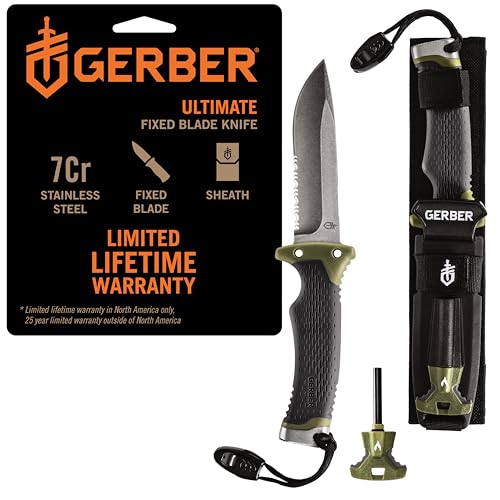
Gerber Ultimate Survival Knife
Gerber Ultimate Survival Knife
Best for: campers who want fire and signal tools in one sheath.
Blade: 4.8-inch stainless steel, half-serrated drop point
The Gerber Ultimate is a camp kit on a belt. Its 4.8-inch half-serrated stainless blade cuts rope and food alike, with a full tang, textured rubber grip, and steel hammer pommel for tent stakes. The sheath carries a sharpener, a ferro rod for lighting tinder, and an emergency whistle, so fire and signal tools travel with the blade. At 11 ounces it is no featherweight, yet campers who like one consolidated kit will value the package.
Which One Fits Your Situation
A first camp knife that covers the basics
New campers should reach for the Morakniv Companion (S). It is light, easy to sharpen, and forgiving in wet conditions thanks to its stainless blade. The sheath clips on and off without fuss, and the bright Dala Red handle is hard to lose at a busy campsite. Pair it with a small folding saw for wood processing, and it covers nearly every chore a first trip throws at it.
Heavy wood work at a fixed camp
When the trip centers on a base camp with a fire every night, the Ka-Bar Becker BK2 earns its pound. It splits kindling, batons branches, and handles prying that would snap a lighter blade. Keep a thinner knife alongside for food prep, since the BK2’s thick edge is clumsy at slicing. The weight is the trade for a blade that never feels out of its depth.
A light pack or a backup blade
Hikers counting ounces should carry the ESEE Izula II, either as a primary or as a backup to a larger blade. At 3.2 ounces it adds almost nothing to a pack, yet its Micarta grip and 1095 edge handle real cutting. The CIVIVI Elementum suits the same role in pocket form for campers who prefer a folder for daily tasks.
One kit with fire tools included
Campers who like consolidated gear should pick the Gerber Ultimate. The ferro rod, whistle, and sharpener ride in the sheath, so fire lighting and signaling stay with the knife rather than scattered through a pack. It suits car campers and base camps where a single grab-and-go sheath covers the essentials.
Common Mistakes
Choosing a blade far bigger than the trip needs, then leaving it behind because of the weight.
Forgetting that carbon steel rusts if packed away wet; dry and oil it after every damp trip.
Batoning wood with a folding knife, which can break the pivot or lock.
Ignoring local carry rules for fixed blades before packing one in a bag.
Judging a knife by looks alone without checking that the sheath holds it securely.
Frequently Asked Questions
What blade length works best for camping?
A blade between 3 and 5 inches covers most camp chores, from food prep to carving feather sticks. Shorter blades near 2.6 inches suit detail work and light packs, while blades past 5 inches help with splitting and heavy cutting. Match length to the work you actually do rather than the biggest blade you can carry.
Is stainless or carbon steel better for camp use?
Stainless steel resists rust and needs little care, which suits damp trips and campers who pack a knife away wet. Carbon steel takes a sharper edge and holds it longer, but it wants drying and a light coat of oil after use. Either works at camp; the better choice is the one whose care routine you will actually follow.
Can a folding knife handle camp work?
A good folder handles food prep, cord, and packages with ease, and it carries more comfortably than a fixed blade. It should not baton wood or pry, since the pivot and lock are the weak points. For heavy camp work, pair a folder with a fixed blade or a small saw rather than forcing one tool to do everything.
What should a camp knife sheath include?
A good sheath holds the knife with a firm click, covers the edge fully, and attaches securely to a belt or pack. A drain hole helps after wet use. Extras such as a ferro rod, whistle, or sharpener are useful when they ride in the sheath, since they stay with the knife instead of getting lost in a pack.
C
Carros Editorial Team
We compare specs, materials and verified owner reviews before a product earns a spot. Rankings are never paid.
Affiliate disclosure. As an Amazon Associate we earn from qualifying purchases at no extra cost to you. Prices accurate as of the date shown.
The best rechargeable CR123A batteries compared by chemistry, voltage and charger: SureFire LiFePO4, Tenergy and Nitecore RCR123A cells, plus the safety checks that matter first.
The best batteries for the Traxxas 1/16 E-Revo VXL compared: Traxxas Series 1 NiMH, HRB and Gens ace 2S 2200mAh LiPo packs, fit, connectors, parallel running, and charging safety.
How to choose a 510 thread battery for Brass Knuckles vape cartridges: voltage ranges, draw vs button activation, cartridge fit, charging, and safety checks explained.
How to pick a stereo keyboard amplifier with balanced line outputs, from power and speaker size to XLR outs, stereo linking, and the five models that set the standard.
A radial drill press swings its head out from the column to reach wide boards and off-centre holes. Learn how swing, spindle travel, speeds and chuck size decide the right machine.
Diamond-frame commuter e-bikes explained: fit, motor feel, battery range, and the equipment that makes a daily ride work, plus the mistakes to avoid before buying.
Find the best tablets under 125 for streaming, reading, school and family use. Compare five budget tablets with strong battery life and sharp displays.
Find the best window fans to cool a room with our guide to twin-blade models, thermostats, remotes, and window fit — compare airflow, noise, and controls.


 Gerber Ultimate Survival Knife