We independently review everything we recommend. When you buy through our links, we may earn a commission. As an Amazon Associate we earn from qualifying purchases.
5 Best Robotic Pool Vacuum Cleaners (November 2026)
Compare robotic pool vacuum cleaners for pools, with cordless robots, wall-climbing brushes and smart navigation that clean floors and waterlines daily.
Compare robotic pool vacuum cleaners for pools, with cordless robots, wall-climbing brushes and smart navigation that clean floors and waterlines daily.
A robotic pool vacuum changes the weekly chore of pool care into a job that runs while you do something else. The real decision is not whether a robot helps, but which kind fits your pool: a corded model that runs as long as it is plugged in, or a cordless model that trades runtime for freedom from cables. Coverage matters too, since some robots clean the floor only while others climb walls and scrub the waterline. Pool size, runtime, filtration, and the way the robot moves all shape the result you get.
This guide suits inground pool owners, above-ground pool owners, and anyone who wants a cleaner pool without manual vacuuming. The five robots below were chosen from the names and specifications shown on their Amazon pages, covering corded and cordless designs, small flat pools and larger inground pools, so you can match a robot to the pool you actually own.
Quick Picks
As an Amazon Associate we earn from qualifying purchases
Product
Best for
Key spec from title
Dolphin Cayman
Scheduled weekly cleaning
SmartNav 2.0 mapping, weekly timer
AIPER Scuba SE
Simple cordless cleaning
90-minute battery, 860 sq ft coverage
AIPER Seagull 2025
Water balancing while vacuuming
Built-in chemical dispenser, 90-minute battery
Dolphin Nautilus CC
Bundle with caddy and cover
Pools up to 33 feet, 2-hour cycle
WYBOT C1 (2026 Upgrade)
Large inground pools
150-minute runtime, 1,614 sq ft coverage
How to Choose
Corded or cordless
Corded robots draw power from an outlet through a cable, so they run for a full cycle without worrying about battery life, and they carry stronger suction and wall-climbing ability. The trade is the cable: it needs a nearby outlet, it can tangle if the robot turns often, and it adds weight when you lift the robot out. Cordless robots run on a rechargeable battery, so you drop one in, press a button, and lift it out when it parks near the edge. The trade is runtime, usually 90 to 150 minutes, and a recharge of two to three hours between cycles. Choose corded for large inground pools and heavy debris; choose cordless for small pools and simple handling.
Pool size and coverage
Match the robot to the size of your pool before anything else. A robot built for pools up to 860 square feet will not finish a 1,600-square-foot inground pool on one charge, and a large robot is awkward in a small above-ground pool. Coverage is the second question: floor-only robots suit flat pools, while wall-climbing robots scrub the sides where algae and grime gather. Waterline cleaning matters if a dirty ring forms at the surface, and it is the hardest job for a budget robot. Check the listing for the pool size it covers and the surfaces it cleans, and buy the robot that covers your whole pool, not just the easy middle.
Runtime and charging
Runtime decides whether the robot finishes the job in one go. A 90-minute cordless robot suits a small above-ground pool, while a 150-minute robot covers a much larger inground pool before it needs a recharge. Look at the recharge time too: a robot that needs three hours on the charger cannot run a second cycle the same afternoon. Corded robots avoid this question entirely, since they run until you switch them off. Self-parking is a feature that saves effort, because the robot returns to the edge when the battery runs low instead of stopping in the middle of the pool. If your pool is large, favour long runtime and a short recharge over extra modes you may never use.
Filtration and debris handling
A robot is only as good as its filter. A large top-load basket holds leaves and twigs without clogging halfway through a cycle, and it is easier to empty than a small cartridge hidden under the body. Fine mesh catches sand and silt, while a coarse basket lets fine dirt pass back into the water. If your pool sits under trees, favour a big basket and a wide intake over a slim design. A built-in chemical dispenser is a bonus on some cordless models, keeping the water balanced while the robot works. Whatever you choose, empty the basket after every cycle: a full filter cuts suction, shortens runtime, and leaves debris behind on the next run.
The 5 Best Options
Dolphin Cayman
Top Pick
Dolphin Cayman
Best for: Inground pools up to 33 feet where a scheduled weekly clean matters.
The Dolphin Cayman is a corded robot built for inground pools up to 33 feet, and it pairs a weekly timer with SmartNav 2.0 mapping so the robot covers the pool instead of wandering. Dual 24-volt motors drive the HyperBrush, which spins twice as fast as a standard brush to loosen stuck grime, while the MaxBin basket holds a load of leaves and debris. HyperGrip rubber tracks keep it moving across floors and up walls, and the 50-foot cable gives it room to reach the far end. It cleans floors and walls in each cycle, and the power supply lets you set a weekly schedule.
Watch out for: No waterline cleaning; the cable needs a nearby outlet and adds weight when you lift the robot out.
AIPER Scuba SE
Runner-Up
AIPER Scuba SE
Best for: Above-ground pools with flat floors where a simple cordless clean matters most.
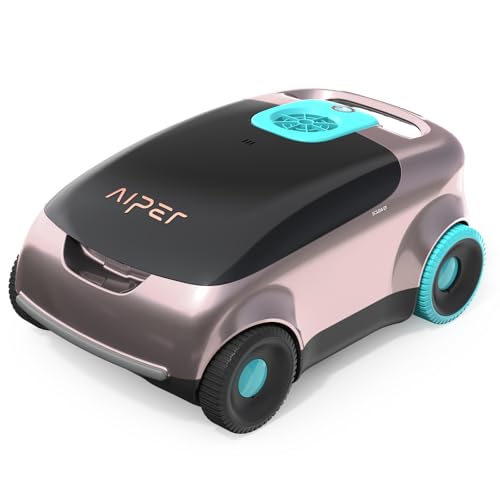
The AIPER Scuba SE is a cordless robot made for above-ground pools with flat floors, and it keeps the job simple: one button, no cable, and a self-parking return when the battery runs low. Dual-drive motors produce 1,200 GPH of suction, and the two-litre filter box holds a cycle of dirt and leaves. A 90-minute battery covers pools up to 860 square feet, and the hydrodynamic shape helps the robot glide across the floor instead of fighting drag. Audio alerts tell you when the battery is low, the impeller is blocked, or water has reached the motor, and the quick-drain system empties most of the stored water in seconds.
Watch out for: Floor cleaning only; a 90-minute battery may not finish a large pool in one cycle.
AIPER Seagull 2025
AIPER Seagull 2025
Best for: Above-ground flat pools where you want the water balanced while the floor is vacuumed.
The AIPER Seagull 2025 is another cordless robot for above-ground pools, and it adds a built-in chemical dispenser that helps balance the water while the robot vacuums the floor. A single charge gives up to 90 minutes of runtime for flat pools up to 860 square feet, and the self-parking design brings the robot to the wall when the cycle ends so you can lift it out without wading in. One-touch operation begins the clean with a single press, and quick drainage empties the body fast for storage. The lithium-ion battery holds 44.4 watt-hours, and the light body is easy to carry to and from the pool.
Watch out for: Floor cleaning only; it does not climb walls or scrub the waterline.
Dolphin Nautilus CC
Dolphin Nautilus CC
Best for: Pools up to 33 feet where a bundle with caddy and cover makes storage easy.
The Dolphin Nautilus CC is a corded robot for pools up to 33 feet, sold as a bundle with a caddy and a cover so moving and storing it is easy. An active scrubbing brush works the floor and walls while 4,000 GPH of suction pulls in dirt, and the filter basket lifts out for a rinse. A cycle runs for two hours, and the robot climbs walls to reach grime above the floor. There is no timer and no app, so you switch it on at the power supply and it runs one cycle, which suits owners who prefer a machine with nothing to program.
Watch out for: No weekly timer and no app control; each cycle runs only when you switch it on.
WYBOT C1 (2026 Upgrade)
The WYBOT C1 is the cordless robot for a large inground pool, with a 150-minute battery that covers up to 1,614 square feet and a four-in-one clean that takes in floors, walls, the waterline, and steps. Smart Navigation 3.0 maps the pool and picks S-shaped paths for floors and N-shaped paths for walls, while 3,038 GPH of suction and a 180-micron filter basket trap sand, leaves, and fine debris. App control lets you choose a mode and check the robot from your phone, and a 24-month warranty backs the machine. At 150 minutes per charge it outlasts the cordless AIPER picks, which matters when the pool is big.
Specs
Cordless, battery powered
150-minute runtime
Pools up to 1,614 square feet
4-in-1 cleaning: floor, wall, waterline, steps
3,038 GPH suction
Smart Navigation 3.0
App control
180-micron filtration
Model OS7010C C1 Pool Vacuum
24-month warranty
Best for: Large inground pools where walls, waterline, and a long cordless runtime matter.
Watch out for: A newer model with a shorter track record; it is heavier to lift out than the smaller cordless robots.
Which One Fits Your Situation
A large inground pool with walls and a waterline
Pick a robot that climbs walls and scrubs the waterline, with enough runtime to cover the whole pool in one cycle. The WYBOT C1 fits here with its 150-minute battery and four-in-one coverage, while the Dolphin Cayman covers walls on a corded supply with a weekly timer. Skip floor-only cordless robots for this pool: they will leave the walls and the waterline ring untouched.
A small above-ground pool with a flat floor
A small flat pool needs a light cordless robot, not a heavy corded machine. The AIPER Scuba SE and the AIPER Seagull 2025 both run for 90 minutes and cover up to 860 square feet, which suits a round above-ground pool. The Seagull 2025 adds a chemical dispenser, while the Scuba SE adds audio alerts and a larger filter box. Either one lifts out easily and stores in a corner.
A pool owner who wants a schedule and no fuss
If you want the pool cleaned on a set routine without touching the robot, a corded Dolphin with a timer is the easy answer. The Cayman runs on a weekly timer from its power supply, so the pool gets cleaned while you are away. The Nautilus CC is simpler still, with no timer and no app: you switch it on and it runs one two-hour cycle. Both need a nearby outlet and a little room for the cable.
A household that wants app control and the longest runtime
App control and a long battery suit a big pool that takes time to clean. The WYBOT C1 is the only pick here with both: 150 minutes of runtime and an app for choosing modes. It also covers walls and the waterline, so one robot handles the whole job. The trade is weight and a newer name in the market, so lift it out with care and keep the filter basket clean after every cycle.
Common Mistakes
Buying a floor-only robot for a pool with dirty walls and a waterline ring.
Choosing a robot built for 860 square feet when the pool covers twice that area.
Ignoring the cable: a corded robot needs an outlet close to the pool edge.
Leaving the filter basket full between cycles, which cuts suction on the next run.
Picking a suction-side or pressure-side cleaner by mistake when you wanted a robot that runs on its own.
Frequently Asked Questions
Can a robotic pool vacuum clean the walls and waterline?
Some can and some cannot. The WYBOT C1 and both Dolphin robots in this guide climb walls, and the WYBOT C1 also scrubs the waterline. The two AIPER cordless robots clean the floor only, which suits flat above-ground pools. Check the listing for wall and waterline cleaning before you buy, since a floor-only robot will leave the ring at the surface untouched.
How long does a cordless pool robot run on one charge?
The cordless robots here run for 90 to 150 minutes on one charge. The AIPER Scuba SE and Seagull 2025 run for up to 90 minutes, which covers pools up to 860 square feet. The WYBOT C1 runs for up to 150 minutes and covers up to 1,614 square feet. Recharging takes two to three hours, so a cordless robot cannot run a second cycle right after the first.
Do I need a pool pump for a robotic pool vacuum to work?
No. A robotic pool vacuum runs on its own power, either from an outlet through a cable or from a rechargeable battery, and it does not connect to the pool pump. That is the point of a robot: it cleans on its own while the pump stays off. Suction-side and pressure-side cleaners are different machines that do use the pump, and they are not the robots covered in this guide.
How often should I empty the filter basket?
Empty the basket after every cycle. Leaves, sand, and twigs build up fast, and a full basket cuts suction and shortens the next run. Lift the basket out, rinse it with a hose, and let it dry before you put it back. A clean filter also keeps fine dirt from washing back into the pool, so the water stays clear between cycles.
C
Carros Editorial Team
We compare specs, materials and verified owner reviews before a product earns a spot. Rankings are never paid.
Affiliate disclosure. As an Amazon Associate we earn from qualifying purchases at no extra cost to you. Prices accurate as of the date shown.
The best rechargeable CR123A batteries compared by chemistry, voltage and charger: SureFire LiFePO4, Tenergy and Nitecore RCR123A cells, plus the safety checks that matter first.
The best batteries for the Traxxas 1/16 E-Revo VXL compared: Traxxas Series 1 NiMH, HRB and Gens ace 2S 2200mAh LiPo packs, fit, connectors, parallel running, and charging safety.
How to choose a 510 thread battery for Brass Knuckles vape cartridges: voltage ranges, draw vs button activation, cartridge fit, charging, and safety checks explained.
How to pick a stereo keyboard amplifier with balanced line outputs, from power and speaker size to XLR outs, stereo linking, and the five models that set the standard.
A radial drill press swings its head out from the column to reach wide boards and off-centre holes. Learn how swing, spindle travel, speeds and chuck size decide the right machine.
Diamond-frame commuter e-bikes explained: fit, motor feel, battery range, and the equipment that makes a daily ride work, plus the mistakes to avoid before buying.
Find the best tablets under 125 for streaming, reading, school and family use. Compare five budget tablets with strong battery life and sharp displays.
Find the best window fans to cool a room with our guide to twin-blade models, thermostats, remotes, and window fit — compare airflow, noise, and controls.



 Dolphin Nautilus CC