We independently review everything we recommend. When you buy through our links, we may earn a commission. As an Amazon Associate we earn from qualifying purchases.
5 Best Golf Cart Solenoids for Quick Starts (November 2026)
Find the best golf cart solenoids for Club Car, EZGO and Yamaha carts. Compare 36V and 48V solenoids, amperage and fitment for reliable starts.
Find the best golf cart solenoids for Club Car, EZGO and Yamaha carts. Compare 36V and 48V solenoids, amperage and fitment for reliable starts.
A solenoid is the heavy switch between your battery pack and your motor controller. When you press the pedal, the small coil inside pulls the big contacts closed, and full pack current flows to the motor. When those contacts wear out or the coil fails, the cart clicks, hesitates, or sits silent even with a full charge. The five units below cover the most common golf cart setups: 36V and 48V electric carts from Club Car and EZGO, including older TXT and Marathon models and newer TXT and Precedent carts.
Every pick states its voltage, cart family, and OEM number, so you can match it against the part already on your cart before ordering. Voltage comes first: a 36V coil on a 48V pack will burn out, and a 48V coil on a 36V pack may never pull in. After voltage, fitment decides everything else, from terminal layout to mounting style and whether a resistor and diode come in the box.
Quick Picks
As an Amazon Associate we earn from qualifying purchases
Product
Best for
Key spec from title
CLUBRALLY EZGO 36V 4 Terminal
Older EZGO TXT carts
36V, 4-terminal, OEM 20468G1
GODCTSUP Club Car 48V
Club Car DS and Precedent carts
48V, 4-terminal with resistor, OEM 101908701
Drive-up EZGO TXT 48V
2010-up TXT and MPT carts
48V, OEM 612711, copper build
Wieoncke MZJ-100A 48V
Lifted and multi-passenger carts
48V, 100A, MZJ series contactor
GODCTSUP EZGO 36V 70 Series
TXT and Marathon 1980-2010
36V kit with resistor and diode, OEM 27855-G01
How to Choose
Match the voltage to your battery pack
Count your batteries and check the pack voltage before you shop. Six 6V batteries make a 36V pack, six 8V batteries make a 48V pack, and gas carts run a single 12V battery for the ignition circuit. The coil voltage on the solenoid must match that pack exactly. A coil built for a lower voltage will overheat and fail early on a higher-voltage pack, while a coil built for a higher voltage may stay silent on a lower-voltage pack because the magnetic pull never gets strong enough. When the listing shows several voltage options, read the variant name and confirm the one you need.
Match the OEM number and cart family
Golf cart makers change solenoid designs across model years, so the OEM number on your old part is the most reliable match. Pull the old solenoid, read the number stamped on its case or label, and compare it with the numbers in the listing. Club Car DS and Precedent carts use different 48V units across year ranges, and EZGO TXT carts split between the 36V 70 series, the 36V 20468G1 unit, and the 48V 612711 unit. A part that fits a neighbor cart can still leave your cart dead if the year range or controller type differs, so treat the OEM number as the final check.
Check the terminal layout and mounting
Most golf cart solenoids use four terminals: two large posts for the battery and controller cables, and two small posts for the coil wires. Before ordering, count the terminals on your old unit and note which side the small posts sit on. Some units add a resistor across the large posts and a diode across the small ones, and those parts protect the controller from voltage spikes when the contacts open. Check the mounting style too. Some solenoids bolt flat to a panel, others use a bracket, and a unit with the wrong footprint will not sit square on your cart even if the wiring matches.
Decide how much current capacity you need
Standard carts run fine on a 100A to 150A unit, and that range covers most stock Club Car and EZGO setups. Lifted carts with larger tires, multi-passenger carts, and carts with upgraded controllers draw more current under load, so a heavier unit gives the contacts a longer life. The MZJ series in this guide runs from 50A to 1000A, and the 100A and 200A versions suit most upgraded carts. Do not chase the biggest number on the page. A 600A or 1000A contactor adds bulk and weight without helping a stock cart, and the money is better spent on fresh cables and clean terminals.
The 5 Best Options
CLUBRALLY EZGO 36V 4 Terminal Solenoid
Top Pick
CLUBRALLY EZGO 36V 4 Terminal Solenoid
Best for: Owners of 1989-up EZGO TXT 36V carts who want a direct OEM 20468G1 replacement.
This CLUBRALLY unit is the direct 36V replacement for 1989-up EZGO TXT carts, built around OEM number 20468G1. It uses a four-terminal, four-pole layout with screw connectors and a panel mount, so it drops into the stock location without new holes or adapter plates. The 36V DC coil matches the six-battery pack found on older TXT carts, and the nylon and plastic body keeps the unit light at 1.27 pounds. Note that the listing groups several Club Car and EZGO fitments on one page, so select the 36V EZGO variant with OEM 20468G1 when ordering.
GODCTSUP Club Car 48V Solenoid
This GODCTSUP 48V solenoid covers Club Car DS carts from 1995-up and Precedent carts from 2004 to 2008, the two most common electric Club Car families on the road. It ships as a four-terminal unit with a resistor in the box, and the resistor mounts across the large posts to soften the load on the controller. The metal body and black finish suit the battery compartment, and the 0.5-kilogram package keeps the swap simple. Match OEM numbers 101908701 or 102774701 against your old part, since Club Car changed solenoid styles across these year ranges.
Specs
Brand: GODCTSUP
Model: Club Car 48V Solenoid
Fits: Club Car DS 1995-up and Precedent 2004-2008 electric
Voltage: 48V
Terminals: 4
OEM numbers: 101908701, 102774701
Included components: 1 solenoid, 1 resistor
Color: Black
Material: Metal
Package dimensions: 4.57 x 4.13 x 3.03 inches
Package weight: 0.5 Kilograms
Best for: Club Car DS 1995-up and Precedent 2004-2008 owners who need a 48V unit with a resistor.
Watch out for: Club Car used more than one 48V solenoid style in these years, so check the OEM number on your old part.
ASIN: B0DHVBLVBS
Drive-up EZGO TXT 48V Solenoid
Runner-Up
Drive-up EZGO TXT 48V Solenoid
Best for: 2010-up EZGO TXT and 48V MPT owners who need the OEM 612711 unit.
Brand: DRIVE UP
Item model number: 612711
Fits: EZGO TXT 48V electric 2010-up and all 48V MPT 800/1000 vehicles
This Drive-up unit fits EZGO TXT electric carts from 2010-up and all 48V MPT 800 and 1000 vehicles, built around OEM number 612711. The copper build and black finish suit the battery compartment, and the compact 380-gram body fits tight spaces near the controller. It is a four-terminal 48V solenoid, so the wiring follows the standard TXT layout with two large posts for the battery and controller cables and two small posts for the coil. Confirm the 612711 number on your old solenoid, since EZGO used a different 48V unit on earlier TXT carts.
Wieoncke MZJ-100A 48V Contactor Solenoid
Wieoncke MZJ-100A 48V Contactor Solenoid
Best for: Lifted and multi-passenger 48V carts that need a heavier contactor than stock.
The Wieoncke MZJ-100A is the heavy-duty pick in this guide, a 48V contactor solenoid from the MZJ series for lifted carts, multi-passenger carts, and towing work. The series runs from 50A to 1000A, and the 100A version suits most upgraded carts without the bulk of the larger frames. Coil options cover 12V through 120V, so order the 48V variant to match a 48V pack. Its contactor design handles repeated switching under load, which matters when big tires and extra passengers push the current draw above stock levels.
GODCTSUP EZGO 36V 70 Series Solenoid Relay
GODCTSUP EZGO 36V 70 Series Solenoid Relay
Best for: Owners of 1980-2010 EZGO TXT and Marathon carts who want a full kit with resistor and diode.
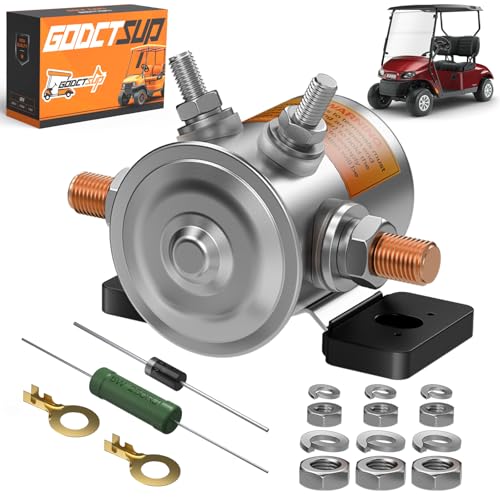
This GODCTSUP kit is the 70 series continuous-duty solenoid for EZGO TXT and Marathon electric carts from 1980 to 2010, built around OEM numbers 27855-G01, 11761G1, 27855G02, and 31680G1. The box includes the solenoid relay, a resistor, a diode, copper wire lugs, nuts, and washers, so the swap needs no extra hardware. The 36V DC coil uses 2no 2nc contacts with a screw mount, and the kit carries a 1-year warranty. It suits owners of older TXT and Marathon carts who want the resistor and diode included rather than sourced separately.
Which One Fits Your Situation
Your cart clicks but will not move
A click with no movement points at the solenoid contacts or coil, and a direct OEM replacement is the fastest fix. Club Car DS and Precedent owners should match OEM 101908701 or 102774701 with the GODCTSUP 48V unit, while 2010-up EZGO TXT owners should match OEM 612711 with the Drive-up unit. Swap one wire at a time and keep the resistor and diode in place.
You run a lifted cart with big tires
Lifted carts draw more current than stock carts, so a heavier contactor earns its keep. The Wieoncke MZJ-100A 48V handles the extra load from larger tires and extra passengers, and the MZJ series scales up to 1000A if the build grows further. Pair it with clean terminals and fresh cables so the new contactor never fights corrosion.
You own an older TXT or Marathon
Older EZGO carts split between two 36V solenoids, so the OEM number decides. Carts with OEM 20468G1 take the CLUBRALLY 36V unit, while carts with OEM 27855-G01 take the GODCTSUP 70 series kit with its resistor and diode. Read the number on the old case before ordering, since the two units look similar at a glance.
You want a complete kit in one box
Some owners would rather open one box and find every part inside. The GODCTSUP 70 series kit includes the solenoid, resistor, diode, lugs, nuts, and washers, which covers the full swap on 1980-2010 TXT and Marathon carts. The GODCTSUP Club Car 48V unit also includes a resistor. Keep the small hardware in a tray during the swap so nothing rolls away.
Common Mistakes
Ordering by voltage alone and skipping the OEM number, which leaves the cart with the wrong terminal layout or mounting style.
Fitting a 48V coil on a 36V pack, or the reverse, and wondering why the cart stays silent or the coil burns out.
Buying a solenoid valve or a forklift contactor instead of a golf cart solenoid, which will not fit the cart or the wiring.
Tossing the resistor and diode during the swap, which leaves the controller open to voltage spikes.
Tightening the large-post nuts with too much force and cracking the case or spinning the post.
Frequently Asked Questions
How do I know my solenoid has failed?
A cart that clicks once and never moves, a cart that moves only after several pedal presses, or a cart with a silent solenoid and a charged pack all point at a failed unit. Check the battery voltage first, then listen for the click at the solenoid when the pedal goes down. No click with good pack voltage means the coil or the wiring has failed.
Can I use a 48V solenoid on a 36V cart?
No. The coil voltage must match the battery pack, because a 48V coil on a 36V pack may never pull the contacts closed. The cart will sit silent even with a full charge. A 36V coil on a 48V pack faces the opposite trouble and can overheat. Match the coil to the pack, then match the OEM number to the cart.
Do I need the resistor and diode?
Most 36V and 48V golf cart solenoids ship with a resistor across the large posts, and many add a diode across the small posts. The resistor softens the load on the controller, and the diode blocks voltage spikes when the coil releases. If your old unit had them, fit the new ones the same way and do not leave them out.
How long does a swap take?
Most owners finish a solenoid swap in under an hour with basic hand tools. Photograph the wiring before you remove anything, then move one wire at a time to the new unit so the layout stays identical. Disconnect the battery pack first, keep the resistor and diode in place, and torque the large-post nuts gently to avoid cracking the case.
C
Carros Editorial Team
We compare specs, materials and verified owner reviews before a product earns a spot. Rankings are never paid.
Affiliate disclosure. As an Amazon Associate we earn from qualifying purchases at no extra cost to you. Prices accurate as of the date shown.
The best rechargeable CR123A batteries compared by chemistry, voltage and charger: SureFire LiFePO4, Tenergy and Nitecore RCR123A cells, plus the safety checks that matter first.
The best batteries for the Traxxas 1/16 E-Revo VXL compared: Traxxas Series 1 NiMH, HRB and Gens ace 2S 2200mAh LiPo packs, fit, connectors, parallel running, and charging safety.
How to choose a 510 thread battery for Brass Knuckles vape cartridges: voltage ranges, draw vs button activation, cartridge fit, charging, and safety checks explained.
How to pick a stereo keyboard amplifier with balanced line outputs, from power and speaker size to XLR outs, stereo linking, and the five models that set the standard.
A radial drill press swings its head out from the column to reach wide boards and off-centre holes. Learn how swing, spindle travel, speeds and chuck size decide the right machine.
Diamond-frame commuter e-bikes explained: fit, motor feel, battery range, and the equipment that makes a daily ride work, plus the mistakes to avoid before buying.
Find the best tablets under 125 for streaming, reading, school and family use. Compare five budget tablets with strong battery life and sharp displays.
Find the best window fans to cool a room with our guide to twin-blade models, thermostats, remotes, and window fit — compare airflow, noise, and controls.


 GODCTSUP EZGO 36V 70 Series Solenoid Relay