We independently review everything we recommend. When you buy through our links, we may earn a commission. As an Amazon Associate we earn from qualifying purchases.
Best Jumper Cables for Cars: 5 Picks for Dead Batteries
Compare the best jumper cables for cars by gauge, length, clamp style and maker amp ratings, plus the safe connection order and five picks for any vehicle.
Compare the best jumper cables for cars by gauge, length, clamp style and maker amp ratings, plus the safe connection order and five picks for any vehicle.
A dead battery rarely picks a convenient moment. It happens in a cold parking lot, at the end of a long workday, or right before a trip you cannot afford to miss. A good set of jumper cables turns that situation into a ten-minute fix, provided a second vehicle is nearby and the cables are thick enough, long enough, and in good condition when you pull them out of the trunk.
The five sets below cover the main types drivers actually buy: a heavy-duty 1-gauge set for trucks and SUVs, a 30-foot quick-connect set for awkward parking, two 4-gauge copper-clad aluminum sets with carry bags, and a compact 10-gauge set sized for small cars. Each one is a real product with a confirmed listing, and the specs quoted are the figures the makers themselves publish.
As an Amazon Associate, we earn from qualifying purchases.
How to Choose Jumper Cables
Gauge is the first number to understand, and it runs backwards: a lower gauge number means a thicker cable that carries more current. A 1-gauge or 2-gauge set suits trucks, SUVs, and diesel engines. A 4-gauge set covers most cars and crossovers. A 10-gauge set is a compact-car option only, and makers position it for smaller batteries.
Length matters just as much. Twelve feet works when two cars can park nose to nose. Twenty feet lets the donor car sit beside or slightly behind the dead one. Twenty-five to thirty feet covers front-to-back parking and batteries mounted far from the grille. Longer cables lose a little voltage along the run, which is why long sets usually pair extra length with a thicker gauge.
Clamps decide whether the connection holds. Look for strong springs, teeth that bite into the terminal, and insulation over the handles. Clamps that fit both top-post and side-post terminals add flexibility, since you cannot choose the battery design of the car that rescues you.
However the cables are built, the connection order stays the same, and maker instructions repeat it for a reason. With both engines off, connect the red clamp to the positive terminal of the dead battery, then the other red clamp to the positive terminal of the good battery. Connect the black clamp to the negative terminal of the good battery. Connect the last black clamp to a clean, unpainted metal part of the dead car’s engine block or chassis, away from the battery, never to the dead battery’s negative terminal. That final connection can spark, and keeping it away from the battery keeps sparks away from the hydrogen gas batteries vent. Start the good car, let it run a few minutes, then start the dead car, and remove the cables in exact reverse order. Wear eye protection, keep flames and metal objects away from both batteries, and make sure the two vehicles never touch each other.
Energizer Jumper Cables, 1-Gauge, 25 Feet
Top Pick
Energizer Jumper Cables, 1-Gauge, 25 Feet
Gauge: 1 gauge
Length: 25 feet
Maker-stated rating: 800 amps
Clamps: Parrot-style, vinyl-coated handles, top- and side-post fit
This is the heavy-duty pick of the group. Energizer rates the ENB125 at 800 amps and builds it with 1-gauge copper-clad aluminum conductors, the thickest cable class most drivers will ever need. The maker says the set is intended for trucks, SUVs, full-size cars, and smaller vehicles alike, and the vinyl coating is designed to stay flexible in severe cold, down to 40 degrees below zero Fahrenheit according to the brand.
The clamps use a parrot-style jaw with vinyl-coated handles, sized for top- and side-post terminals. At 25 feet, the cables reach between vehicles parked front to back, which is where shorter sets fail. A carrying bag is included, and Energizer backs the set with a two-year warranty. The trade-off is bulk: this coil is heavy, and it takes real trunk space.
Thirty feet is the longest reach in this roundup, and it changes how you park. The donor vehicle can stay behind the dead one, off to the side, or wherever the lot allows, and the cables still bridge the gap. TOPDC rates this 1-gauge set at 800 amps and fits it with UL-listed clamps, which the maker offers as its safety certification for the clamp design.
The quick-connect layout is the defining feature. A short lead stays attached near the battery of a vehicle you jump often, such as a tow truck, plow, or fleet car, and the long cable plugs into it instead of clamping on every time. For a single family car that design is more than you need, but for repeated jumps it removes the fiddliest step. A carry bag is included. At over eleven pounds, this is a working set, not a glovebox spare.
TOPDC Jumper Cables, 4-Gauge, 20 Feet
TOPDC Jumper Cables, 4-Gauge, 20 Feet
Gauge: 4 gauge
Length: 20 feet
Maker-stated rating: 200 amps
Clamps: Alligator clamps, rubber-insulated, top- and side-post fit
If the Energizer is the heavy-duty answer, this TOPDC set is the organized one. The 4-gauge copper-clad aluminum cables run 20 feet, long enough for side-by-side and most front-to-back jumps, and the listing copy rates the set at 200 amps for cars, SUVs, and trucks. The PVC jacket is built to resist freezing, cracking, and folding, and the maker states an operating range from 40 degrees below zero to 140 degrees Fahrenheit.
The four alligator clamps have jagged teeth, reinforced jaws, and insulating rubber covers, and they grip both top-post and side terminals. What sets this kit apart is storage: it ships in a 600D Oxford fabric carry bag with a zipper, plus a printed step-by-step jump-start guide, so the safe connection order is always with the cables. TOPDC states a five-year quality guarantee for the set.
CARTMAN Jumper Cables, 4-Gauge, 20 Feet
CARTMAN Jumper Cables, 4-Gauge, 20 Feet
Gauge: 4 gauge
Length: 20 feet
Maker-stated rating: 400 amps
Clamps: Patented rubber-covered clamps, top- and side-post fit
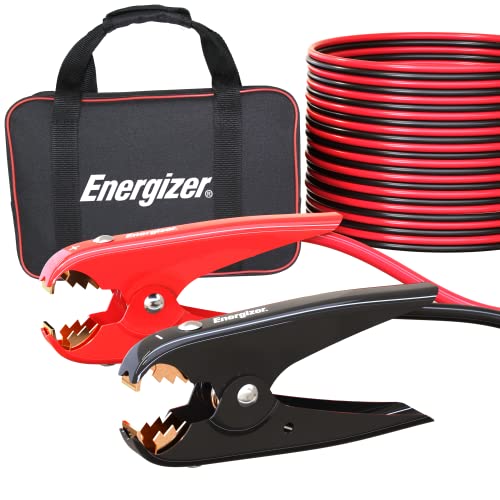
Cartman’s BC0420K takes a different route to cold-weather flexibility. Instead of PVC, the 4-gauge copper-clad aluminum conductors wear a T-Prene synthetic rubber coating that the maker says stays flexible down to minus 13 degrees Fahrenheit and resists motor oil, rain, and chemicals. Published specs rate the set at 400 amps, and the cables are UL listed.
The clamps are the highlight. Cartman uses a patented design with non-conducting rubber covers, triple polarity identification that is color-coded and stamped, and jaws shaped for both top-post and side-post batteries. The kit goes further than most: the carry bag also holds work gloves and a wire brush for cleaning corroded terminals before you clamp on, which is often the real reason a jump fails. Cartman states a five-year warranty on the set.
Amazon Basics Jumper Cable, 10-Gauge, 12 Feet
Not every car needs a 25-foot, 1-gauge coil. This Amazon Basics set is the compact emergency option: 10-gauge cable in a 12-foot length that coils small enough for the corner of a small trunk or under a seat. The maker positions it for compact cars and smaller batteries, listing suitability for batteries up to 35 amp-hours, so it is a city-car spare rather than a truck tool.
The alligator clamps use tight-grip springs, and the build is deliberately simple: no bag, no accessories, just two cables that assume the two cars can park close together. That assumption is the limit. Twelve feet demands nose-to-nose parking, and 10-gauge wire is not the choice for large engines or diesels. For a small hatchback that mostly needs insurance against a battery drained by an interior light, it matches the job at the lowest bulk here.
Specs
Gauge: 10 gauge
Length: 12 feet
Maker-stated fit: Compact cars, batteries up to 35 amp-hours
Clamps: Alligator clamps with tight-grip springs
Extras: None; bare cable set
Comparison
The table below lines the five sets up by the numbers that decide a purchase: gauge, length, the maker’s own amp rating where one is published, and what arrives in the box.
Product
Gauge
Length
Maker rating
Extras
Energizer ENB125
1
25 ft
800 amps
Carry bag
TOPDC Quick Connect TD-S02P0130
1
30 ft
800 amps
Carry bag
TOPDC TD-P0420
4
20 ft
200 amps
Oxford bag, step guide
CARTMAN BC0420K
4
20 ft
400 amps
Bag, gloves, brush
Amazon Basics BC120749A
10
12 ft
Compact cars to 35 Ah
None
Thicker, longer sets cost more trunk space but start bigger engines from worse parking positions. The two 4-gauge sets split on priorities: the TOPDC kit organizes storage and guidance, while the Cartman kit adds terminal-cleaning tools and a chemical-resistant jacket. The Amazon Basics set trades capability for size.
FAQ
What gauge jumper cables does a typical car need?
A 4-gauge set covers most cars, crossovers, and SUVs, and both 4-gauge picks above sit in that class. Move to 1-gauge or 2-gauge for trucks and diesels, and treat 10-gauge as a compact-car spare only, exactly as its maker positions it.
Does cable length change how well a jump works?
Yes. Longer cables lose more voltage along the run, so a long set should also be a thick one. That is why the 30-foot pick here is 1-gauge. A short, thin cable on a small car loses little; a long, thin cable on a big engine can fail to crank it.
Why does the last black clamp go on the engine block instead of the battery?
Maker instructions are consistent on this point. The final connection can spark, and batteries vent flammable hydrogen gas, so the spark should happen away from the battery. An unpainted bolt or bracket on the engine block gives the circuit its ground without putting a spark next to the battery case.
How long should the good car run before starting the dead one?
Maker guides generally say to let the donor vehicle run for a few minutes with the cables connected before cranking the dead car. If the dead engine does not start within about thirty seconds of cranking, stop, recheck that every clamp is tight and on the right terminal, and wait before trying again.
Final Verdict
Most drivers should buy a 20-foot, 4-gauge set and be done. Between the two here, choose the CARTMAN BC0420K for its clamp design, gloves, and terminal brush, or the TOPDC TD-P0420 if you prefer the zippered Oxford bag and printed step guide. Step up to the Energizer ENB125 for trucks, SUVs, and cold climates, and to the TOPDC Quick Connect when thirty feet of reach or repeat jumps justify the weight. Keep the Amazon Basics set as the compact spare for a small car. Whichever set you choose, learn the connection order before you need it, because a roadside at night is the worst classroom.
The best rechargeable CR123A batteries compared by chemistry, voltage and charger: SureFire LiFePO4, Tenergy and Nitecore RCR123A cells, plus the safety checks that matter first.
The best batteries for the Traxxas 1/16 E-Revo VXL compared: Traxxas Series 1 NiMH, HRB and Gens ace 2S 2200mAh LiPo packs, fit, connectors, parallel running, and charging safety.
How to choose a 510 thread battery for Brass Knuckles vape cartridges: voltage ranges, draw vs button activation, cartridge fit, charging, and safety checks explained.
How to pick a stereo keyboard amplifier with balanced line outputs, from power and speaker size to XLR outs, stereo linking, and the five models that set the standard.
A radial drill press swings its head out from the column to reach wide boards and off-centre holes. Learn how swing, spindle travel, speeds and chuck size decide the right machine.
Diamond-frame commuter e-bikes explained: fit, motor feel, battery range, and the equipment that makes a daily ride work, plus the mistakes to avoid before buying.
Find the best tablets under 125 for streaming, reading, school and family use. Compare five budget tablets with strong battery life and sharp displays.
Find the best window fans to cool a room with our guide to twin-blade models, thermostats, remotes, and window fit — compare airflow, noise, and controls.



 CARTMAN Jumper Cables, 4-Gauge, 20 Feet