
Key takeaways
- Find the best canoe paddles for calm lakes and river trips, from classic wood beavertail blades to light aluminum models, with sizing and blade guidance.
A canoe paddle has one blade, one grip, and one job: move a canoe across calm water with steady, quiet strokes. Unlike a double-bladed kayak paddle, it stays on one side while your lower hand drives the shaft and your upper hand guides the grip. The classic J-stroke, a small corrective flick at the end of each pull, keeps the canoe tracking straight without switching sides.
Calm lakes and gentle rivers ask for a blade that enters the water cleanly, a shaft long enough to reach the water from a seated position, and a grip that stays comfortable through an afternoon of easy paddling. Weight matters, because you lift the paddle out of the water on every stroke. The five paddles below cover the flatwater range: classic laminated wood, a long narrow beavertail, two budget Attwood models, and a tough laminated wood paddle with a rock guard.
As an Amazon Associate, we earn from qualifying purchases.
Quick Answer
For calm lakes and rivers, the Bending Branches Beavertail is the best all-round pick: a long narrow blade, a 22-ounce build, and a Rockgard tip that survives gravel landings. The Caviness Twin Stripe is the hardwood choice, the Attwood 11764-1 is the best budget aluminum paddle, the Attwood 11761-1 suits short paddlers and kids, and the Crooked Creek wooden paddle is the toughest option for rocky shores.
Blade Shapes and What They Do on Flat Water
Blade shape decides how a canoe paddle behaves, and three shapes cover almost every flatwater need. The beavertail blade is long and narrow, wider toward the tip, and it suits deep water because it slips in and out without catching or splashing. The ottertail blade is even longer and narrower, built for the same deep-water cruising with a softer catch. The rectangular blade is shorter and wider, which gives more bite per stroke and suits shallow rivers.
1. Caviness Twin Stripe — Best Classic Hardwood Paddle

The Caviness Twin Stripe is the paddle to buy when looks matter as much as performance. Two black bands run down a lightwood blade, giving it a presence that plain wood never has. The stripes are not decoration alone: they stiffen the blade, and the cross-grain laminated hardwood underneath resists cracking when the blade bumps a rock or a dock. A signature wedge insert adds another layer of reinforcement where impacts land hardest.
Four sizes cover most paddlers, from 3.5 feet for smaller frames up to 6 feet for tall paddlers in deep canoes. The palm grip fits the hand well, and the protective lamination sheds water and resists dings. At about 2 pounds, it is heavier than the lightest wood paddles here, and that weight shows on long days. Some owners have noted small flaws in the clear varnish finish, which a light sanding and a fresh coat can fix at home.
Specs
- Material: Cross-grain laminated hardwood with two black bands
- Blade: Twin stripe design with Caviness signature wedge insert
- Lengths: 3.5, 4, 4.5, 5, 5.5, and 6 feet
- Weight: About 2 pounds
- Grip: Palm grip
- Finish: Protective lamination on the blade
2. Bending Branches Beavertail — Best All-Round Paddle for Deep Lakes

Bending Branches builds some of the finest wood paddles available, and the Beavertail shows why. The blade is long and narrow, 6.75 inches wide by 25 inches long, with a surface area of 139 square inches, and that shape is made for deep water. It enters cleanly, pulls smoothly, and leaves the water without a splash. The blade is basswood and red alder, the shaft is solid basswood, and the whole paddle is made in the United States.
At 22 ounces for the 54-inch paddle, it is one of the lightest wood canoe paddles you can buy, and the difference shows after a few hours on the water. The symmetrical Freestyle Palm Grip fits the curve of the hand, and the Rockgard tip protects the blade end from cracks and chips on gravel or rock. The blade is a little thick, which can feel clumsy to highly skilled paddlers, but for recreational paddling on calm lakes it is a fair trade.
Specs
- Material: Basswood and red alder blade, solid basswood shaft
- Blade: Beavertail shape, 6.75 by 25 inches, 139 square inches
- Weight: 22 ounces for the 54-inch paddle
- Grip: Symmetrical Freestyle Palm Grip
- Tip protection: Rockgard tip
- Made in: United States
3. Attwood 11764-1 — Best Budget Aluminum Paddle
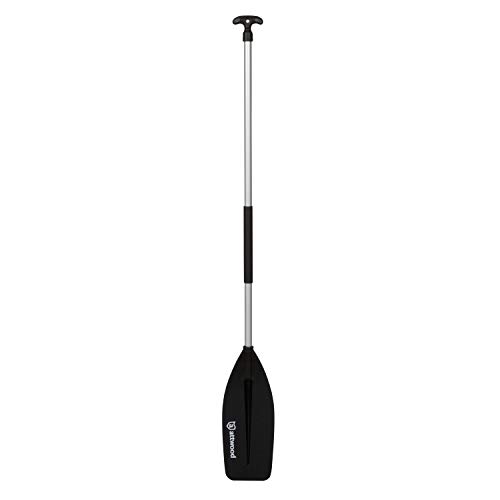
The Attwood 11764-1 is the workhorse of this group, a simple aluminum and plastic paddle that does the job without fuss. The aluminum shaft keeps it light and easy to handle, the plastic blade takes abuse that would dent a wood blade, and the ergonomic molded grip lets you paddle for hours without sore hands. At 48 inches long, it suits shorter paddlers and younger canoeists best, and its compact size makes it easy to carry and store.
This is a one-size paddle with no adjustment, so taller paddlers will find it short for a deep canoe. That is the honest trade for the low cost and light build. It suits beginners, spare-paddle duty, and anyone who wants a paddle that can live in the garage or the truck bed without worry. One detail to check: Attwood also sells a 5-foot version under model number 11765-1. This pick is the 48-inch 11764-1, and the two models are easy to confuse because the numbers differ by one digit.
Specs
- Material: Aluminum shaft with plastic blade
- Length: 48 inches
- Grip: Ergonomic molded grip
- Ferrule: Molded polypropylene
- Shaft: Straight shaft
- Model: 11764-1
4. Attwood 11761-1 — Best Short Wooden Paddle

The Attwood 11761-1 is the simplest paddle here, and that simplicity is its charm. It is a varnished hardwood paddle with a T-shaped grip, a center stripe down the blade, and a durable lacquer finish that holds up to lake water and sun. It comes in two sizes, 2.5 feet and 4 feet, and the small size is a genuine child-sized paddle. At about 1 pound, it is the lightest paddle in this group, and small hands can use it all afternoon without tiring.
The short length limits it. A tall adult in a deep canoe will find the 4-foot paddle too short for a comfortable stroke, and it is not built for long-distance cruising. But for kids learning to paddle, for short paddlers in shallow canoes, and for a spare tucked under a seat, it is hard to beat. The lacquer finish gives the hardwood a classic look, and the T-grip makes steering easy even in a breeze.
Specs
- Material: Hardwood with lacquer finish
- Lengths: 2.5 feet and 4 feet
- Weight: About 1 pound
- Grip: T-shaped grip
- Blade: Center stripe design
- Model: 11761-1
5. Crooked Creek Wooden Boat Paddle — Best Tough Laminated Paddle

The Crooked Creek wooden boat paddle is built for paddlers who land on rocky shores and push off gravel bars. The blade is multi-ply laminated hardwood, finished with a clear polyurethane coating and reinforced with epoxy resin. An epoxy rock guard protects the tip, the part that takes the most abuse. The flat blade pulls well in calm water, and the A-palm grip sits comfortably in the hand through long stretches of paddling.
Sizes run from 3.5 feet to 6 feet, so tall paddlers can find a length that fits, and the sleek shaft keeps the paddle easy to handle. At about 1.5 pounds, it is light for a laminated wood paddle, though it feels a touch heavier than the lightest paddles here. One detail to keep straight: Crooked Creek also sells an aluminum and plastic model called the C11445, a different paddle entirely. This pick is the wooden boat paddle with the laminated hardwood blade and polyurethane finish.
Specs
- Material: Multi-ply laminated hardwood
- Finish: Clear polyurethane coating with epoxy resin reinforcement
- Blade: Flat blade with epoxy rock guard
- Lengths: 3.5 to 6 feet
- Weight: About 1.5 pounds
- Grip: A-palm grip
How to Choose a Canoe Paddle
Length comes first. Sit in the canoe, measure from the seat to the water, and add the grip. In practice, most adults in a standard recreational canoe do well with a paddle between 52 and 56 inches long, while shorter paddlers suit 50 to 52 inches and taller paddlers suit 56 to 58 inches. A paddle that is too short forces you to lean over the gunwale, which tires your back, while one that is too long drags the blade deep and wastes effort. If the canoe carries two paddlers of different heights, the stern paddler usually takes the longer paddle.
Material follows the water you paddle. Laminated wood gives the best feel and flex, and it suits paddlers who value the stroke itself. Aluminum and plastic give the best toughness for the least upkeep, and they suit rental fleets, kids, and paddlers who treat gear roughly. Grip shape matters: a palm grip suits long cruising days, while a T-grip gives better control for steering. Weight is the last check. A paddle under 24 ounces feels light all day, while one over 32 ounces will tire your arms on a long trip.
Who Should Skip These Picks
These five paddles are built for calm lakes and gentle rivers, and they are the wrong tools for harder water. If you paddle whitewater, look for a dedicated whitewater paddle with a reinforced blade and a shorter shaft, because a long wood blade will not survive rocks and drops. If you paddle a kayak, none of these will work, because a kayak needs a double-bladed paddle.
Solo canoeists who paddle from a kneeling position may want a shorter paddle, since kneeling lowers the paddler and shortens the reach to the water. Racers and expedition paddlers who count every ounce should look at bent-shaft paddles, which change the blade angle for a more efficient stroke on flatwater. And if the canoe is a wide fishing model with high sides, measure carefully, because a standard-length paddle may not reach the water from a high seat.
FAQ
What length canoe paddle do I need for a calm lake?
Most adults in a standard recreational canoe do well with a paddle between 52 and 56 inches long. Shorter paddlers suit 50 to 52 inches, and taller paddlers suit 56 to 58 inches. Sit in the canoe, measure from the seat to the water, and add the grip.
What is the difference between a beavertail blade and a regular blade?
A beavertail blade is long and narrow, wider toward the tip, and built for deep water where the blade has room to work. It enters and leaves the water cleanly without splashing. A regular rectangular blade is shorter and wider, which gives more bite per stroke and suits shallow rivers.
Can I use a canoe paddle in a kayak?
No. A canoe paddle has one blade and is used from one side, while a kayak paddle has two blades joined by a shaft and is used from both sides. A kayak seat sits lower and the boat is narrower, so a canoe paddle cannot reach the water properly from a kayak.
How do I keep a wooden canoe paddle in good condition?
Rinse the paddle with fresh water after use, dry it before storage, and store it out of direct sun. Check the varnish or polyurethane finish each season and recoat bare spots before they soak up water. A light sanding followed by a fresh coat of varnish keeps a wood paddle sound for years.
Final Verdict
The Bending Branches Beavertail is the pick for most calm-water paddlers, because it pairs a classic deep-water blade with a 22-ounce build and a Rockgard tip that forgives gravel landings. The Caviness Twin Stripe is the choice when a handsome hardwood paddle matters, and the Crooked Creek wooden paddle is the toughest laminated option for rocky shores. The two Attwood models cover the budget end: the 11764-1 aluminum paddle for adults who want a light, low-upkeep spare, and the 11761-1 wooden paddle for kids and short paddlers. Match the length to your height and your canoe, and confirm availability before ordering, since stock on these paddles varies by season.
Product and ASIN Reference
| Product | ASIN |
|---|---|
| Caviness Twin Stripe Canoe Paddle | B00BIZ2QPI |
| Bending Branches Beavertail Canoe Paddle | B00404WBF4 |
| Attwood 11764-1 Ergonomic Aluminum Canoe Paddle | B00FTERO9W |
| Attwood 11761-1 Wooden Canoe Paddle | B003DJZ9D8 |
| Crooked Creek Wooden Boat Paddle | B00BV1WVLS |









