
Key takeaways
- Charge in a ventilated space. Batteries can release flammable hydrogen gas during charging, so avoid sparks and flames nearby.
- Connect the clamps with the charger unplugged, observe polarity, and follow the manual’s order for connecting and disconnecting.
- Do not charge a visibly swollen, leaking or frozen battery. See a mechanic or battery specialist.
- Use only the charger’s own cables and a properly grounded outlet. Avoid long, thin extension cords.
- Follow the vehicle maker’s instructions for batteries in modern cars; some manuals specify connection points.
- Do not leave any charger covered or in a confined space where heat can build up.
- Permanent wall mounting and any hardwired connection should follow the manual and local code, and a licensed electrician should do any mains work.
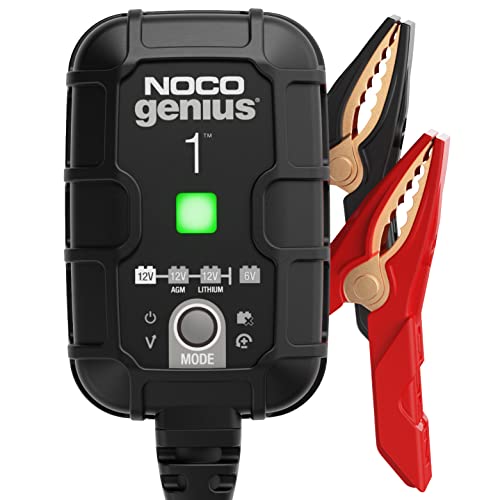
The best car battery wall charger for most drivers is a compact smart charger that plugs into a household outlet and clips to the battery, such as the NOCO Genius10 for cars, trucks and SUVs or CTEK’s MXS 5.0 for lead-acid batteries; owners of motorcycles and small batteries should look at the CTEK CT5 Powersport, and anyone wanting a permanently installed unit should look at an onboard charger like the NOCO GEN5X2.
Our top picks


As an Amazon Associate we earn from qualifying purchases at no extra cost to you.
What “car battery wall charger” means
The keyword has two readings. Most shoppers mean a battery charger that runs from a wall outlet, as opposed to a jump starter or solar charger. A smaller group means a charger that is mounted to a wall in a garage and left connected. In both cases the device converts household AC to the DC a 12 V battery needs, in stages, and then holds the battery at a float level. This guide covers both and notes where makers do not confirm a feature such as a wall-mount bracket.
Because mains voltage differs by country, check the label: CTEK sells region-specific versions, with its MXS 5.0 listed for 220 to 240 V input, while its CT5 Powersport has North American versions for 110 to 120 V.
At a glance
| Model | Best for | Key stated specs | Limits |
|---|---|---|---|
| NOCO Genius10 | Cars, trucks, SUVs, diesel trucks and RVs | 6 V and 12 V, 10 A; lead-acid and lithium-ion; charges batteries up to 230Ah; IP65; 3.33 lb as listed; lithium mode is for 12 V batteries with a built-in BMS | Portable single-bank unit; some listings mention a mounting bracket in the box, so confirm on the maker page |
| CTEK MXS 5.0 | Everyday cars and maintenance charging | 14.4/14.7/15.8 V output (5.0 A on most regional pages, 4.3 A on the North American page); for WET, MF, Ca/Ca, AGM, EFB and GEL; 8-step charge; IP65; 5-year warranty; temperature compensation built in | Lead-acid only, no lithium; charges up to 110Ah, with maintenance to 160Ah per CTEK |
| CTEK CT5 Powersport | Motorcycles, ATVs, jet skis, small batteries | 2.3 A output; 5 to 25Ah batteries; lead-acid and LiFePO4; IP65; 5-year warranty; back current drain under 1.5Ah per month | Too small for car batteries |
| NOCO Genius GEN5X2 | Permanent onboard installation, such as boats and RVs | Two banks at 5 A each, 10 A total; up to 120Ah per bank; IP68; modes for 12 V, AGM, lithium and repair; mounts in any direction | Marine and onboard product; install and wiring planning needed |
What to look for in a wall-plug charger
Amperage
Charge current determines how quickly a battery refills. A 10 A charger such as the Genius10 charges faster than a 5 A unit such as the MXS 5.0, but a smaller current is gentler for maintenance and sufficient for overnight charging. CTEK lists the MXS 5.0 for charging batteries from about 1.2 to 110Ah, and some regional pages give 160Ah, which appears to refer to maintenance charging. Regional pages also differ on rated output current, so use the maker’s page for your region.
Battery chemistry
Many cars use flooded lead-acid, AGM or EFB batteries, and a few use lithium. Chargers are not interchangeable. NOCO lists lead-acid and lithium-ion support for the Genius10, while CTEK states the MXS 5.0 is lead-acid only and the CT5 Powersport handles both lead-acid and LiFePO4. If your car has a start-stop system, check the battery type in the manual and charge with a mode that suits it.
Smart stages and maintenance mode
Smart chargers move through stages: assessment, bulk, absorption and float or maintenance. That last stage lets you leave the charger connected for weeks. CTEK lists an 8-step process on the MXS 5.0, and its CT5 Powersport lists Normal, Lithium and Recond programs. Recond or repair modes are designed to help with deeply discharged lead-acid batteries; read the maker’s warnings before using them and do not use them on a lithium battery.
Protection and rating
CTEK lists the CT5 Powersport as splash and dustproof, non-sparking, reverse-polarity protected and short-circuit proof. NOCO lists IP65 on the Genius10 and IP68 on the GEN5X2. IP ratings tell you about water and dust resistance, and do not mean the charger is meant to be left outdoors in the rain unless the maker says so.
Using a wall charger safely
- Charge in a ventilated space. Batteries can release flammable hydrogen gas during charging, so avoid sparks and flames nearby.
- Connect the clamps with the charger unplugged, observe polarity, and follow the manual’s order for connecting and disconnecting.
- Do not charge a visibly swollen, leaking or frozen battery. See a mechanic or battery specialist.
- Use only the charger’s own cables and a properly grounded outlet. Avoid long, thin extension cords.
- Follow the vehicle maker’s instructions for batteries in modern cars; some manuals specify connection points.
- Do not leave any charger covered or in a confined space where heat can build up.
- Permanent wall mounting and any hardwired connection should follow the manual and local code, and a licensed electrician should do any mains work.
Picks by situation
Everyday car or small SUV
The CTEK MXS 5.0 fits regular lead-acid starter batteries and has temperature compensation. If you drive a vehicle with a lithium starter battery, it is not suitable, so look at the NOCO Genius10 or another unit that lists lithium support.
Truck, diesel or RV with larger batteries
The NOCO Genius10 lists up to 230Ah and supports both 6 V and 12 V. The 10 A output charges bigger batteries more quickly, though a very large bank may need a higher-current charger than any listed here.
Motorcycle, ATV or garden tractor
The CTEK CT5 Powersport lists 5 to 25Ah and a 2.3 A output, suiting smaller batteries. CTEK’s chart estimates about 9 hours to reach 80 percent from empty on a 25Ah battery.
Boat or RV with permanent charging
The NOCO GEN5X2 lists two banks at 5 A each, selectable chemistry modes, and installation in any direction. It suits boats and RVs where you want a fixed installation, and the wiring should follow the manual.
Budget tiers
- Budget: basic automatic chargers with limited chemistry options. Fine for occasional top-ups, but look for reverse-polarity protection.
- Mid-range: CTEK MXS 5.0 and NOCO Genius10 style smart chargers with multiple modes and maintenance stages.
- Premium: onboard multi-bank chargers and heavy-duty units for permanent installs.
Pick X if…
| If you… | Pick | Why |
|---|---|---|
| Want one charger for several vehicles including lithium | NOCO Genius10 | 6 V and 12 V, lead-acid and lithium listed |
| Want a low-current charger with temperature compensation | CTEK MXS 5.0 | 8-step charge and built-in temperature compensation |
| Charge a motorcycle or ATV | CTEK CT5 Powersport | 5 to 25Ah range and lithium program |
| Want a permanent install | NOCO GEN5X2 | Two banks, IP68, mounts in any direction |
| Store a car for winter | Any smart charger with float mode | Maintenance stage holds the battery over weeks |
Alternatives
- Jump starter: for getting a car going, not for restoring a battery.
- Solar maintainers: low-power panels for vehicles stored outdoors in sun.
- Battery replacement: if a battery fails to hold charge after being charged, a workshop test is a better route than repeated charging.
Matching charger size to battery size
Battery capacity is measured in amp-hours, and a small charger on a big battery works but takes a long time, while a big charger on a small battery can be too aggressive, so stay inside the amp-hour range the charger maker lists. The listed ranges help: the CT5 Powersport covers 5 to 25Ah, the MXS 5.0 covers about 1.2 up to 110Ah for charging, and the Genius10 lists batteries up to 230Ah. Car starter batteries commonly fall in the middle of those ranges, but the battery label and the vehicle manual give the real figure.
Charge time is roughly the amp-hours removed divided by the charger’s current, plus extra for the absorption stage. A battery that was only used to start the car needs far less time than one drained by leaving the lights on. A deeply discharged battery may take many hours, and an old battery may never reach a full charge. If a charger shows an error or refuses to start, the battery may be too far gone or may have a failed cell, and testing it at a workshop is the sensible next step.
Remember also where the charger will sit. Keep it off the battery, on a stable surface, with its cables free of strain. Wall-mounted installations should use the maker’s mounting guidance where provided, and the outlet should be protected as local code requires.
Frequently Asked Questions
Can I leave a smart charger connected all the time?
Smart chargers with a float or maintenance stage are designed for that purpose, but follow the maker’s manual. Keep the charger in a ventilated place and inspect it regularly.
Can I charge a battery while it is still in the car?
Often yes, but follow the vehicle and charger manuals. Some cars specify a ground point and a connection method, and the engine should usually be off.
Will a 5 A charger work on a car battery?
Yes for most passenger cars, just more slowly. CTEK lists the MXS 5.0 for charging batteries up to 110Ah, which covers most passenger cars.
What is the difference between a charger and a maintainer?
A charger restores a depleted battery, while a maintainer holds a charged battery at a safe level. Most smart chargers do both through their stages.
Can I use a lead-acid charger on a lithium battery?
Not unless the charger lists lithium support. CTEK states the MXS 5.0 is lead-acid only, whereas NOCO lists lithium-ion support on the Genius10.
When should I replace the battery instead?
If a battery will not hold a charge, is swollen or leaks, replace it. A workshop can test it for you.









