We independently review everything we recommend. When you buy through our links, we may earn a commission. As an Amazon Associate we earn from qualifying purchases.
Best Window Fans to Cool a Room
Find the best window fans to cool a room with our guide to twin-blade models, thermostats, remotes, and window fit — compare airflow, noise, and controls.
Find the best window fans to cool a room with our guide to twin-blade models, thermostats, remotes, and window fit — compare airflow, noise, and controls.
A stuffy room on a warm evening does not always need an air conditioner. When the air outside is cooler than the air inside, the best window fans to cool a room can pull fresh air in, push hot air out, or do both at once. Used well, a twin window fan can bring a bedroom to a comfortable sleeping temperature in under an hour.
The trick is choosing a fan that fits your window, moves enough air, and gives you controls you will actually use. This guide compares four twin window fans still selling on Amazon, all dual-blade window fans built to sit in a window opening and exchange indoor and outdoor air. Based on specifications, features, and user feedback, we compare fit, airflow, controls, noise, and build quality.
Disclosure: As an Amazon Associate, we earn from qualifying purchases.
Measure the inside width and height of your window before ordering; fit ranges differ. The Bionaire fits 24 to 36 inches, the Comfort Zone stretches from 23.5 to 37 inches, and the Genesis covers openings up to 37 inches wide. A fan even slightly too wide cannot be installed, and one too narrow leaves gaps that let hot air leak back in.
2. Look for reversible airflow
The best models let each blade run in either direction. Intake pulls cooler outdoor air in, exhaust pushes hot air out, and exchange runs one blade in and one out at the same time. The Bionaire reverses electronically from the remote, the Comfort Zone labels its modes Cool, Circulate, and Exhaust, and the Genesis and Holmes use independent motors. Exchange mode suits a stuffy room best.
3. Match airflow to room size
Window fans do not publish standardized cooling ratings, so blade size and listed airflow are your best guides. Two 9-inch blades generally move more air than two 8-inch blades, and the Comfort Zone lists 431 cubic feet per minute, a solid figure for a bedroom or living room. A twin fan suits a small to medium bedroom easily.
4. Decide how much control you want
The Bionaire is the most automated, with a programmable thermostat, an LED display, and a remote. The Comfort Zone also includes a remote, controlling power, speed, and mode. The Genesis has a built-in thermostat with a Max Cool mode that holds a temperature between 60 and 80 degrees Fahrenheit, but no remote. The Holmes uses a manual thermostat dial, which is simpler and cheaper but means walking to the window.
5. Consider noise, especially for bedrooms
A fan that runs overnight needs to be quiet on low speed. User feedback on the Bionaire is notably positive, with many reviewers calling it quiet even on high. The Comfort Zone is listed at 52 decibels, audible but normal for a fan moving this much air. The Genesis and Holmes draw mixed reports on noise.
6. Check weather resistance and sealing
The Holmes stands out with water-resistant motors, useful if a sudden shower catches the fan in place. The Comfort Zone includes a removable bug screen and a fabric cover. The Bionaire and Genesis do not describe their motors as water-resistant. Seal the gaps around the extender panels, because unsealed gaps let hot air back in.
7. Think about power draw
A window fan uses far less electricity than an air conditioner. The Comfort Zone draws about 57.5 watts and the Holmes about 60 watts, so running one for hours every evening through spring and fall costs little. All four plug into a standard 120-volt outlet, so check that an outlet is within reach of the window.
Top Picks
Bionaire BW2300-N
Top Pick
Bionaire BW2300-N
Best for: Bedrooms where quiet operation, a remote, and automatic shutoff matter most.
The Bionaire BW2300-N is the most complete twin window fan here and the first pick for a bedroom. Its two reversible 8.5-inch blades can be set independently to draw fresh air in, exhaust warm air out, or exchange air in both directions, controlled from the included remote or the buttons on the unit. Three speeds cover gentle overnight circulation and stronger evening cool-downs, and the programmable thermostat switches the fan on and off automatically to hold the temperature you choose. Extender panels cover windows from 24 to 36 inches, and it carries a 3-year limited warranty, the longest in this group. The listing shows a 4.4-star average from more than 19,000 ratings.
Pros:
– Electronically reversible twin blades for intake, exhaust, or exchange
– Programmable thermostat with LED display and dimmer
– Remote control included for changing settings from bed
– Fits windows from 24 to 36 inches
Cons:
– Plastic housing feels less substantial than metal-framed alternatives
– Temperature sensor sits at the fan, so its reading may differ from the center of the room
Comfort Zone CZ310R
Runner-Up
Comfort Zone CZ310R
Best for: Living rooms and kitchens where strong airflow, simple modes, and a remote matter most.
The Comfort Zone CZ310R wins on flexibility: it spells out what each of its three modes does, and it fits the widest range of windows in this group. Two 9-inch blades deliver a listed airflow of 431 cubic feet per minute at about 57.5 watts, with three speeds from a gentle breeze to full air exchange. Cool mode runs both fans inward, Exhaust runs both outward, and Circulate runs one in and one out. Accordion expanders adjust the width from 23.5 to 37 inches, and the fan comes with a removable bug screen, a fabric cover, and attachable feet. The included remote controls power, speed, and mode.
Pros:
– Three clearly labeled modes: Cool, Circulate, and Exhaust
– Strong listed airflow of 431 CFM from twin 9-inch blades
– Widest fit range here, from 23.5 to 37 inches
– Remote control, bug screen, and fabric cover included
Cons:
– No thermostat, so it will not shut itself off when the room cools
– Listed noise of 52 decibels is noticeable on the highest speed
Genesis A1WINDOWFAN
Genesis A1WINDOWFAN
Best for: Buyers who want thermostat control and durable motors and do not mind walking to the window.
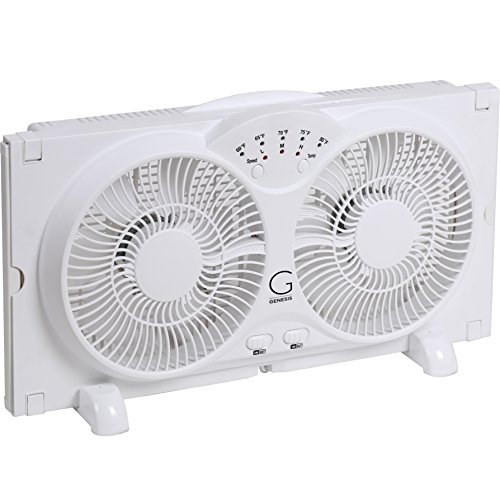
The Genesis A1WINDOWFAN suits buyers who want real thermostat control without paying for a remote. Each of its two 9-inch fan heads runs on its own copper motor, so the heads work independently: set both to intake, both to exhaust, or one in and one out to exchange a room’s air continuously. Three speeds give a useful range, and the built-in thermostat adjusts from 60 to 80 degrees Fahrenheit, with LED indicator lights showing the setting and Max Cool technology cycling the fan to hold the temperature you choose. Expandable side panels stretch to fill windows up to 37 inches wide, and removable legs let it stand on a table or floor out of season.
Pros:
– Two independent copper motors for simultaneous intake and exhaust
– Built-in thermostat with Max Cool mode, 60 to 80 degrees
– Expandable side panels fit windows up to 37 inches wide
– Removable legs allow freestanding use away from the window
Cons:
– No remote, so every adjustment happens at the unit
– Brushed motors can be louder on the highest speed
The Holmes HAWF2041-N is the budget pick: two 8-inch blades, three speeds, a manual thermostat, and water-resistant motors. Independent electronically reversible motors let the fan intake fresh air, exhaust stale air, or exchange air through one window. A manual thermostat dial cycles the fan on and off to hold a comfort level, and the water-resistant motors are a genuine advantage if the fan gets caught in a summer shower. The fan fits most double-hung and slider windows from about 24 to 37 inches wide and draws about 60 watts.
Pros:
– Water-resistant motors handle rain better than most window fans
– Reversible motors for intake, exhaust, and exchange
– Manual thermostat included at a budget level of features
– Low power draw of about 60 watts
Cons:
– No remote control and no digital display
– Mixed user feedback on noise, including reports of an electrical hum
Best for: Budget buyers and second rooms where water resistance matters more than a remote.
Comparison Table
Feature
Bionaire BW2300-N
Comfort Zone CZ310R
Genesis A1WINDOWFAN
Holmes HAWF2041-N
Blade size
Two 8.5-inch blades
Two 9-inch blades
Two 9-inch blades
Two 8-inch blades
Speeds
3
3
3
3
Window fit
24–36 inches
23.5–37 inches
Up to 37 inches
About 24–37 inches
Thermostat
Programmable digital
None
Built-in, 60–80 degrees F
Manual dial
Remote
Yes
Yes
No
No
Listed airflow
Not stated
431 CFM
Not stated
Not stated
Power draw
Not stated
About 57.5 watts
Not stated
About 60 watts
Warranty
3-year limited
1-year limited
Not stated
Not stated
Buying Guide
Start with the window, not the fan
Measure the inside width and height of the window opening against the fit range of each fan. Leave a small margin, since a fan that exactly matches your opening may still be hard to seat if the frame is out of square. If your window is wider than 37 inches, none of the twin fans here will fill it on their own, and you will need a filler panel or a different cooling approach.
Use the fan when the outside air helps
A window fan cools by replacing warm indoor air with cooler outdoor air, so timing matters more than raw power. The best results come in the evening and overnight, when outdoor temperatures drop below indoor temperatures, and in spring and fall. During a heat wave, when the air outside is hotter than the air inside, close the window.
Create a cross-breeze and seal the gaps
Open a second window on the opposite side of the room, even a few inches, so the fan has somewhere to draw air from. With the fan on intake, the second opening becomes the exhaust path; with the fan on exhaust, it becomes the intake. This cross-flow moves air through the whole room instead of just the area near the window. Then seal the gaps around the fan with the included accordion panels and foam weatherstripping, since every gap lets hot air back in.
Run the fan on low overnight
For sleeping, low speed plus a thermostat works best. Low speed keeps noise down and still moves enough air to keep a bedroom comfortable once the evening cool-down is done. If your fan has a thermostat, set it a few degrees below your usual sleeping temperature so the fan cycles off when the room is cool.
Common mistakes to avoid
The most common mistake is buying before measuring, which leads to a fan that does not fit. The second is expecting a window fan to replace air conditioning in hot, humid weather: it cannot, because it only moves air rather than removing heat and moisture from it. The third is running the fan on intake during the hottest part of the day, which heats the room instead of cooling it. Finally, do not leave a non-water-resistant fan in an open window during a storm.
Frequently Asked Questions
Do window fans actually cool a room?
Yes, when the air outside is cooler than the air inside. A window fan cools by exchanging air: intake brings cooler outdoor air in, exhaust pushes hot indoor air out, and exchange does both at once. The effect is strongest in the evening, overnight, and in spring and fall.
What size window fan do I need?
Measure the inside width of your window opening first. Twin fans in this guide fit openings from about 23.5 to 37 inches wide. Two 9-inch blades move more air than two 8-inch blades, so favor the larger blades for living rooms and the smaller blades for a single bedroom.
Should a window fan blow in or out?
Both directions have a use. Blow in when the outdoor air is cool, such as on a summer evening. Blow out when the room is hotter than outside, for example after cooking. Exchange mode, with one blade in and one out, is the best default for a stuffy room.
Are window fans safe to leave running overnight?
Yes, with sensible precautions. Use the lowest speed that keeps the room comfortable and make sure the fan is seated firmly in the window so it cannot slip. A thermostat that shuts the fan off at your set temperature adds safety and comfort.
How loud are window fans?
Noise varies by model and speed. The Bionaire earns the most praise from users for quiet operation, while the Comfort Zone lists 52 decibels and the Genesis and Holmes draw mixed reports, with more noise on high speed. Running any of these fans on low speed overnight keeps the sound at a gentle background level.
Can I use a window fan in a sliding window?
Yes. All four fans in this guide are designed for double-hung and slider windows, and the Bionaire and Genesis also list casement windows. For a horizontal sliding window, measure the opening carefully and use the extender panels to seal the remaining width.
Conclusion
The best window fans to cool a room fit your window, move air in both directions, and give you controls you will actually use. For most buyers, the Bionaire BW2300-N is the strongest choice: its programmable thermostat, remote, and quiet operation make it the easiest fan to live with in a bedroom. If you want the widest fit and the clearest modes, the Comfort Zone CZ310R is the practical alternative. The Genesis A1WINDOWFAN suits buyers who want thermostat control and durable copper motors without a remote, and the Holmes HAWF2041-N is the budget pick for a second room or a kitchen.
Whichever model you choose, measure the window first, seal the gaps around the fan, and run it when the outdoor air is cooler than the indoor air.
C
Carros Editorial Team
We compare specs, materials and verified owner reviews before a product earns a spot. Rankings are never paid.
Affiliate disclosure. As an Amazon Associate we earn from qualifying purchases at no extra cost to you. Prices accurate as of the date shown.
The best rechargeable CR123A batteries compared by chemistry, voltage and charger: SureFire LiFePO4, Tenergy and Nitecore RCR123A cells, plus the safety checks that matter first.
The best batteries for the Traxxas 1/16 E-Revo VXL compared: Traxxas Series 1 NiMH, HRB and Gens ace 2S 2200mAh LiPo packs, fit, connectors, parallel running, and charging safety.
How to choose a 510 thread battery for Brass Knuckles vape cartridges: voltage ranges, draw vs button activation, cartridge fit, charging, and safety checks explained.
How to pick a stereo keyboard amplifier with balanced line outputs, from power and speaker size to XLR outs, stereo linking, and the five models that set the standard.
A radial drill press swings its head out from the column to reach wide boards and off-centre holes. Learn how swing, spindle travel, speeds and chuck size decide the right machine.
Diamond-frame commuter e-bikes explained: fit, motor feel, battery range, and the equipment that makes a daily ride work, plus the mistakes to avoid before buying.
Find the best tablets under 125 for streaming, reading, school and family use. Compare five budget tablets with strong battery life and sharp displays.
Compare the best alarm clocks with charger and speaker for your nightstand, with wireless charging, Bluetooth audio, FM radio, and gentle wake-up features.