We independently review everything we recommend. When you buy through our links, we may earn a commission. As an Amazon Associate we earn from qualifying purchases.
Best Power Inverter for Milwaukee Batteries Reviewed
Find the best power inverter for Milwaukee batteries, from the Milwaukee TOP-OFF and CARRY-ON to compatible 220W and 300W units. Compare output and ports.
Find the best power inverter for Milwaukee batteries, from the Milwaukee TOP-OFF and CARRY-ON to compatible 220W and 300W units. Compare output and ports.
A Milwaukee M18 battery is more than a power source for drills and saws. With the right inverter, that same pack can charge a laptop, run a work light, or keep a small fan going during an outage. The catch is that not every inverter fits an M18 pack, and the wattage on the box does not always tell the whole story. This guide looks at the genuine Milwaukee power supplies and the best third-party inverters built to clip straight onto M18 batteries, so you can match the unit to the job instead of guessing.
As an Amazon Associate, we earn from qualifying purchases.
Quick Answer
For everyday carry and charging phones, laptops, and lights, the Milwaukee M18 TOP-OFF 175W is the most practical pick because it is small, light, and made for the platform. For running full-size jobsite tools, the Milwaukee M18 CARRY-ON delivers far more power. If you want a lower-cost portable option, the Azocek 220W and TANHEYIN 300W inverters both clip onto M18 packs and cover small electronics well.
1. Milwaukee M18 TOP-OFF 175W Power Supply 2846-20
Top Pick
1. Milwaukee M18 TOP-OFF 175W Power Supply 2846-20
The TOP-OFF is Milwaukee’s own compact answer to the question of how to get wall-style power out of an M18 battery. It slides onto any M18 pack and gives you one AC outlet plus USB charging, all in a unit that weighs well under a pound before the battery is attached. That makes it the easiest inverter in this guide to toss in a tool bag, a truck console, or a camping bin.
Its headline figure is 175 watts of continuous output, which is enough for laptops, phone chargers, camera batteries, LED lights, and other small electronics. It will not run a circular saw or a heater, and it is not meant to. The value here is convenience: you already own the batteries, so this turns them into a portable outlet without buying a separate power station or dragging out a generator.
The USB-C port supports fast charging, so a depleted phone or tablet tops up noticeably quicker than it would from a basic wall plug. The USB-A port covers older cables and accessories. A pair of rafter hooks folds out so the unit can hang from a joist, a cart rail, or a ladder rung, keeping it off a dusty floor and within reach on a jobsite.
Runtime depends entirely on the battery you attach. A compact pack will keep a phone charged many times over but will drain quickly under a laptop load. A high-capacity pack stretches that time considerably. Because the battery is sold separately, the TOP-OFF only makes sense if you already own M18 packs or plan to buy into the platform.
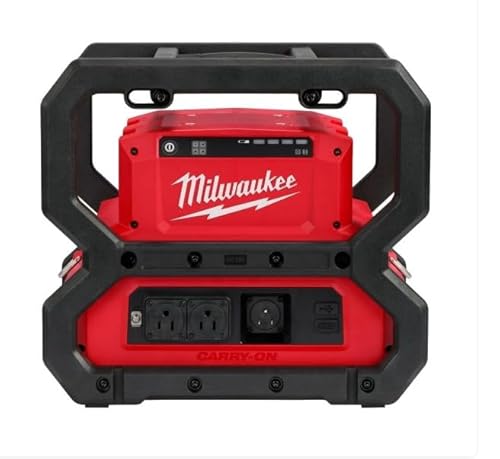
2. Milwaukee M18 CARRY-ON 3600W/1800W Power Supply 2845-20
Runner-Up
2. Milwaukee M18 CARRY-ON 3600W/1800W Power Supply 2845-20
The CARRY-ON is in a different league from every other pick here. It accepts up to four M18 batteries at once and turns them into a genuine jobsite power source, with 3600 starting watts and 1800 running watts of pure sine wave output. That is enough for 15-amp tools such as table saws, pancake compressors, and pipe threaders, plus sensitive electronics that need clean power.
This is the pick for crews who work where there is no outlet and no generator, or for homeowners who want backup power that runs quietly indoors. It produces no exhaust, and its noise level stays low enough for indoor and confined-space work. The pure sine wave output matters for electronics: motors run smoother and chargers behave better than they do on the rougher modified sine wave output of cheaper inverters.
It also works as a charger. When the unit is plugged into a wall outlet, its built-in charger tops up the attached M18 packs at the same time, so the CARRY-ON doubles as a multi-bay charging station between jobs. USB-C and USB-A ports handle phones and tablets directly.
The trade-offs are size, weight, and cost. This is a large, heavy unit that needs several high-capacity batteries to deliver its best runtime, and it is far more expensive than a compact inverter. It is also overkill if all you want is to charge a laptop at a campsite. But for anyone who already owns a stack of M18 packs and needs real tool power away from the grid, nothing else in this guide comes close.
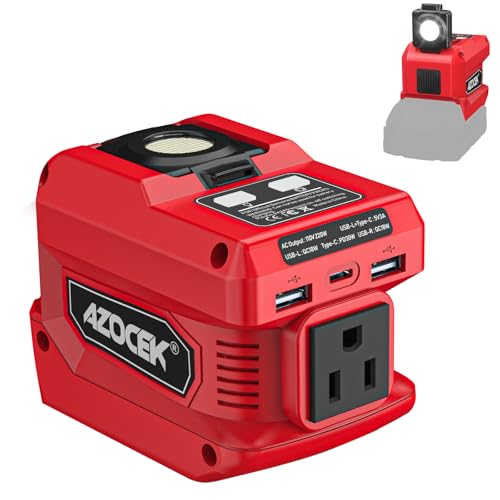
3. Azocek 220W Power Inverter Compatible with Milwaukee 18V Battery
3. Azocek 220W Power Inverter Compatible with Milwaukee 18V Battery
The Azocek 220W is a third-party inverter that clips directly onto Milwaukee 18V batteries, giving M18 owners a low-cost way to get AC power without buying Milwaukee’s own hardware. It converts the battery’s DC output to household-style AC, with one AC outlet, two USB-A ports, and a Type-C fast-charging port, plus a built-in LED work light.
Its 220-watt rating puts it a step above the TOP-OFF for raw output, and the extra USB ports let you charge several devices at once. The LED light is a genuinely useful touch: it throws a broad beam that works as a jobsite light or a campsite lantern, and it means one less item to pack. The unit is compact enough to carry in a tool bag, and it works with common M18 packs.
Because it is a third-party product, fit and finish are not identical to Milwaukee’s own gear. The battery latch feels lighter, and the housing is plain plastic rather than the tougher shell of the genuine article. That is a fair trade at this level, but it is worth handling your expectations accordingly and checking that your specific battery model seats firmly before relying on it in the field.
The Azocek suits owners who want a cheap, light inverter for phones, laptops, lights, and small fans, and who already have M18 batteries sitting on a shelf. It is not a substitute for a generator or for the CARRY-ON when heavy tools are involved.
4. TANHEYIN 300W Power Inverter Compatible with Milwaukee M18 Battery
4. TANHEYIN 300W Power Inverter Compatible with Milwaukee M18 Battery
The TANHEYIN 300W adds more capacity and more outlets than the smaller third-party options. It offers two AC outlets alongside two USB-A ports and two Type-C ports, one of which supports fast charging at a higher wattage than the standard USB ports on most compact inverters. That makes it the most versatile budget pick in this guide for anyone who needs to power two AC devices at once, such as a laptop and a lamp, or a fan and a charger.
The higher output rating gives it a little more headroom for devices that draw a brief surge when they switch on. It still sits firmly in the small-electronics category: laptops, tablets, phones, LED lights, routers, and small fans are all fair game, while power tools, heaters, and anything with a large motor are not. The unit is designed as a portable power station in miniature, with a handle-free body that packs flat in a bag.
Cooling matters more at this output level, so the TANHEYIN includes a fan and thermal protection that shuts the unit down if it overheats. That is a useful safety net, though it also means the fan can be audible in a quiet room. The battery is not included, so factor in the cost of an M18 pack if you do not already own one.
For campers, van owners, and jobsite workers who want two AC outlets and fast USB-C charging from the batteries they already own, this is the strongest third-party option here.
5. 1200W Integrated Power Inverter with 6A Fast Charger for Milwaukee M18 Battery
5. 1200W Integrated Power Inverter with 6A Fast Charger for Milwaukee M18 Battery
This unbranded multi-port unit is the most ambitious third-party option in this guide, combining an inverter with a fast battery charger in a single body. It provides a 120-volt AC outlet, six USB ports, and a 6-amp fast-charging circuit, plus an LED light, all in a tool-only unit that clips onto an M18 pack.
The headline wattage deserves a note of caution: the US listing describes it as a 1200-watt unit, while the same product on another Amazon marketplace lists 1000 watts. That disagreement is a reminder to size your loads by what you can verify, meaning the AC outlet, the USB ports, and the battery you attach, rather than by the biggest number on the page. In practice, treat it as a multi-device charging hub for small electronics rather than a heavy-duty power source.
Where it stands out is the charging side. The 6-amp fast charger can replenish an M18 battery far faster than a standard charger, which is handy when you have one pack in use and another waiting. The six USB ports let a whole crew charge phones and tablets from a single battery, which is useful on remote sites and during outages.
The unit is bulkier than the compact inverters above, and as an unbranded product it carries less track record than the Milwaukee or Azocek options. Check the return terms before buying, and test it with your own batteries and devices before depending on it.
How to Choose
Start with the load. Add up the watts of everything you plan to run at the same time, then add headroom for devices that surge when they start. A laptop and a phone need far less than a saw, and buying more inverter than you need wastes money and battery life. The TOP-OFF covers small electronics, the 220W and 300W third-party units cover a bit more, and only the CARRY-ON handles full-size tools.
Next, look at the waveform. Pure sine wave output is the safer choice for sensitive electronics, medical devices, and modern tool chargers, because it mimics wall power closely. Modified sine wave output works for many simple devices but can make motors run hot and some chargers buzz or refuse to work. Milwaukee’s own units use pure sine wave output, and that is one of the reasons they cost more.
Then think about runtime, which is set by the battery, not the inverter. A rough guide is to multiply the battery’s amp-hour rating by 18 volts to get watt-hours, then divide by the load in watts. A 5 amp-hour pack holds roughly 90 watt-hours, so it can run a 45-watt laptop for about two hours before losses, and far longer for a phone. Bigger packs and spares are the simplest way to extend runtime, and the CARRY-ON’s four-bay design exists for exactly that reason.
Ports matter more than most buyers expect. Count the AC outlets you need, then check the USB mix: USB-C fast charging is far more useful for modern laptops and tablets than a row of slow USB-A ports. A built-in light is a bonus on a jobsite or at camp, and a fan or thermal shutoff is worth having on any unit rated above 200 watts.
Finally, check what is in the box. Almost every inverter in this guide is sold as a bare tool, with no battery included. If you already own M18 packs, that keeps the cost down. If you do not, add the cost of at least one high-capacity battery before comparing prices, and remember that a single small pack will drain fast under any real load.
Who Should Skip It
Skip a Milwaukee battery inverter entirely if you do not own M18 batteries and do not plan to buy into the platform. The inverter is only half the system, and buying batteries just to run one is usually more expensive than buying a standalone power station with its own cells built in.
Skip the compact inverters if your goal is to run heavy tools, heaters, or anything with a large motor. A 175-watt or 300-watt unit will shut down or drain a battery in minutes under that kind of load. For sustained heavy work away from the grid, a generator or the CARRY-ON with several large packs is the honest answer.
Skip the third-party options if you need guaranteed compatibility and warranty support. Milwaukee’s own power supplies are built for the platform, carry the brand’s warranty, and are the safest choice for expensive electronics. Third-party inverters cost less and often offer more ports, but fit, cooling, and long-term reliability vary.
Also skip any inverter if you need 240-volt power. Every unit in this guide outputs standard North American household voltage, and none of them will run equipment that requires a higher-voltage supply.
FAQ
Can any power inverter work with Milwaukee M18 batteries?
No. A standard inverter expects a 12-volt car battery or a wall outlet, and it has no way to connect to an M18 pack. You need an inverter with a battery interface molded for the M18 platform, either Milwaukee’s own power supplies or a third-party unit built specifically for M18 batteries. Check the battery fit in the listing before buying, because lookalike inverters exist for other tool brands and will not seat on an M18 pack.
How long will an M18 battery run a laptop through an inverter?
It depends on the battery and the laptop. A 5 amp-hour M18 pack stores roughly 90 watt-hours, so a laptop drawing 45 watts will run for about two hours before inverter losses, while a phone drawing a few watts can charge many times over. A larger 12 amp-hour pack more than doubles that time. Heavy loads drain packs fast, so carry spares if you need all-day power.
Do these inverters include a battery?
Almost never. The Milwaukee TOP-OFF and CARRY-ON and the third-party inverters in this guide are sold as bare tools, with the battery sold separately. That keeps the cost down for owners who already have M18 packs, but it means a first-time buyer needs to budget for at least one battery, and ideally a high-capacity one for useful runtime.
Is a pure sine wave inverter better for sensitive electronics?
Yes. Pure sine wave output closely matches household wall power, so laptops, medical devices, and modern chargers run cooler and more reliably on it. Modified sine wave output can cause buzzing, excess heat, or refusal to charge in some devices. Milwaukee’s own power supplies use pure sine wave output, and several third-party units advertise it as well, so check the listing if your gear is sensitive.
Final Verdict
The best power inverter for Milwaukee batteries depends on the load, not the brand. For everyday charging and light portable power, the Milwaukee TOP-OFF 175W is the most practical pick: it is small, well built, and made for the platform. For running real jobsite tools away from an outlet, the CARRY-ON is the only option here that truly qualifies, and it earns its size and cost. Between those two poles, the Azocek 220W is the best low-cost portable pick, while the TANHEYIN 300W adds a second AC outlet and faster USB-C charging for a small step up. The multi-port 1200W unit is worth a look as a charging hub, but its conflicting wattage listings mean you should size loads conservatively. Whichever you choose, match the inverter to your batteries and your loads, and carry a spare pack.
Product and ASIN Reference
Product
ASIN
Milwaukee M18 TOP-OFF 175W Power Supply 2846-20
B08YXRDRF2
Milwaukee M18 CARRY-ON 3600W/1800W Power Supply 2845-20
B0F29RY89P
Azocek 220W Power Inverter Compatible with Milwaukee 18V Battery
B0DHGX4Y9F
TANHEYIN 300W Power Inverter Compatible with Milwaukee M18 Battery
B0FQV3SN8G
1200W Integrated Power Inverter with 6A Fast Charger for Milwaukee M18 Battery
B0FPX7SJCC
C
Carros Editorial Team
We compare specs, materials and verified owner reviews before a product earns a spot. Rankings are never paid.
Affiliate disclosure. As an Amazon Associate we earn from qualifying purchases at no extra cost to you. Prices accurate as of the date shown.
Best 3 inch stainless muffler: 5 universal 3-inch stainless mufflers from Flowmaster, MagnaFlow and LCGP, compared by inlet layout, body size and build.
Four firearm carbon remover solvents compared by soak use, bottle format and named parts, from bolt carriers and bores to suppressor baffles and chambers.
Compare four luxury gas grills from Napoleon, Broil King and Lion by burner output, cooking area, stainless build and the rotisserie hardware included.
Compare the best retractable awning for truck setups: side-mount pull-out shade, LED lighting, freestanding 180-degree and 270-degree coverage for camping.
The best 5x5 5 17 inch wheels for trucks and Jeeps: four 17-inch wheels with a 5x5.5 bolt pattern compared by offset, backspacing, bore and load rating.

 1. Milwaukee M18 TOP-OFF 175W Power Supply 2846-20
 2. Milwaukee M18 CARRY-ON 3600W/1800W Power Supply 2845-20
 3. Azocek 220W Power Inverter Compatible with Milwaukee 18V Battery
 4. TANHEYIN 300W Power Inverter Compatible with Milwaukee M18 Battery
 5. 1200W Integrated Power Inverter with 6A Fast Charger for Milwaukee M18 Battery